


















While State Farm publicly supported auto insurance reform measures in New York this year, now that a package of changes has been written into the state’s statutes, the insurance giant is taking a measured business approach.
“We want some proof before we move too hard [or] too fast there,” State Farm Chief Executive Officer Jon Farney told an analyst who asked whether the company would change its business plans in New York a few weeks after New York lawmakers agreed to some reforms proposed by Governor Kathy Hochul as part of the state’s budget approval process.
Related article: NY Lawmakers Agree to Governor’s Auto Insurance Reforms in New Budget
The exchange between Farney and Assured Research President William Wilt took place during an Executive Perspectives panel at the S&P Global Ratings 42nd Annual Insurance conference in early June in midtown Manhattan, with Farney reporting that State Farm is excited about New York’s “first step” toward improving a difficult situation for insurers.
Other speakers included Jim Williamson, President and CEO of Everest Group Ltd., and Brian Young, President of Fairfax Insurance Group.
Read more about their remarks in the related article, “Mythos Myths: Good Guys Hold More Cybersecurity Cards, Insurer CEOs Say” and the soon-to-be published article, “What Happens to Property Pricing in 2027, Insurance, Reinsurance Execs Ask”
“The New York market is a very tough market in auto insurance,” he said. Over multiple years the Empire State has actually been “our toughest market,” Farney reported, referring to a high level of losses incurred in the state.
That reality may be part of the reason for a State Farm blog post earlier this year titled “New Yorkers Deserve a Path to Lower Auto Insurance Premiums,” authored by State Farm Senior Vice President Lisa Stewart. Stewart’s post, which put the insurer’s support behind several reform initiatives in play at that time, also contrasted the experiences of State Farm policyholders in New York with those in other states. Specifically, the post noted that New York drivers’ share of a $5 billion cash back policyholder dividend declared by the insurer earlier this year represented just 4% of premiums for New York drivers vs. 10% outside of New York.
“The amount varies because claims experience varies by state, and premiums reflect the cost of risk in each state. Across the country, we have also reduced auto rates in more than 40 states, collectively saving those customers over $4.6 billion a year. New York was not one of them,” the post said, throwing support behind Hochul’s fraud-fighting plan that proposed to crack down on staged accidents and organized fraud, give insurers more time to investigate suspected fraud, and reform the serious injury threshold under New York’s no-fault system.
The reform measures ultimately approved by state lawmakers included a clarification of what constitutes a “serious injury” for the recovery of non-economic damages under New York’s no-fault law, a cap on non-economic damages for drivers engaging in criminal behavior, changes to the comparative negligence law, and a crackdown on individuals responsible for organizing staged accidents. (Editor’s Note: Based on CM’s reading of the final approved reform package, a proposal supported by State Farm that would have extended insurers’ time to investigate suspected no-fault fraud from 30 days to 60 days was not enacted. The existing 30-day framework remains in place.)
While Farney welcomed the reforms that passed, the sting of past losses remains.
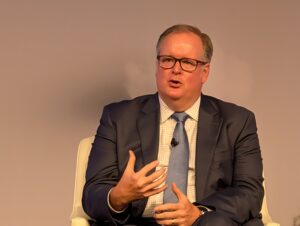
Said Farney at the S&P conference: “We will probably be in the stature of let’s see how this plays out rather than being too proactive. [We] just have had losses for a long time.”
Earlier in the session, Farney referenced the activity in New York in response to a question from Moderator Taoufik Gharib, director and lead analyst for S&P Global Ratings, about State Farm strategies for addressing the impact of inflation while maintaining customers. Farney said the first step is to identify the factors driving the costs of doing auto and property business on a state-by-state basis and to determine which ones are controllable. After discussing drivers such as catastrophe perils and materials cost inflation, he focused on liability exposure, which he said is “really driving the cost of insurance for people. That’s where we work a lot on tort reform…”
“You’ve probably read the news articles about markets that have done tort reform, what it’s done to the cost of the product for customers,” he continued. “Even a jurisdiction like New York is taking on tort reform and trying to change the fundamental cost equation,” he said.
End in Sight?
Later in the session, a media representative asked another panelist, Jim Williamson, president and CEO of Everest Group, Ltd., if there’s an end in sight to increasing litigation settlements and jury awards.
“How does this end? How can the industry tackle its problem?”
Referencing Farney’s comments, Williamson said the state-by-system in the United States provides “a laboratory of different outcomes based on different inputs,” pointing to Florida as a state adopting thoughtful, economically sensible policies and getting the problems under control.
Within the insurance industry on the commercial liability insurance side, Williamson and Fairfax Insurance Group President Brian Young discussed individual underwriter moves to compress limits in recent years in response to the pressures of increased claims severity. For the industry as a whole, however, “that’s made us more vulnerable to social inflation because everybody’s capitulating,” Williamson suggested, going on to specifically describe situations where excess insurers force resolution of claims in lower layers when case facts don’t warrant those actions. “I’ve withdrawn the authority for my team to hammer people underneath us,” he said. “I need to make those decisions because that’s not necessarily the right behavior for us as an industry to manage these claims.”
Related articles: Insurers, Insureds Must Collaborate to Get Ahead of Social Inflation; Unite and Conquer: How the Insurance Industry Can Deflate Social Inflation
Williamson believes others in the industry are also getting smarter about claims management. “AI will help us manage claims, and we’re using it at Everest to accelerate to outside counsel or more seasoned adjusters when we think there are factors that will result in an outsized award,” he added.
“So, it’s going to end because it’s just one of those things that cannot go on. The industry, I think, will mainly influence it by claim management and our own behavior. I’m a little less optimistic about the industry’s ability to educate its way out of this problem just because we’re the wrong message bearer,” Williamson said. “I always tell my insurance clients, you’re the person to deliver this message—the trucking firm, the retailer, the industrial company… Tell your Congressman.”
Farney agreed. “When the industry does it, it feels self-serving. Even though we’re mutual and we don’t really have the same profit motive as a lot of our competitors, people still think, ‘It’s the greedy insurance company.'”
“I’m not sure why I would try to overcharge a member so I could overpay [claims]. “We’re really just trying to price for the claims that are happening,” he said.
When Costs Go Down…
“When costs go down, customers benefit,” said State Farm’s March blog post supporting tort reform efforts in New York.
Farney told Gharib and the financial officers and analysts in the S&P conference crowd that State Farm is also doing what it can to manage costs within its walls to position the carrier to compete.
“How can we get more efficient? How do we bring more technology and tools to bear to still provide the Good Neighbor service that people expect from us but also bring more technology at speed?” he said, referring to the company’s “Next Generation Good Neighbor” vision that focuses on leveraging AI tools—including the introduction of AI coworkers for agents and employees. It is “the idea of quality service and relationships, integrity, financial strength, being the bedrock of who we’ve been for a hundred years but saying we have to be faster,” Farney said.
Related article: The Big Dog Is Off the Tech Porch: State Farm as ‘Next Gen Good Neighbor’

The Elephant in the Room
At the S&P Annual Insurance conference, State Farm CEO Jon Farney was not asked about the cost-cutting moves directly impacting State Farm agents, including commission decreases and cuts in agents’ benefits reported by a Bloomington NPR affiliate and on social media in May, as well as in a June 17 Wall Street Journal article (“State Farm’s AI Plan for Sales Agents Sparks Uproar. ‘A Real Slap in the Face,’” subscription required). State Farm offered the following information to CM via email weeks before the S&P event.
- “The independent contractor agent distribution model remains a critical part in serving our customers … Customers still want a real relationship with someone who knows them, but they also want even faster and simpler service and more competitive prices that match price to risk.”
- “One consistent compensation structure across agents provides clarity and gives State Farm flexibility to adapt as customer needs evolve— while supporting the entrepreneurial opportunity of independent business ownership.”
- “The complexities and changing nature of the health insurance market and associated regulations make it exceptionally challenging to provide independent contractors with a modern benefits offering.”
“Customer policies and coverage are not affected by these changes,” State Farm said in the emailed statement.
State Farm published a similar statement on its website on June 2: State Farm – For The Record
Farney also spoke about efforts to try to lower material costs for customers seeking vehicle and property repairs. “We can try to do some things with suppliers to try to increase volume there. We let our customers decide who repairs their things but through some select service options around auto repair, some similar [arrangements] around shingle buying as hail claims explode,” State Farm tries to “manage the cost of the inputs as much as possible,” he said.
Asked specifically by Gharib to talk about State Farm’s use of AI, Farney said AI’s “biggest power will be to empower human beings. And we think that’s State Farm agents, we think that’s our underwriters, we think that’s our claims folks.” Embedding data into AI will help the insurer to better understand risks—”the largest driver of cost our products,” he said. “How do we continue to use AI to accelerate our telematics program, to get more knowledge about what’s going on with each individual home risk so that you can underwrite more specifically rather than more generally?” Farney said.
Gharib also asked the State Farm leader how the company balances goals of price adequacy with customer concerns about affordability and with public policy issues in states like California.
Farney responded: “When you think about us as a mutual, that’s at the crux of our mission because we want affordable products that meet people’s needs available to them in all markets. [But] also, long term, if you don’t charge for the risk, all kinds of issues come from that.”
“Our No. 1 goal is that the promise we make is a promise we keep. That’s what the whole product is. Then as you think about the other pieces that come with that, you could have a situation where you really have people spending more on a home because the cost of insurance is suppressed, and if the cost of insurance is suppressed below the cost it takes to provide the product, you’re going to have an availability issue.”
“We think the only thing worse than expensive insurance is not being able to get it. And we’ve talked to a lot of customers where we’ve had to manage our exposure in markets. They’ve got to go to the secondary market and pay multiples of what they would have to pay if we could get our rates approved in the primary market,” he said.
State Farm works on balancing all those things. Ultimately, “somebody has to pay for it. And it turns out people in states with less catastrophes don’t want to pay for the risk that someone has in a place where there’s higher catastrophe risk. We really believe that matching that price to risk and competition gets customers the best outcomes,” he said.
Earlier in the session, Farney stressed State Farm’s advocacy for open competition in every state. Competition works to the advantage of customers in 2026, given recent positive returns for personal lines carriers across the industry. “We think the industry will continue to beat each other up. You see that when you look at Jake and Flo and [the] emu and geckos and all this stuff. We’re going to go pretty hard at each other,” he said.
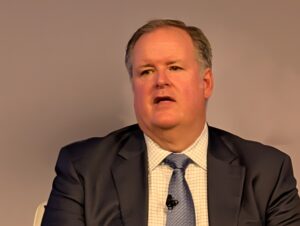 Responding to a question about the competitive advantage of being a mutual insurer, Farney said the mutual structure “really does the best job of aligning long-term interest with customers. “[A]ll other things being equal, which they never are, we should be able to deliver better service or a lower price because we don’t have the same cost of capital or have to provide returns for shareholders,” Farney said, going on to highlight State Farm’s ability to give customers back $5 billion in aggregate though a dividend that’s paying out of the course of the summer.
Related article: How State Farm, USAA Boost Customer Retention: Historic Dividends
“In a world where all of our institutions are being attacked from a trust standpoint, we think that’s a little bit of a feather that we can use in the marketplace, and we try to deepen trust and align interest with our customers,” he said.
Primary Perils
While State Farm reported an underwriting gain of $1.5 billion for its property/casualty businesses in 2025, the giant personal lines insurer’s homeowners underwriting results were still written in red ink last year—an underwriting loss of more than $3 billion. During the S&P conference, Farney explained the impact of secondary perils like hail and tornado on the insurer’s performance.
“They’re primary perils. They are massive in our book of businesses,” Farney said, noting that catastrophe events account for half of the loss costs in the State Farm fire affiliates for the home insurance product—and that 80% of State Farm’s cat claims and cat dollar payouts in the last five years have been for tornado and hail. “That puts double pressure on you,” he said, referring to profit pressure and operational pressure “to be able to respond in the way that you want to be able to respond.”
Related article: State Farm Paid a ‘Hail’ of a Lot of Claims in 2025
He offered the example of a weather system coming across the Midwest. “If you go back a decade, it would be a single tornado hitting a single town—easy to respond to. You could come in and really help people. It was a big financial event and a travesty for that locality, but it was manageable from an operational, financial standpoint.”
“Now you’ve got a system that comes across, spawns 30 tornadoes, hits different places and drives the cost of losses up, and then also creates more operational risks as well.”
Farney reported that State Farm is now working with customers on resiliency efforts “in places that we didn’t think we would need to be focused on that…By that I mean hail-resistant shingles and all of those kinds of things, which in a world where items aren’t affordable, to spend extra on your house right now isn’t the top of people’s list,” he said.
 Broad AI Exclusions in Insurance Policies Could Create Uncertainty, Marsh CEO Says
  Edison Utility Shares Drop Due to Willful Misconduct Allegations in Eaton Fire Case
  KCC Says Isaias Insured Losses to Be $3 Billion; AM Best Calls Storm an Earnings Event
  Federal Bill Seeks to Reduce Work Week to 32 Hours