



















A growing number of corporate leaders, buckling under the stress and uncertainty of the AI age, are looking for a very human solution: A chief of staff.
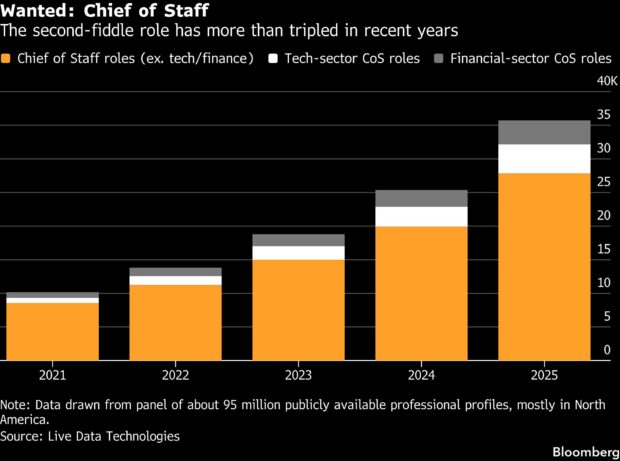
Postings for the job more than doubled last year, according to Revelio Labs, with salaries that can reach $400,000. And the number of professionals in North America now holding the title has more than tripled since 2021, according to Live Data Technologies, with the increase especially noticeable in the tech and financial services sectors.
Part confidante, part concierge and part consigliere, the modern chief of staff role took its shape in the military of the Napoleonic era, then moved into the political sphere, and is now typified by savvy West Wing operators like Ronald Reagan’s Jim Baker, Barack Obama’s Rahm Emanuel and Donald Trump’s Susie Wiles. Big, public companies had adopted the position in recent years for their globe-trotting CEOs, but now it’s expanding to smaller firms and even beyond the C-suite.
“The complexity of the CEO role over the past five years has multiplied to a level where the CEO cannot even sit back and think anymore,” said Craig Stevens, a managing partner at Boyden, an executive search and advisory firm. “The chief of staff gives a CEO breathing space.”
A good one does more than that, though, by amplifying the boss’s vision, spearheading strategic projects and challenging the groupthink that tends to breed inside boardrooms.
“You need to be able to tell the CEO what you really think,” said Saj Cherian, a former chief of staff to Michael Rubin, the founder and CEO of one-stop sports shop Fanatics Inc. “And it may not always be what they want to hear.”
Cherian, now in his own executive role at Fanatics, worked as a McKinsey & Co. consultant and in venture capital before becoming Rubin’s shadow in 2011. He said he had no idea what the role entailed when he started — “it was a leap of faith on both sides” — but he recalled clicking with Rubin immediately. He said personal chemistry is vital to having success in the role.
As Stevens put it, “You’re connected to the person more than the position.” And that connection is 24/7, according to Ann Hiatt, who supported Jeff Bezos at Amazon.com Inc. in the early 2000s and, later, Google’s Eric Schmidt when he was CEO and executive chairman of the internet giant.
“The job absorbs you,” said Hiatt, who’s now an advisor to CEOs and boards. “Your calendar isn’t your own. It’s a job that gives enormous returns, but it asks for enormous sacrifice in exchange.” The median tenure for the role is just 2.3 years, according to McKinsey research. Salaries typically top out between $250,000 and $300,000, according to Marc Cenedella, founder of high-end jobs platform Ladders, but on occasion go higher.
The demands of the role are not only incessant, they vary widely, ranging from administrative tasks to strategic and operational duties. One minute, they’re taking notes in a meeting or writing a speech for the CEO; the next, they’re tasked to help crack into a new market, or take the pulse of a factory floor. The mix of responsibilities is at the discretion of the boss and usually depends on the types of challenges facing the organization and the specific skills of the person in the chief of staff role.
“It’s not one size fits all,” said Richard Moore, the London-based CEO of Mercuri Urval (MU), a mid-sized executive search and leadership consultancy. Like a caddy for a professional golfer, sometimes the chief of staff is a valued partner, knee-deep in complex tactics, while at other times they’re simply holding the bag in the background.
“It’s a funny job — it’s done by those who are ambitious, but you need humility because the job is not about you,” said Andrew Goodman, a senior partner at McKinsey and a former chief of staff himself. (McKinsey holds a Chiefs of Staff Forum several times a year where those in the role gather to share lessons on surviving and thriving.)
Those who fill the role come from all walks of corporate life, from executive assistants to project managers or strategy consultants. They can be early in their career, or in their 50s. But chiefs of staff are mostly internal hires, according to McKinsey, as the role requires deep knowledge of how an organization gets stuff done.
Another common denominator is a knack for observation and persuasion. “You rely on reading the room,” said Trent Smyth, CEO of the Chief of Staff Association, which runs educational programs at Oxford University and Harvard Business School for more experienced chiefs of staff.
As the role gets more established and embedded in corporate organizational charts, it’s now common for large companies to have multiple chiefs of staff serving much of the C-Suite and even divisional presidents, McKinsey’s Goodman said. Microsoft Corp. alone has more than 300, according to a Revelio analysis of online job profiles. (The tech giant declined to comment.)
Widening efforts by CEOs to cut costs and reduce bureaucracy could put chief of staff positions at risk. There’s also a possibility that some of the more routine functions performed by a chief of staff could get done by artificial intelligence. But skills like judgement, communications and influencing others are tough to automate.
Meanwhile, the rapid embrace of AI by executives could provide their chiefs of staff an opportunity to gain stature by building new workflows, executive dashboards and accountability systems, according to Catherine Berardi, a former chief of staff to Ariel Investments’ Mellody Hobson.
For those who succeed in a chief of staff role, plum jobs await. Two-thirds of those in the role were promoted after their chief of staff stint, according to McKinsey research, and some do come back to the role later in their career.
The poster child here is Sheryl Sandberg, who leveraged her time as chief of staff to U.S. Treasury Secretary Larry Summers into a high-profile job at Google, before becoming chief operating officer at Facebook. A former chief of staff to the CEO of SAP SE is now chief operating officer at the German software maker. Cherian, for his part, now has a job leading Fanatics Ventures, a new business unit, where he’s tasked with reshaping the company’s merchandise supply chain.
“It’s been an extraordinary springboard,” said Cherian, who also advises other business leaders on hiring their own chiefs of staff.
 Monster Tsunami Sent Water 1,580 Feet Up an Alaskan Mountain
  Viewpoint: Six Questions Every CIO Should Ask Before Their Next AI Investment
  Insurance, Maintenance Factors Challenge U.S. Plans to Ease Shadow Fleet Sanctions
  AAA Survey Reveals Disconnect in Drivers’ Obeying ‘Slow Down, Move Over’ Laws