


















I am sorry for the innovation cheerleaders and the black-swan hunters who have flooded my LinkedIn feed with predictions—and outright celebrations—of the incoming extinction of human agents and brokers for the past five months.
Executive Summary
What does Matteo Carbone really think about ChatGPT disrupting insurance agents and brokers?
The director of the IoT Insurance Observatory, well-known to more than 100,000 LinkedIn followers for weighing in on a variety of insurance and technology topics, shared his opinions on this question on the social platform recently.
He also offered the LinkedIn article for republication to Carrier Management readers.
The original LinkedIn article is available under the same title, “Let’s talk about insurance distribution before ChatGPT disrupts it | LinkedIn.”
I believe ChatGPT-driven insurance apps, or similar AI-native journeys, will not make a dent in the insurance distribution landscape.
First, time matters. It is not enough to drop a prediction and to repeat it over time, waiting for an eventual occurrence. In this article, I focus on the next five-to-10-year horizon (as I have done for my entire career). I leave the long-term predictions to the futurologists and their crystal balls.
Just for the record: I have called out the supposed disruption by autonomous cars, OEMs and the tech giants for 10 years:
- I wrote “Let’s talk about insurance before Amazon disrupts it” in January 2018 and predicted Amazon and the other tech giants (GAFA and BAT) would not touch the core of the insurance profit pool.
- I collected a significant number of bets (some already won, others going in the money in the next few years) about when Level 5 autonomous vehicles will represent a significant part of the autos on the roads in any of the Western countries.
- I pushed back on all the talks about the inevitable OEM triumph in embedded insurance.
I was a contrarian on all these topics, and I was right. Of course, past results aren’t a guarantee of future results.
So, why did I consider the market reaction silly when insurance broker valuations took a haircut in February? (By the way, the haircut didn’t last long.)
Related articles: Insurify Starts ChatGPT App Allowing Consumers to Shop for Insurance; Investor Chicken Little and the AI Sales Channel: OpenAI Insurance Apps Trigger Uncertainty
Commenting on those events, some insurance professionals have pushed back on the disruption to commercial lines and the more complex personal line products but conceded it on the simplest personal line coverages. Corporate risks require more than a tiny summary and lineup of the premiums.
What exactly counts as insured property? How will the reimbursement of a specific event be influenced by the language of valuation basis, coinsurance rules, depreciation, reinstatement conditions, and the way fixed assets are classified between building, equipment, improvements and contents? Will a loss be treated as one event, one occurrence or a series of related occurrences? How does this trigger sublimits and deductibles?
Will the liability tower respond cleanly across primary, umbrella and excess policies, or will the conditions fracture the protection right when a large loss starts moving through the organization?
Will prevention obligations, inspection warranties or maintenance requirements narrow recovery after a fire, flood or equipment failure?
Two programs can look identical in a summary, while one gives only the illusion of coverage quietly and leaves the company exposed on claims day.
The corporation has many decisions to make about which part of its risks to retain and which to transfer with an appropriate insurance solution.
These corporate needs require risk assessments, guidance in the selection of the insurance solutions, relations with carriers’ underwriters to place the risks, and the need to serve the policy along its life cycle.
Moving to personal lines: Any rookie is told in his earliest days in the sector that insurance is sold, not bought. Many coverages are not compulsory, and some of them require an understanding of context—the ones a normal person cannot self-diagnose or prefers to ignore—and tend to be sold by a human who creates the demand. These are the things good producers can stimulate in their conversations.
This was true in the last century, and it has not changed an inch across three decades of digitalization.
The resilience of agents and brokers has been the single most robust insight in insurance distribution over the past two decades.
Do you foresee a client opening the insurance app in ChatGPT with the purpose of starting a conversation about a risk he doesn’t know he is exposed to or prefers to ignore? Honestly, I don’t. It sounds like utopia.
For the rest of this rant, I will throw out everything complex and argue on the disruptor’s home turf: the “simplest” personal auto and homeowners coverage. You need to have auto third-party liability to drive a car (almost in any country around the world, with just a few exceptions), and you need homeowners insurance to obtain a mortgage from a bank (almost anywhere in the world).
Again, I’m a contrarian about the pretended AI-driven disruption of the human insurance agent and broker channel. I believe LLM-driven insurance apps will not make a dent in the insurance distribution landscape. Not even in personal auto or homeowners insurance.
Since last February, we have seen a wave of initiatives focused on this distribution approach: Tuio; Insurify; Experian’s Gabi; Steadily; Jerry.ai; Neptune Flood—the list goes on.
Many were launched inside ChatGPT in a matter of weeks. A hundred others are claimed to be queued to go live. The technology is real, it is here. The customer experience is still a nightmare.
Picture the unusual customer who actually wants to find a product for his insurance needs. He opens ChatGPT, turns on an insurance app—a comparison marketplace or a carrier—and has a guided conversation that collects his information and returns one or more tentative quotes with contracts. Then he picks an offer and is bounced out to the comparison site or carrier website, where he has to re-enter everything from scratch as if the LLM-driven conversation never happened.
As I told P&C Specialist last February, “by far a worse experience than any existing digital purchase process.” It is innovation theatre chasing AI. (AI Can Ace the Licensing Exam But It Can’t Sell Insurance, P&C Specialist, February 2026, subscription required)
Anyway, let’s do an act of faith, assuming the experience gets fixed, and the suggestions become genuinely accurate rather than the output of a stochastic parrot. I can be so generous on the supply side scenario, because I’m convinced that the key reasons these approaches will not make a dent are on the demand side.
Friction has been stripped out of insurance many times over the past 30 years (from online quotes to aggregators, from one-click switching to embedded insurance), and the belly of the book has stayed put across most business lines and most international markets, as has been acknowledged lately by McKinsey, BCG and PwC.
Related sources:
- Direct insurance was set to disrupt the industry: What went wrong? – McKinsey, November 2019
- Long Live the Insurance Agency – BCG, November 2022
- Insurance 2030 – Direct distribution – PwC, 2025
Full-stack InsurTech carriers started their journey mocking agents and brokers. Then, they started to knock on independent agents’ doors.
Related articles: Amazon and Agents: How Did Leaders Read The Tea Leaves?; Root Views Independent Agents as Consistent With Digital Growth Plans; ITC Reporter’s Notebook: How Next, Root and Swiss Re Are ‘Adapting’ and Innovating
Even Google (auto insurance comparison in the U.S.) and Amazon (homeowners insurance comparison in the UK) failed in their attempts to disrupt insurance distribution.
Do you remember all the talk about “controlling the top of funnel,” “owning the customers’ attention,” “being present in the moment of the need,” … blah, blah, blah. It didn’t matter.
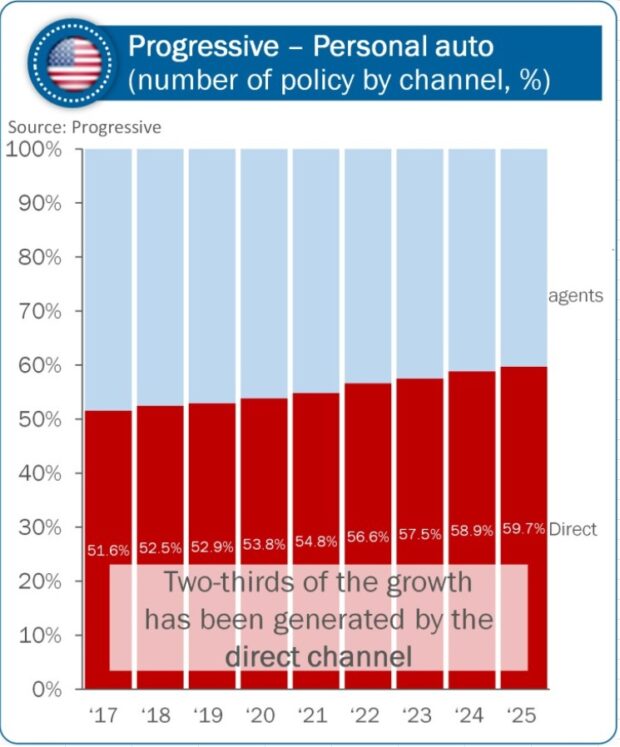
We have witnessed some business lines in certain markets (personal auto in the U.S, is the textbook case) shift a little more business to the direct channel each year. But nothing remotely like the disruption that was foreseen.
- Independent agents sell a material chunk of Progressive’s auto business (even if slowly but constantly decreasing, as shown by the graph below).
- GEICO has its local agents and has recently started to work with independent agents too.
“There are signs that the economics of the traditional agent model are beginning to unravel. Carriers are interacting more directly with customers, at lower cost and often with more consistent service levels… Many carriers are asking themselves what role agents should play in the system.” (Agents of the Future: The Evolution of Property and Casualty Insurance Distribution – McKinsey, 2011)
“Digital technology is quietly revolutionizing insurance distribution …The direction is clear: globally, digital channels will ultimately be used throughout the distribution process.” (Digital distribution in insurance: a quiet revolution, Sigma, Swiss Re Institute, 2014)
These sentences were not written in June 2026, after State Farm[i] changed its agents’ remuneration scheme. (“State Farm’s AI Plan for Sales Agents Sparks Uproar. ‘A Real Slap in the Face,’” WSJ, June 17, 2025). They were written in 2011 and 2014.
Not a single LLM was in the room.
Twenty years ago, there was an expectation that all personal line markets would follow the same path as the UK market (where nowadays more than 60% of auto premiums are purchased through a digital channel, and more than 30% of homeowners premiums). Australia is one of the few markets that followed the path.
Agents were supposed to lose their jobs to digital distribution, then to InsurTech, then to embedded insurance. Every wave was going to kill the agent; the agents’ share stayed remarkably stable.
The resilience of agents and brokers has been the single most robust insight in insurance distribution over the past two decades. The vast majority of customers continue to show a preference for accountable delegation at the moment of truth. Friction reduction is a killer application in sectors with frequent, impulse, and low-stakes purchases, but it doesn’t have the same power in infrequent and high-consequence purchases. That is why, even if an agentic AI optimizes the funnel, it will barely alter the current trajectories of agents’ and brokers’ businesses over the next 10 years.
Why should it be different for ChatGPT-driven insurance apps now?
Forget insurance for a second and look at the easiest possible case for autonomous purchase: low-stakes, high-frequency, reversible e-commerce.
It isn’t working yet. Customer adoption of agentic commerce still needs to be demonstrated. OpenAI has pulled back from its native Instant Checkout, moving transactions into merchant-controlled apps that route the customer out. That direction is opposite from “bind it in the chat” and friction removal. It looks less easy than futurologists expect.
We are still at the stage of an unproven scenario for ChatGPT-driven apps and agentic commerce. “ChatGPT, Claude, and Gemini are product discovery tools, and their performance can be uneven,” according to a summary of Bernstein research (published by investing.com, “How ‘agentic’ is AI shopping today,” June 14, 2026). Agentic commerce remains an intellectual speculation without any real success stories. It is not being adopted for a $40 reorder.
What are the chances for an agentic insurance purchase? Is it a sound buying behavior for an infrequent, non-impulse, high-consequence purchase?
And even more relevant to the current discussion, would a significant chunk of customers who have stayed with their insurance agent or broker for the past decade use these ChatGPT-driven insurance apps?
The “safety net” instinct has never been about information, which AI now— and even more tomorrow—supplies in abundance. It is about having an accountable human to own a rare, high-consequence outcome. You use the machine to inform the decision but keep a human to own it. If you let an expert guide you in making choices that may have significant consequences, then you save yourself from owning the responsibility.
You have the comfort of having an expert to blame if something goes badly one day.
“Friction reduction is a killer application in sectors with frequent, impulse and low-stakes purchases, but it doesn’t have the same power in infrequent and high-consequence purchases. That is why, even if an agentic AI optimizes the funnel, it will barely alter the current trajectories of agents’ and brokers’ businesses over the next 10 years.”
A normal person cannot tell whether they bought adequate coverage until the claim arrives—so they delegate ownership of that risk to an accountable human. Moreover, the agent or broker is not only accountable but also acts as the policyholder’s advocate, fighting denials, knowing the adjuster, and advising the client throughout the claims process.
I can already hear the most diehard of my futurologist friends furiously typing their objections. An agentic AI personal assistant, they will argue, will earn users’ trust and eventually be treated—and blamed—like any human advisor: first by digital pioneers, and later by the masses.
I can see their passionate descriptions of the insurance AI assistant (one day, somewhere in an undefined future, because time is futurologists’ kryptonite) not only finding the best deal but also fighting for your claim…blah blah.
Even pretending that this will work, I wouldn’t expect over the next 10 years that we will reach a point where a material number of policyholders not only trust the machine for the autonomous execution of their insurance purchase but also perceive the machine as a comfortable “safety net,” as happens today with the human agent.
Consider this question also: Do you really see the average customer sitting down to configure and instruct an agent to manage their insurance?
I don’t. People do not wake up wanting to optimize their risk transfer; they buy insurance because they have to buy it. Within financial services, they will likely spend that energy on investments, loans or credit cards—things they touch and watch. Lowering the switching friction doesn’t change customers’ attitudes toward something they think about only once every few years; they default to the path of least cognitive resistance.
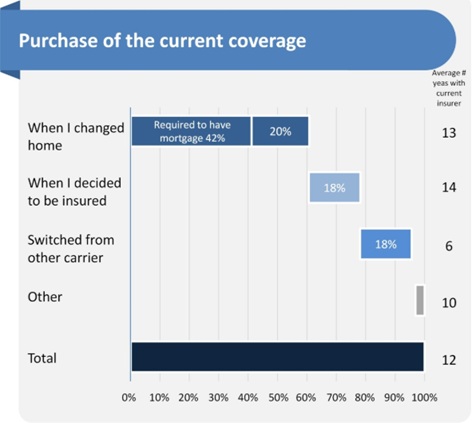
The last aspect to weigh is the limited churn that auto and homeowners insurance have in many markets:
- The graph above shows how a large part of the homeowners in the U.S. switch their homeowners insurance policy only when they change homes.
- The graph below shows the duration of customer relationships with their auto insurers in different international insurance markets.
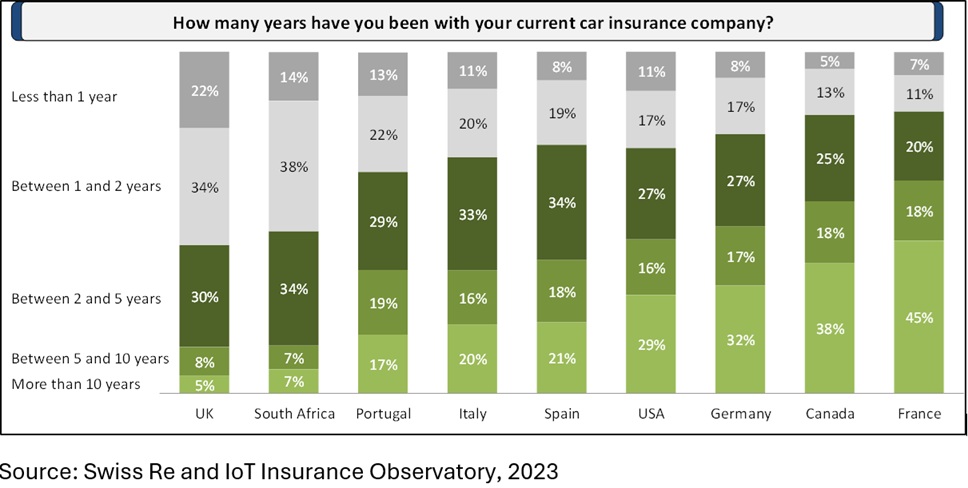
Even when (and if) agentic commerce one day is chosen by a decent amount of policyholders for buying a new policy, it will take years to make a dent in the agents’ portfolios due to the structural low churn that will not magically disappear in the time frame I have focused on for this article.
Agents and brokers have shown far more resilience than any analyst predicted over the past two decades. Each business line in each market has a pre-existing trend in channel weight and commission rates, with a pre-existing slope, and will continue to run at its own pace (e.g., the recent review of the commission system by State Farm isn’t so different from what other carriers did with their captive agents years before, and hasn’t much to do with similar AI-native journeys for purchasing insurance).
Some business lines in some markets have seen a growing role for the direct channel, while others have seen a stagnant direct channel for the same lines. Those trends will be barely touched by LLMs and AI agents in the next five to 10 years. Even in the business lines potentially more impacted, AI doesn’t bend the slope of that curve for all the reasons explained in this article. I don’t see AI significantly altering the current trajectory of distribution channels and their margins across international insurance markets.
After limiting the discussion only to auto and homeowners insurance, let’s zoom back out to all the insurance business written by insurance companies and sold by their agents and brokers.
We have a broken and unproven supply side and a long list of demand-side issues. Even assuming the technology gets fixed, it will just move the marketing funnel from a search box to a chat box, and it will touch only the quote process of policies sold online. On current trajectories, that will barely reach double digits in the next 10 years. The intermediated volumes stay where they are. In the 10 years, the agents’ and brokers’ profit pool isn’t facing any new hole that AI is digging; only the same gentle, decades-old drift in a few corners of the global markets it has always lived with.
Last February, the stock market priced in a discontinuity that isn’t there. So, how was the haircut on brokers’ valuations anything but silly?
 Viewpoint: Six Questions Every CIO Should Ask Before Their Next AI Investment
  Insurers Say French Supermarkets’ Cyber Insurance Unlikely to Cover Food Losses
  When Builder’s Risk Coverage Doesn’t Reach the Finish Line
  More Roller Coasters Shut Down as Authorities Probe Fatal Fall Off Georgia Ride