
















On my first day of my first job in the insurance industry, my boss asked me, “Have you heard of this Internet thing? Agents are going to be gone.”
Executive Summary
“AI is not the Internet,” writes Bryan Falchuk. In this counterpoint to an article Carrier Management published last month by Matteo Carbone—Let’s Talk About Insurance Distribution Before ChatGPT Disrupts It—Falchuk argues that AI is not a transaction layer the way ecommerce is.
Like Carbone, Falchuk believes the demand for guidance in making consequential decisions will not change. But the suppliers of that help could include AI agents, informed by patterns across millions of other people and businesses, in Falchuk’s view. In fact, AI agents can understand the need for risk protection from context it holds, without anyone typing a question or request to secure insurance.
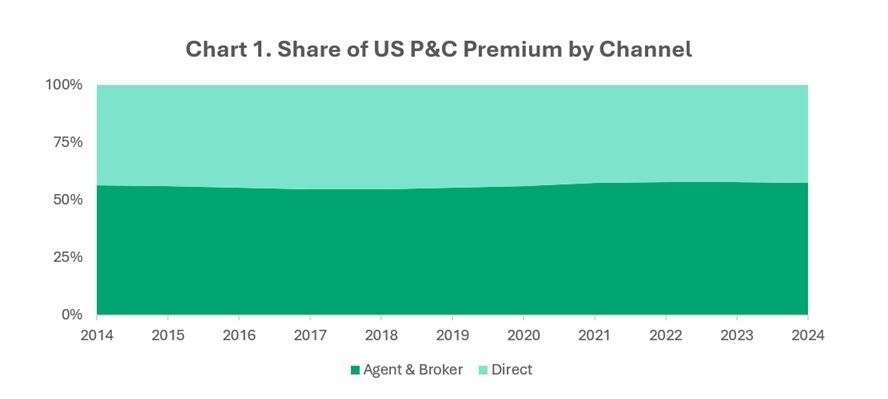
Fast forward to today, and that often-repeated prediction still has not come true. Over the past 10 years, the share of U.S. property/casualty premium written through intermediaries has held almost constant at 57-58% (see Chart 1) — a genuinely boring chart, and proof that agents and brokers remain the primary way insurance is bought and sold in the U.S., “this Internet thing” notwithstanding.
Despite the threat never playing out, the same prediction is heard again today, with one substitution: “AI” in place of “the Internet.”
The question is whether that substitution changes the outcome, or whether, like the Internet, AI will change the work of agents without ending it. This debate is playing out across many industries and roles, but here we are focused on one question: Will human intermediation still be central to how insurance is bought and sold in a world where AI is mature and prevalent?
To answer that, we first need to clear up a few fallacies in how the threat is being framed.
Today Is Different
The Internet is an extraordinary transaction enabler—that is why retail, banking, and travel booking all moved online as much as they have. Insurance did not follow because insurance is, famously, “sold and not bought.” Some of it is transactional—people who know what they need and are comfortable shopping on price—and that slice moved online. But most consumer and business insurance buyers need help, and they often still seek it out from an agent or broker. That is why the channel has stayed resilient through a quarter century of predictions of its demise.
AI is not a transaction layer the way ecommerce is, and that is the real difference this time. AI can understand context—and build that context itself, by interviewing the consumer and pulling in third-party data. It can go beyond price shopping to map a person’s or business’s risk picture, informed by patterns across millions of other people and businesses it accesses data on and learns from. It can parse policy wording and case law to compare insurers’ offerings against that specific context.
If that sounds familiar, it should: it is what a good agent does, using experience and training to make up for having far less information at hand than AI can draw on.
That is why we should not assume the AI threat will fizzle out the way the Internet threat did. AI is not the Internet.
Author’s Note: The term “agents,” as used in this article, isn’t meant to specifically speak about agents or to exclude brokers. The primary distinction between the two is that agents legally represent the insurers they are appointed by, while brokers represent the insured as their clients. This distinction between the two types of intermediaries is irrelevant to the discussion here. References to either in this article will be meant as the agent and broker channel as a whole.
Editor’s Note: The 2026 Market Share Report of the Independent Insurance Agents & Brokers of America (the Big “I”) shows a slightly higher market share for agents of 62% in recent years, including 2026, also source AM Best data.
Agents ≠ The Agent Channel
Some of the best pushback on this idea comes from people who argue agents are not going anywhere—including my friend and colleague Matteo Carbone, in a recent piece making the case against AI disrupting the channel.
Related article: Let’s Talk About Insurance Distribution Before ChatGPT Disrupts It
Here is the reframe that I think gets missed on both sides of this debate: Matteo’s piece is a defense of buyer demand for the agent channel—the case that people will keep seeking out an intermediary rather than transacting directly. I do not dispute that. If that were the whole claim, I would agree with it without reservation.
But that is not the claim I am making. Mine is about supply—about who and what is inside that channel doing the work once a buyer shows up looking for guidance. A channel can have entirely stable buyer demand and still be staffed by a fraction of today’s headcount or partly staffed by AI standing in the traditional agent role, without any of the demand-side behavior moving an inch. Low churn, a preference for delegation, resistance to self-directed shopping—none of that tells us who or what is on the other end of the conversation once the buyer arrives. That is the question I am actually asking.
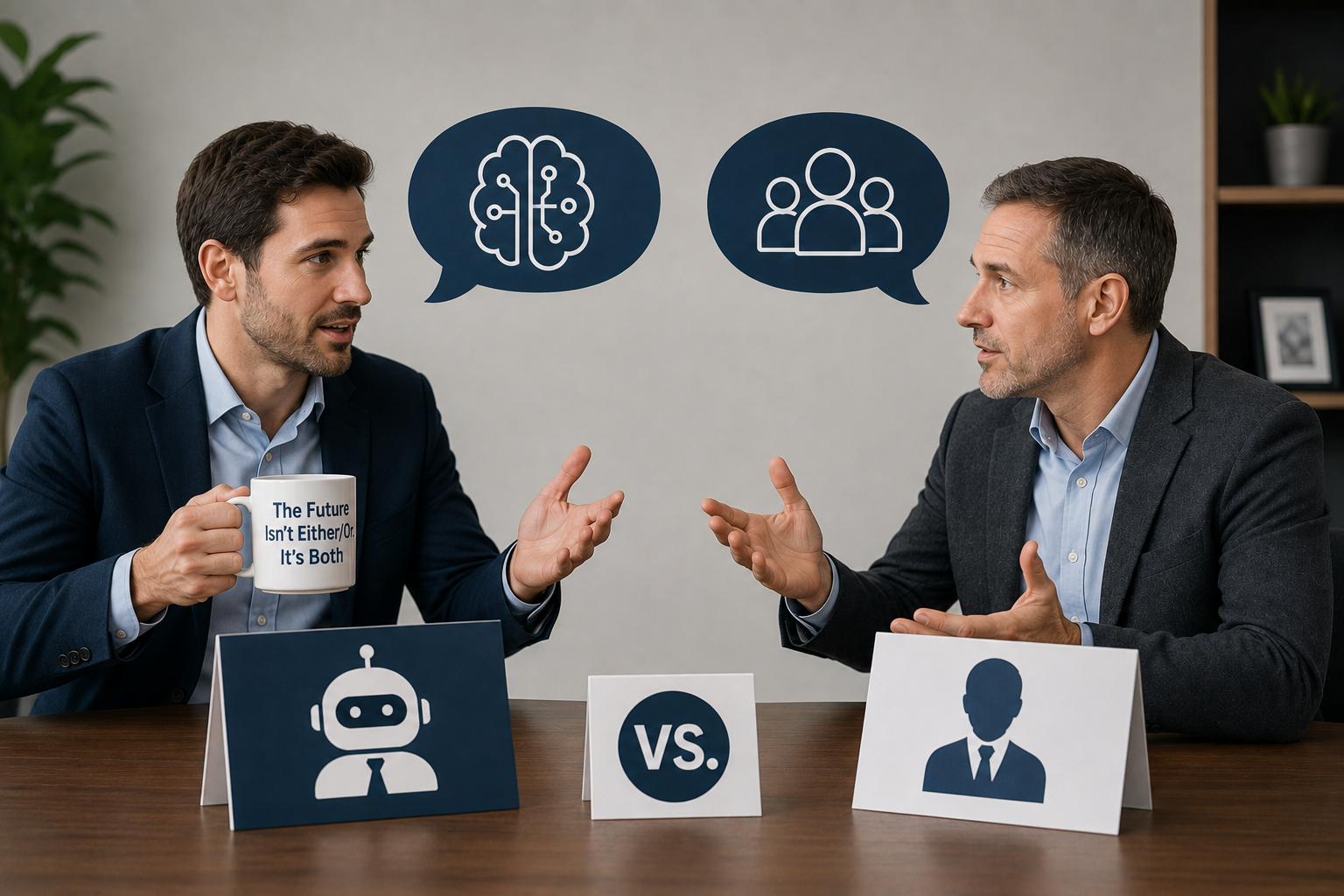 So, “AI will not be the end of agents” is correct, if it means the function of guidance and support in meeting people’s protection needs. That is essentially Matteo’s argument, and on that point we agree.
Where we part ways is in assuming that support has to keep coming from the same people, doing the same work, in the same numbers, as today.
Let’s take the two pieces in turn: the people, and the timing.
The People Will Change
I think consumers, commercial and personal alike, will keep needing advice and guidance in understanding and managing their risk. I also think a similar share of buyers will keep valuing an intermediary to source their options, rather than switching entirely to buying direct, no matter how capable AI tools become.
Part of Matteo’s case rests on “accountable delegation” — the idea that buyers stick with a human because they want an expert to blame if something goes wrong. I do not think that is really what is happening in most buyers’ heads. I doubt anyone (or at least almost no one) consciously picks an agent thinking, “I could do this myself, but I want someone to yell at later if something goes wrong.” What looks more likely is that buyers are offloading the cognitive burden of a complicated, infrequent decision to someone they trust to have done the homework. Accountability is a background comfort, not the reason for the choice.
That distinction matters because it points to two very different futures. If delegation is fundamentally about having someone to blame, that is a role built for a human, and AI struggles to fill it. If it is about trusting something to carry the research and judgment so you do not have to, that is a need AI can plausibly meet—arguably one it is already meeting in other corners of people’s financial and personal lives.
But why would that intermediary have to look like today’s agent, using the same staffing and tools? It does not.
As more people lean on AI in their lives and businesses, using it to it to work through a need they have becomes second nature—and I expect the same will happen with insurance. That could mean a generalist assistant like Claude or ChatGPT that connects into insurance offerings and matches coverage to a person’s risk context. It could also mean purpose-built insurance AI tools, in the spirit of comparison engines like The Zebra, Insurify, Gabi, and NerdWallet, that go beyond quotes into binding and managing coverage. That is a more literal version of “AI agent” than the term usually implies. And these two pathways are not mutually exclusive. People may go down the path to understanding what they need to buy with a generalist tool, and transition to a purpose-built tool to actually secure coverage.
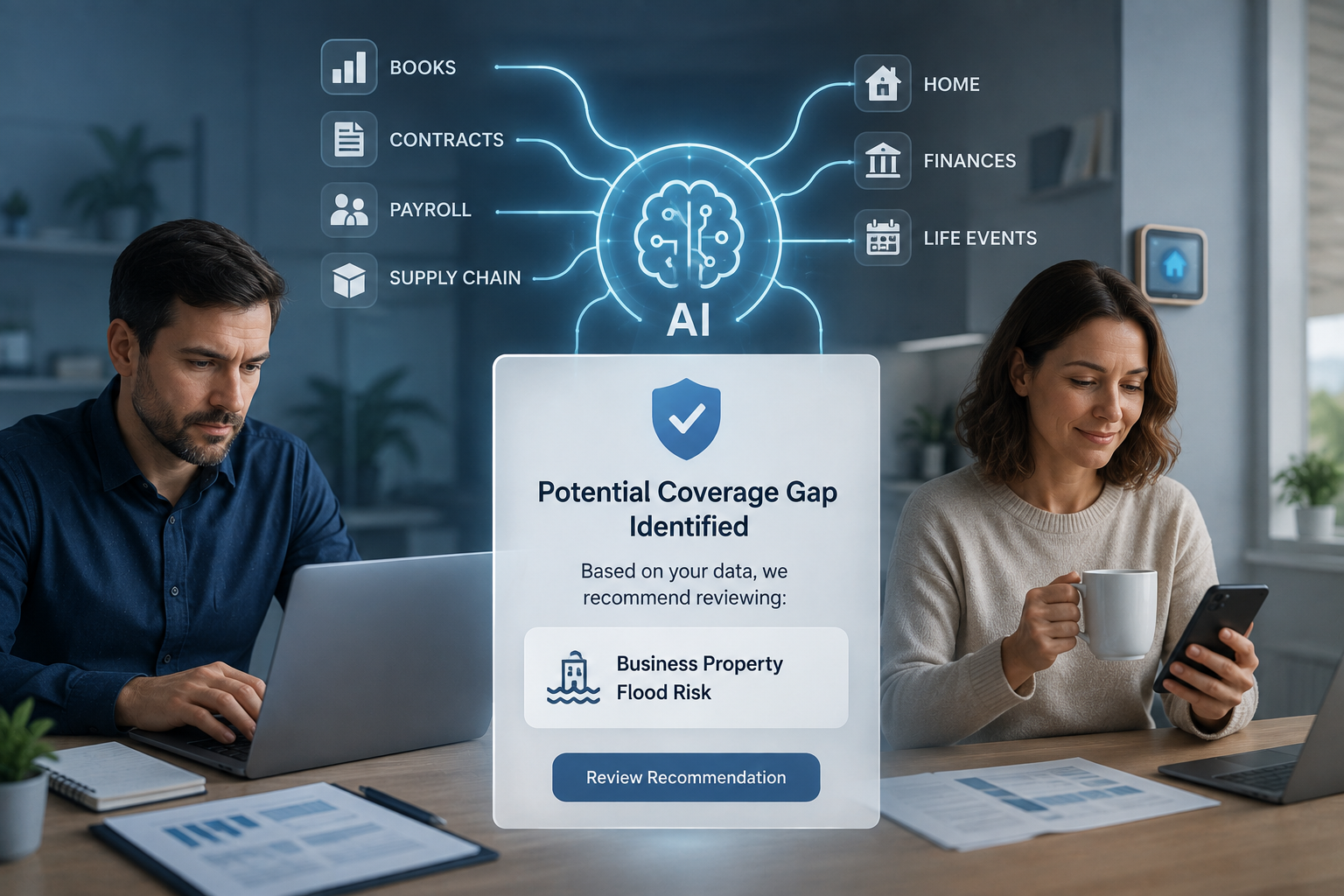 But there is a bigger shift coming, and it is the part of this debate I think gets missed most. The scenario above still assumes a person has to recognize their own risk and describe it to a chatbot. That is not what this looks like once agentic AI is genuinely woven into how people and businesses operate. An AI system already managing a small business’s books, payroll, contracts, and supply chain does not need to be told about a coverage gap. It can see the exposure in data it already has, and surface it before anyone asks.
The same goes for a personal AI assistant with visibility into someone’s home, finances, and life events.
That is the real disruption: not a friendlier chatbot for people who already know they need insurance, but AI that identifies the need on its own, from context it already holds, proactively.
That capability is not broadly here yet, but it is a natural extension of tools already emerging, and it changes who does the informing and guiding far more than a better quote-comparison interface does.
At the same time, human agents will lean on AI more heavily in their own work, something already well underway. Keeping up with constantly shifting coverage, rates, and underwriting appetite is close to impossible for a person alone, and doing so leaves less time for clients. AI can track that flow of change in real time and hand an agent an up-to-date view they can apply to a client’s needs — exactly what Mylo founder and CEO David Embry described to me when he joined my show in 2024 to talk about what his team built at the intersection of AI and human brokers. (“The Future of Insurance Season 6 Episode 15 – David Embry, CEO, Mylo,” Insurance Evolution Partners, 22 November 2024)
AI is also absorbing much of the operational load of running an agency, often without being asked, through agentic AI solutions that act on their own. That lets an agency produce the same amount of business, or more, with fewer people — something Jason Cass described in similar terms as a guest on my show in 2026. (“The Future of Insurance Season 8 Episode 24 – Jason Cass, Leading Voice in the Independent Agent Channel” Insurance Evolution Partners, 19 May 2026.)
Layer on top of that a workforce problem the industry already has: agents are retiring and leaving faster than they are being replaced (true of most roles within the insurance industry). That reduction in headcount was coming with or without AI. What AI adds is a way for the agent channel to hold its position in the market even as the number of agents doing the work shrinks.
The Timing Is Already Here
When the Internet was the threat, people reasonably spoke in decade-long time frames. Adoption curves were slow, and a lot of enabling technology and cultural change had to happen before people would buy things online. That shift has now happened; the barrier is gone.
Technology still needs to mature, but even that looks different this time. We used to talk about needing years for a technology to reach the point where it could support the shift being predicted for it to enable. For example, autonomous vehicles are the textbook case of something still years from broad reality despite multiple predictions of it being an impending reality whose timeframes have come and gone.
AI will not follow that curve. Much of what is needed to reshape how insurance is bought and sold already exists.
It is worth remembering that almost none of what we now see as a threat to agents existed three or four years ago (or less). And these technologies are not improving on a multi-year cycle; they are taking real steps forward every few months, and sometimes faster.
Kyle Nakatsuji, co-founder and CEO of Clearcover and AI company Dearborn Labs, put it well in a recent interview we did together: this may be the most powerful technology ever built, being adopted faster than any technology in history — which means old forecasts do not hold. (“The Future of Insurance Season 8 Episode 18 – Kyle Nakatsuji, Co-Founder & CEO, Dearborn Labs,” Insurance Evolution Partners, 7 April 2026)
That combination—a cultural shift toward digital that is already behind us, and a technology curve moving in months rather than years—is why I do not see this as a 5-to-10-year story. I would put real, visible change inside the next five years, with the first signs of that shift already showing within two to three.
Same Channel, Different People
So, will AI be the end of agents? Not in the way Matteo and others making the same case are defending against. Buyer demand for a trusted intermediary who does the guiding is not going anywhere, and I do not think that particular argument is actually in dispute. People will keep wanting someone, or something, they can hand a complicated, consequential decision to—not principally so they will have someone to blame later, but because offloading that judgment to something they trust is easier than doing the work themselves. AI can plausibly become that something for an expanding share of buyers.
But that was never really the question worth asking. A channel surviving buyer demand says nothing about who, or what, is inside it doing the work. That is a supply-side question, and I think the answer is changing faster than a decade-long horizon suggests. AI is going to absorb a growing share of what fills an agent’s day, from tracking the market to processing business to, increasingly, spotting a client’s risk before the client thinks to ask. Some of the “agents” a client works with in five years will not be human at all, and the humans who remain will be doing a different, more consultative job, with far fewer colleagues around them.
The flaw in the “agents are fine” argument is not in defending buyer demand; I think that defense holds up. The flaw is treating a defense of demand as an answer to a question about supply. Insurance distribution survived the Internet because the Internet could not do the informing and guiding that makes agents valuable, and buyers still wanted that guidance from a person. AI can now do more of that informing and guiding itself, which changes not whether buyers want a guide, but how many people—and what kind of people —it takes to be one.
The agent channel will still be here. Many of today’s agents, and the way they work, will not be—and we will not need a decade to see it.
Images embedded in this article were generated by AI (ChatGPT)
 Hawaii Likely Needs $1B in Disaster Recovery, Resilience Funds
  Weather Service Confirms 2 Tornadoes Touched Down in Arizona Last Week
  Levers and Guardrails: How Growth Is Being Built at Hippo
  Global Commercial Insurance Rates Drop 5% in Q3; Signs of Stabilization