













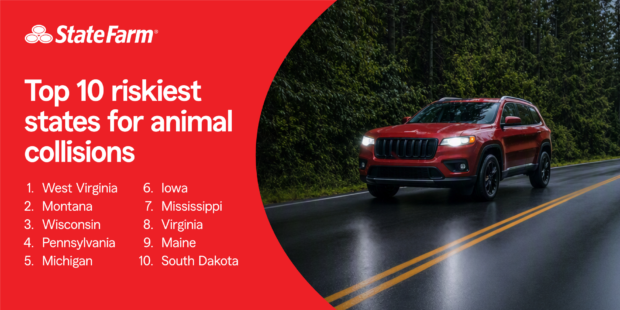
New data indicates that between July 1, 2025, and June 30, 2026, there were more than 1.6 million animal-vehicle collision claims across the United States, with $1.9 billion in related claim costs paid by State Farm during the study period.
The number of animal-vehicle collisions reflects a year-over-year decline, down from 1.7 million from July 1, 2024, to June 30, 2025.
After studying these types of collisions for twenty years, the Illinois-based insurer’s insights offer clues on why they happen more in certain places and at certain times of year, especially in the fall when deer are more active.
Data indicates the national likelihood of an animal collision improved from 1 in 139 last year to 1 in 145 this year, but the number and cost highlight a significant roadway risk remains.
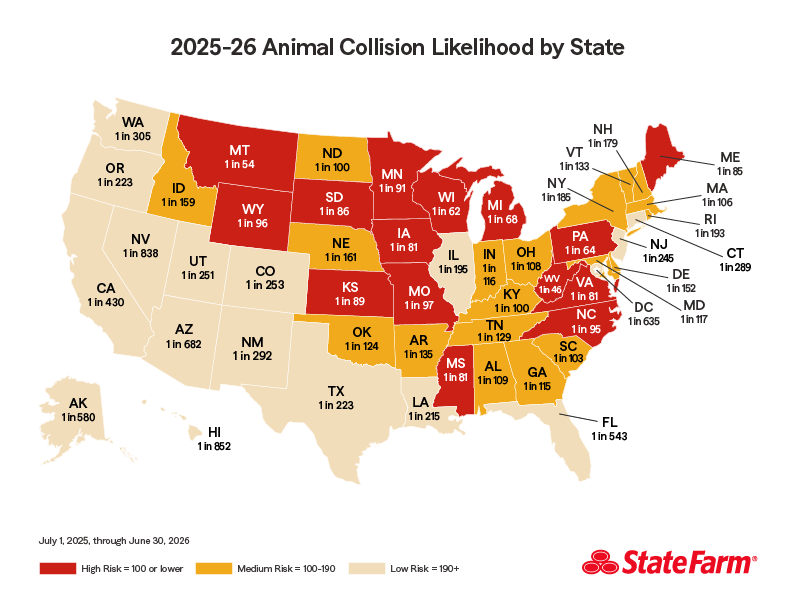
West Virginia continues to have the highest likelihood of an animal collision, with odds of 1 in 46, and has held the top spot for more than a decade.
Montana ranks second at 1 in 54, followed by Wisconsin (1 in 62), Pennsylvania (1 in 64), and Michigan (1 in 68).
While West Virginia has the highest likelihood, Pennsylvania had the highest number of estimated industry claims, at approximately 141,000.
The insurer emphasized that better infrastructure, wildlife crossings, vehicle technology, driver awareness and data-informed decisions can all play a role in reducing risk.
State Farm’s research initially focused on deer collisions but has expanded over time to provide a broader picture of collisions involving wild and domestic animals.
Deer remain by far the most frequently struck animal, but claims also involve rodents*, dogs, raccoons, cattle, coyotes, cats, turkeys, hogs, and bears.
*Rodents are not only involved in collisions but included in claims data as an animal-related loss for damage they cause to vehicles, like chewing wires.
 Friend of Suspected FBI Data Thief Warned Teen Not to Hack Bureau
  AI Models May Soon Self-Replicate Across Smart-Home Devices, Anthropic Warns
  Delegation Without Abdication: A Division of Labor for Human-AI Decisions in Insurance
  Nearly 50,000 Cars Damaged by Floods This Year: CARFAX