

















At 22 years old, as a claims adjuster trainee, I began taking accounts from people who had been in accidents. One of the head-scratchers I heard most consistently was that the other driver was speeding. So, I would ask how they knew. More than once I got back a version of the same sentence:
“I never saw him before the impact, so he must have been flying.”
Executive Summary
Human beings have been terrible witnesses since human beings were invented. Vehicle performance data—not the robotaxi—is the automation story the insurance industry cannot afford to miss.The absence of a memory, offered as proof of a fact. And the person saying it is not lying. They believe it. A crash takes about a second-and-a-half, and then everybody starts remembering it differently.
The most consistent piece of evidence in any claims file is what the driver said took place. It is also the least reliable. Human beings do not accept blame readily; we never have. What has changed is that there is now something else in the car to blame, and the account is more and more often some version of “I didn’t do anything. The car did it.”
Sometimes that driver is lying. Far more often the memory is simply wrong. Human beings can be good investigators, but we have always been terrible witnesses, and an investigation built on human accounts alone is begging for trouble. Nor is this only about automation: whether the fight is over what the system was doing or over how two drivers shared fault at an intersection, the vehicle’s data is the best evidence of what happened.
Consider what the human version of events actually is. It is a report of what one person sensed through a windshield, and that assumes the driver was looking through it at all rather than at a passenger, a center screen or a phone. Human binocular vision spans about 120 of the 360 degrees the vehicle is monitoring, and the sharp cone the brain builds a memory from is roughly five degrees, about 1% of the scene. The driver has little view to the side or rear, none at all of the pedal box, the steering column or what the automation was commanding, and no ability to rewind. The vehicle has all of it, from every angle, on replay.
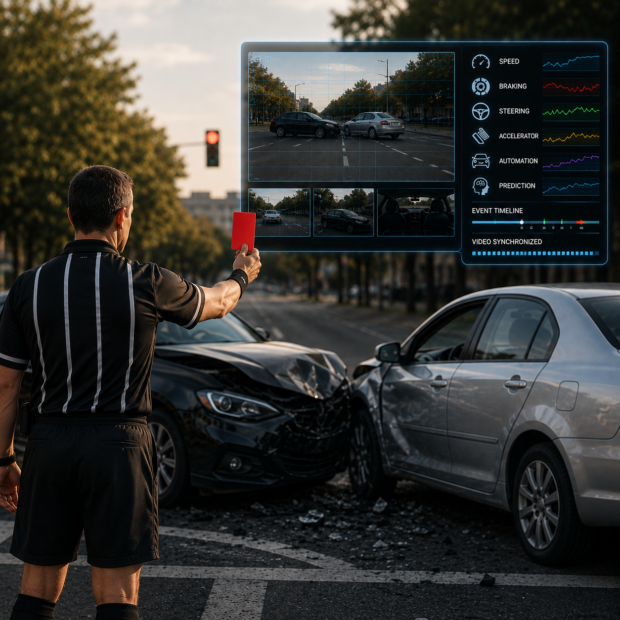
We have already accepted this everywhere else. Baseball has an automated strike zone. Tennis calls its lines electronically. Soccer put a sensor inside the ball. Football reviews the catch. In each case we concluded that a trained, well-paid, professional judge of the situation, watching from one vantage point with no replay, was working from too little data and too much humanity.
Officials can be biased, and people will always suspect it, but far more often they simply got it wrong. So, we built a better record.
The auto claims file is one of the last places where we still take the eyewitness at their word.
For a hundred years, the industry had no choice but to build claims handling on that testimony. That era is over, and I suspect many of you haven’t noticed, because you’ve been watching the wrong show.
You Have Been Distracted by the Robotaxi
When the industry talks about vehicle automation, the conversation jumps straight to Waymo, driverless taxis and a future that always seems 10 years away.
That future is interesting. It is also a distraction.
Something far more consequential has already happened: the vehicles your policyholders drive today are connected computers that record speed, braking, steering input, accelerator position, what the automation was doing, what it perceived, what it predicted, and increasingly video of the event.
At NCOIL’s summer meeting in Boston, Waymo presented on how far its service has spread. A Louisiana legislator made the point that stayed with me: his state has 64 parishes, and he doubted many of them would see a Waymo anytime soon.
Waymo had no real answer. But every one of those parishes is filling up with ADAS-equipped vehicles, and that half of the story never got addressed.
Software-defined vehicles will be the overwhelming majority of the new-vehicle market within a few years. This is not a robotaxi story. It is a story about the Camry, the Model Y and the F-150 in your book of business right now.
Six Vehicle Automation Levels, Simplified
The automotive industry and the engineering world organize all of this around SAE J3016, which defines six levels of driving automation. Calling it a “standard” is generous. It has been criticized for years as confusing and easy to misuse in marketing, and it has been a poor predictor of how the technology actually arrived: Level 0 was irrelevant the day it was written, and Level 3 spent a decade perpetually two years away.
Strip away the engineering language and it comes down to who is driving and who is watching:
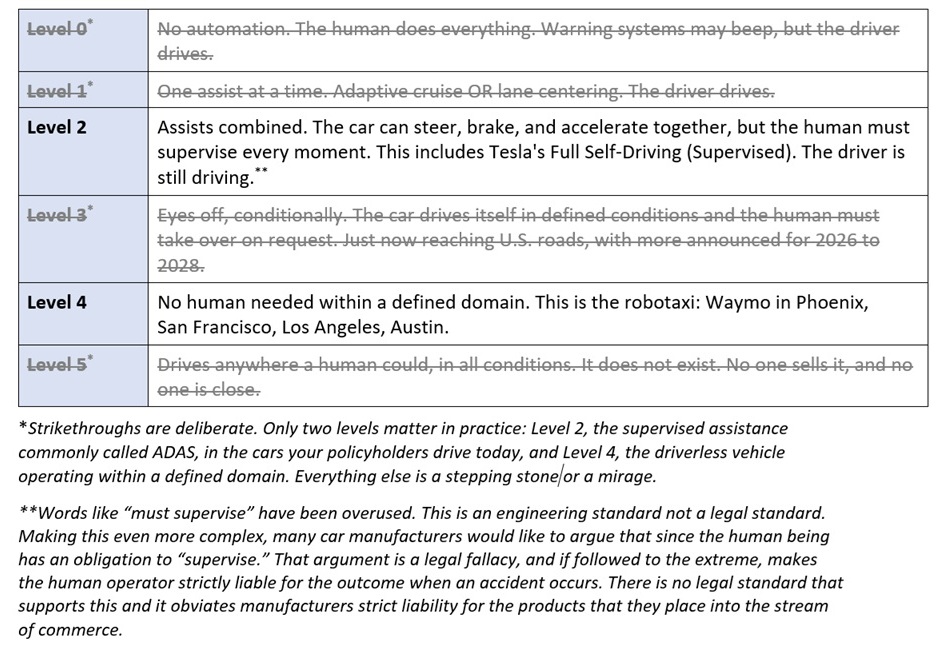
Here is why that matters to a claims organization: nearly every vehicle in your book sits at Level 2 or below, so a human is legally driving while marketing persuades that same human the car is driving itself. That gap is a defining liability question of this decade. Calling an umbrella a parachute does not make one. It just makes it a more dangerous umbrella.
Same Story, Two Different Truths
In presentations to insurance regulators, legislators and executives, I walk through two real crashes with data and video. In both, the driver’s story was a version of the same sentence: “I didn’t do anything; the car went out of control.”
In the first, the data showed a sustained accelerator press and no braking—classic pedal misapplication. The driver genuinely felt the car ran away; the data proved human error. In the second, the data showed automation commands steering the vehicle out of its lane with no driver input at all. The automation misbehaved, and the data exonerated the driver.
One story; two different truths. Both resolved in minutes by data the vehicle recorded; neither resolvable by testimony alone. Video from crashes like these is posted on our YouTube channel, Mobility Nerd Heard, deliberately unlabeled as to which clip produced which finding. Watch a few of them cold, the way an adjuster would.
What This Means for Carriers
Insurers have a duty to conduct a “reasonable investigation.” In 2026, an investigation that ignores available vehicle performance data while relying on the recollection of the people in the car is becoming hard to defend as reasonable. The data is objective. It shortens cycle time from months to minutes, confirms fraud, protects honest policyholders when automation fails, and shifts liability to manufacturers when the product, not the person, caused the loss.
The obstacle is access. Manufacturers hold this data, and their obligation to hand it to their own customers on request is still being worked out in statehouses, courtrooms and regulatory meetings.
The major trades named transparency and availability as priorities this summer. Carriers that engage now, building data acquisition into their claims workflows and their government affairs agendas, will set the standards everyone else inherits.
The author of this article, Mike Nelson, hosts the Mobility Nerd Heard podcast. The next episode, “The Consequences of Not Conducting a Reasonable Investigation Using Smart Vehicle Data,” airs Wednesday, Aug. 5 at 11:30 a.m. ET.
Civil justice only works when the evidence is objective and transparent. Our industry is the largest consumer of accident evidence on earth, which makes this our fight to lead, not to watch.
The vehicles have been telling us the truth for years. The only question left is whether we keep building files on the testimony of the worst witness in the car or start listening to the best one.
Featured image: AI-generated (ChatGPT)
 AI Data Center Boom: Understanding How Risks Are Changing
  Viewpoint: Six Questions Every CIO Should Ask Before Their Next AI Investment
  Tech Bytes: New Partnerships at The Zebra, LexisNexis Risk Solutions
  The Latest Launches from Orion180, Arbol, Zywave