



















Economic uncertainty—fueled by shifting trade policies, geopolitical instability, and operational disruptions—is driving leaders to rethink planning, risk management, and long-term strategy, according to new research from Sentry Insurance.
New data from a survey of more than 600 executives reveals that C-suite confidence has fallen sharply since the start of 2026, with 82% of U.S. executives more concerned about the future of their business than at the beginning of the year.
The shift is even more pronounced among small business leaders, with 90% saying they are uncertain their businesses will survive.
The findings, featured in the mutual insurer’s 2026 C-Suite Stress Index: Midyear Report, found nearly all executives (98%) say events in the first half of 2026 have changed how they approach long-term planning and risk management.
Many are preparing for a wider range of interlinked risks by shortening planning horizons (70%) and creating more contingencies (61%). This strategy holds for geopolitical events, with 88% of executives indicating they struggle to manage risks accurately due to the pace of change.
“What’s changed since the beginning of the year isn’t simply the list of risks businesses are managing—it’s how fast risks evolve and are affecting one another,” said Jeff Cole, assistant vice president of National Accounts at Sentry. “Leaders are recognizing that today’s environment demands a more adaptable approach to planning. Organizations that regularly reassess their risks add flexibility to their decision-making, allowing them to prepare for multiple possible outcomes and better position their organizations to respond to ongoing change.”
Executives remain uneasy about many of the same issues that shaped their outlook at the beginning of the year, with the most pressing business challenges intensifying.
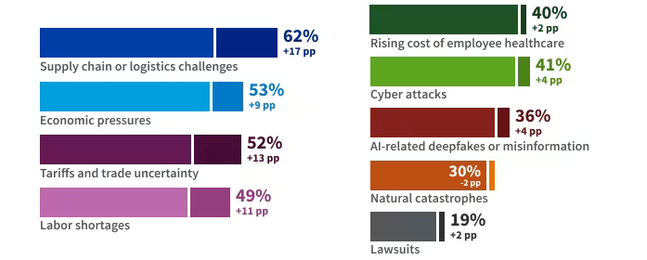
Their most pressing concerns include:
- Supply chain and logistics challenges rose 17 percentage points to 62%
- Tariffs and trade uncertainty increased 13 percentage points to 52%
- Labor shortages climbed 11 percentage points to 49%
Workplace safety risks and severe weather round out executives’ concerns.
Worries More Pronounced for Small Businesses
The shift in executive outlook due to international and geopolitical events is even more pronounced among small businesses, the poll found.
Nine in ten (90%) executives at companies with 10–49 employees say they’re more concerned following events thus far in 2026, a 21-percentage point increase from the start of 2026, compared to 69% of executives at companies with more than 1,000 employees.
Additionally, 65% of small business executives reported negative impacts from geopolitical events, with 95% struggling to keep pace with rapidly evolving external risks.
“Smaller businesses often have less capacity to absorb disruption, making it even more important to anticipate emerging risks and adapt quickly as conditions change,” said Brett Hoopingarner, national sales director—direct writer and Life & Annuities at Sentry. “Resilience isn’t about the size of a business—it’s about the ability to adjust. Businesses that regularly evaluate their risks and work closely with trusted advisors—including their agent and insurer—can make more informed decisions in an increasingly uncertain environment.”
Wakefield Research surveyed 625 U.S. executives with at least 10 employees. Eligible respondents included business owners, CEOs, CFOs, and Chief Risk Officers (CROs).
 Companies, Governments Fight Hacking Attempts in Rush to Patch PHP Flaws
  Building a Glass Box Not a Black Box at Elara Spatial
  Stress Is Reshaping Americans’ Lives
  Hawaii Likely Needs $1B in Disaster Recovery, Resilience Funds