













Someone will have to pick up the tab for the damage wrought by Europe’s increasingly volatile weather, and with the bulk of those economic losses uninsured, that will be the public purse unless immediate action is taken.
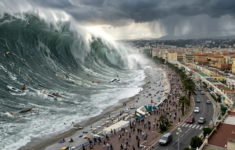
This year’s wildfires in southwestern Europe and the severe flooding that hit Spain in 2024 and Germany and its neighbors in 2021 show how climate damage is adding to a list of strains on Europe’s finances that already includes higher defense spending and rising costs associated with an aging population.
“The problem is that they’re becoming more recurrent,” Federico Barriga-Salazar, head of Western Europe sovereign ratings at Fitch, said of catastrophes until now largely viewed as costly budget one-offs rather than as a regular expense.
“If a government is already fiscally tight, it means that it does create some policy trade-offs,” he said of the pressure that such economic losses put on other spending items.
If the current scale of the fiscal hit is arguably quite small, there is a growing acceptance it will only get bigger in a region which is the world’s fastest-warming continent.
Weather- and climate-related extremes caused economic losses of an estimated €822 billion ($953 billion) in the European Union between 1980 and 2024, according to the European Environment Agency — with a quarter of that damage inflicted in just the last four years.
Public deficits across the euro zone already average around 3% of GDP. Barriga-Salazar cited estimates that the Spanish 2024 floods — Europe’s worst flooding event in five decades — imply reconstruction costs of 0.7 percentage points of output from 2024 to 2026.
Moreover, only a quarter of climate-linked catastrophe losses are insured in the EU, with coverage in some countries below 5%, the EU estimates. Some fear that level of insurance coverage will only get smaller as a proportion of overall costs as extreme weather events occur more regularly.
“I do think this just means the more you have these risks, the less they will be insured,” said David Zahn, head of European fixed income at Franklin Templeton. “This is a big issue, and it will impact some of the countries by 1% to 2% of GDP.”
Economic think tank Bruegel calculated that, while most of the 2021 flood damage was covered by insurance in Belgium, the low level of insurance coverage in Germany meant it had to draw on public funds of €30 billion for the bulk of damages.
ADAPTING AND SHARING RISKS
With the European Union due to release proposals for climate resilience and risk management this autumn, attention is focused on possible solutions.
Greece, whose tourism-dependent economy is notably exposed to the risk of heatwaves and wildfires, is looking at ways to boost insurance coverage while making water and energy infrastructure more robust in tourist hotspots.
Following huge floods in early 2026, Portugal has announced plans to introduce mandatory home insurance backed by a natural disaster and earthquake disaster fund and a solidarity mechanism to guarantee universal access.
A possible stopgap measure for some could be recourse to so-called catastrophe bonds under which investors can receive handsome returns but also lose part or all of their principal if a predefined event, such as a hurricane or earthquake, occurs.
Franklin Templeton’s Zahn noted that for the sovereign, this could amount to an expensive gamble: “If the event happens, it pays off immediately. But you could also have five years with nothing, and you just paid out 8% per year.”
Heather Grabbe, senior fellow at Bruegel, said governments needed to put in place arrangements more systematic than one-off emergency spending, which risks creating the perverse incentive for households and businesses not to take out insurance.
“All governments across Europe need to assess their exposure and make comprehensive plans to reduce future damage through adaptation investments, as well as pooling risks across borders,” Grabbe said.
Numerous studies highlight how early investments in making economies more resilient to climate change can over time save money – and avoid what a 2025 Oxford University study called an “adaptation investment trap,” where repeated climate disasters raise debt and so leave less money for protection measures.
Spanish Prime Minister Pedro Sanchez has argued that green investments worth 0.1% of GDP could prevent economic losses totaling eight times that, and avoid tax revenue losses amounting to three times the original investment.
The ECB has proposed a joint EU public-private reinsurance scheme pooling private risks from natural catastrophes, backed up by an EU fund for public disaster financing.
But the question is whether this summer’s heatwaves will generate the political will to take on some of the upfront costs of such action — both at government and EU level.
A European Commission spokesperson said the EU executive was looking into ways to address the climate insurance protection gap as part of a package of measures due to be adopted by the end of the year.
($1 = 0.8624 euros)
(Additional reporting by Kate Abnett in Brussels, Aislinn Laing in Madrid, Andrei Khalip in Lisbon, Johann M Cherian in Bengaluru, Francesco Canepa in Frankfurt; Writing by Mark John; Editing by Hugh Lawson)
 Men Sentenced in Multi-State Stolen Construction Equipment Scheme
  The Great Miami Hurricane: What a 1926 Catastrophe Reveals About Modern Coastal Risk
  States Question Safety, Challenge FAA Review of Commercial Drone Delivery Rules
  FEMA’s New Flood Maps Mean More Homes Require Flood Insurance: Cotality