




















Insurance and reinsurance executives speaking at a recent industry conference said there were few surprises during midyear 2026 reinsurance renewals—with past overreactions on price hikes explaining this year’s declines.
“The question that’s going to be super relevant is: Where are we a year from now?” asked Jim Williamson, president and chief executive officer of insurer and reinsurer Everest Group Ltd., during the S&P Global Ratings 42nd Annual Insurance Conference earlier this month.
“Do we see, which I’m hopeful we will, a discipline that creates a bit of a floor?” Williamson asked, going one step beyond answering a question about the adequacy of property reinsurance pricing posed by Taoufik Gharib, director and lead analyst for S&P Global Ratings, during an “Executive Perspectives” session of the S&P conference.
Williamson prefaced his question about what happens in 2027 by first confirming that property pricing in the reinsurance industry and the underlying primary industry has been heading down this year. “That’s definitely occurring,” he said. Offering the “very simple” reason, Everest’s leader recounted the need for both the primary and reinsurance sectors to meaningfully correct rates upward a few years ago. “Losses had exceeded available capacity, and you saw a correction. …”
“In retrospect, that was a bit of an overcorrection, and you had some really strong profitability in property, both primary and reinsurance, which obviously we love as a seller of both those products. But at the end of the day, it’s a competitive market. [There] are lots of market participants who see that excess profitability and they want to lean into it.”
He noted that Gharib’s question focused on rate change, which is easy to measure and often reported by brokers. “The question is if you’ve overcorrected and now [rates are] coming down, where are you relative to what price you need to charge to earn a reasonable return? Define that as you will—15% ROE or whatever.”
Right now, Williamson said, “We’re still in a really good spot,” giving his take on the now-settled June 1 renewals for Florida windstorm reinsurance contracts. “It’s what everybody expected. Rates traded down mid-teens. Largely terms and conditions held.”
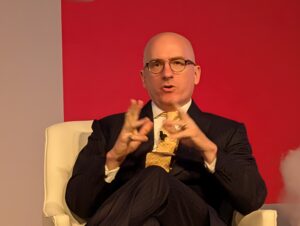
“Have we corrected back down to something that’s sustainable? Or does it continue to track down as the greed overcomes the fear factor?”
Jim Williamson, Everest Group, Ltd.
For Everest, in particular, which does the vast majority of its deals on non-concurrent terms—different terms and conditions than the rest of the market—Williamson said, “We saw it as an opportunity to get more of the best,” putting the company in a position to earn strong returns this year assuming a normalized level of catastrophe activity.
What about 2027?
The industry overcorrected and has now reversed course. “Have we corrected back down to something that’s sustainable? Or does it continue to track down as the greed overcomes the fear factor?” he asked.
Williamson doesn’t have a prediction. “Obviously, we like one of those outcomes a whole lot better. If it’s the one we don’t like, we’re more than willing to [take] chips off the table,” he said, indicating that he expected co-panelist Brian Young, president of Fairfax Insurance Group, to have a similar reaction.
Young agreed that the focus should not be on rate changes but instead on rate adequacy. From his vantage point, Young reported that the steepest property price declines are occurring in the commercial insurance market, specifically in the shared-and-layered market in the U.S. “The U.S. results in property have been fantastic. Those have been carrying the industry results, which have been excellent, but it’s mainly been as a result of property as compared to other lines,” he stated.
“When you look at price adequacy, notwithstanding the significant reductions we’ve seen in the U.S., it’s still the best-priced market from a reinsurance property-cat perspective. It’s just not about price. It’s about structure, it’s about retention levels that continue to [be] maintained at what we think is a decent level,” Young reported.
Fairfax’s leader did note one market surprise this year outside the U.S.—in Japan, where he reported the “weakest pricing today.” According to Young, Japanese cat pricing saw significant reductions this year—more than he anticipated given major typhoon activity in 2018 and 2019.
“Reinsurers were still in the process of getting paid back… The pricing of that business today is really a challenge. If it continues next year, I wouldn’t be surprised if reinsurers start pulling capacity out of the market,” he stated, also noting that in addition to pricing concerns, reinsurance agreements in Japan have the lowest retention levels of any major reinsurance markets.
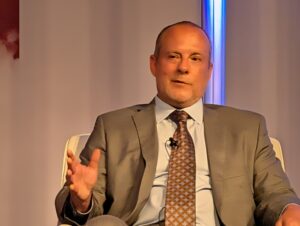
“I would go out on a limb and say there isn’t a lot of room.”
Brian Young, Fairfax Insurance Group
Young reported that price adequacy in Europe is also weaker than the U.S., indicating that secondary perils like flood and hail in Europe have had a big impact on reinsurers. “We’ve had a lot of loss activity over the last six years. Again, we’re still in the process of getting paid back, and pricing has declined,” he said, noting, however, that retention levels are at higher levels today than they were before those events.
As to Williamson’s question about what happens next year and how much more reinsurers can afford to give, Young suggested that more price cuts are possible. “I would go out on a limb and say there isn’t a lot of room,” he said.
If prices continue to go down “in a material way,” then the supply of catastrophe reinsurance capacity could diminish, he added.
Williamson said Everest’s reinsurance arm is communicating with clients about the opposing trajectories of pricing and loss trends. Referring to the loss events in Europe mentioned by Young, Everest’s CEO said those are “right over the target of being affected by climate change. That’s happening and that doesn’t seem to be abating. That’s marching upward. And now you’ve got physical inflation or material inflation in the economy, both as an overhang of COVID…supply chain [issues] and then the Middle East.”
While the price reductions occurring now make sense, “we want sustainability…. You can’t let those [pricing and loss] curves cross again, or we’re going to be back in a position where you’re going to need some big dislocation—30 points of rate increase overnight. Nobody wants to deal with that,” he said.
Third-Party Capital Beneficial
Gharib asked the executives about the impact of alternative capital on property insurance and reinsurance cycles. Offering views from varying perspectives—Everest as a manager of third-party capital and Fairfax only tapping alternative capital for retrocessional cover—neither of the leaders viewed alternative party as a big driver of rate declines.
Williamson noted that alternative capital has represented around 20% of reinsurance capital for a number of years. “My sense is that the quality of the alternative capital has gotten better over the last several years. By that I mean that more of that capital is being provided by people that really understand the risk they’re taking,” he stated. “We went through a long period where we had a lot of folks who looked at particularly property ILS as kind of free money. They got hammered by a number of storms in the 20-teens and withdrew capacity.”
“Now things have normalized back to where our counterparties for our Mt. Logan sidecar, for example, are hyper-sophisticated decision makers,” he said. Since 2013, Everest’s Mt. Logan Re has offered alternative capital markets the opportunity to gain exposure to a diversified pool of property-cat reinsurance risks through collateralized reinsurance products.
“They understand the climate change risk. They understand trend. They understand the pricing cycle. They’re making a very long-term bet to invest in a non-correlated asset. That’s exactly the kind of counterparty we want because we also understand the risk,” Williamson said. “We like alignment of interests, and I don’t want to be having a discussion after a major loss—how could this happen? We all understand what we’re doing.”
During the S&P conference session, Williamson reported that Everest was starting to see “people expressing interest in our casualty reserves as a source of investment opportunity.” He added: “I believe that casualty is the next frontier [but] it’s a very different deal. The asset leverage is really different. The variability around outcomes is different.”
“And the duration,” Young interjected.
“It’s different on every dimension,” Williamson said.
A week after the conference, Everest and investment firm Stone Point jointly announced a partnership to launch a Bermuda-based casualty reinsurance sidecar, Annapurna Re Ltd. As part of the transaction, Annapurna is expected to deploy approximately $600 million of third-party capital, providing dedicated reinsurance capacity to support Everest’s global casualty and specialty reinsurance portfolios over a three-year underwriting period.
“Annapurna sharpens our edge in casualty reinsurance and supports our long-term strategy through underwriting excellence and disciplined capital management,” said Williamson in a media statement about the launch. “Through our partnership with Stone Point, we are bringing additional high-quality capital to our platform in a scalable structure, enabling us to grow efficiently while enhancing our capital flexibility and positioning us to pursue the most attractive opportunities,” he said.
Back at the conference, speaking about the impact of alternative capital generally, he said, “Clearly you could say, that more capacity increases competition, [which] depresses rates to a degree. That’s true. But again, it’s on the margins…. [W]hen we’re talking to folks about introducing third-party capital into our [own] underwriting, [the goal] is alignment of interests. [There’s] clarity around the risk we’re taking. And our underwriting doesn’t change because people want to give us third-party capital.”
“We absorb that third-party capital when the underwriting opportunity is there. And if the underwriting opportunity is not there, I’m not putting my balance sheet at risk against that, and I’m certainly not going to take investors’ money and put it [at] risk.”
“As long as investors are being thoughtful about aligning with underwriters who understand what they’re doing and whose interests are aligned with their own, [alternative capital] will be a positive for the industry. It will help us [solve] clients’ needs. It will help us deal with all of the societal changes, data centers, AI, you name it.
“It’ll be a positive thing if we can manage it effectively.”
Young, who noted that Fairfax does not manage third-party capital from an insurance perspective, said “That’s been a strategic decision. We’d prefer to just focus on putting our own capital to work, growing float.”
He observed that the ILS market is most prevalent in the U.S. market where pricing is highest. “They’re a competitor for our Fairfax companies operating in the cat space. They’re also a reinsurer, a retrocessionaire—and they provide useful capacity,” he said, agreeing with Williamson that “it’s informed capacity.”
“It’s not naïve. It’s deployed smartly. But to be honest, I don’t really see it as the main competitor for Fairfax. The main competitors for Fairfax are the traditional balance sheets operating in the cat reinsurance space,” Young said.
Dodging a Bullet on Casualty
Later in the session, Gharib asked the two leaders to comment on casualty pricing and rate adequacy.
Young reported that casualty pricing is more stable in the international market than in the U.S. because litigation exposure is lower in most jurisdictions outside the U.S. Breaking down U.S. casualty, he said D&O pricing is extremely challenging—it’s “back to where it was pre-2020″—but that “price decreases are slowing down, which is necessary.” Likewise, professional lines pricing is under some pressure.
Strength in U.S. casualty pricing is in GL, excess and umbrella, and on commercial auto. “There have been significant price increases and it’s needed. Frankly, the development from the 2014 to 2018, 2019 period has been significant—more than reinsurers anticipated, driven by inflation. And even if you look at accident years 2022, 2023, they’re probably trending higher than you would’ve expected at this point,” he said.
Young offered varying explanations for the development patterns, noting that one theory is that the market still isn’t pricing the business correctly? An alternative explanation is that claims are settling faster because the market is shrinking limits, “which is a real positive. And that’s been maintained. People are not putting out 25s and 50s and even more capacity on risks in the GL and excess like they were pre-2020.”
“If you have smaller limits of risk and you’re concerned about bad faith or getting hammered by the carrier above you, you’re more likely to settle more quickly,” he added.
With prices continuing upward for U.S. casualty insurance—specifically GL, excess and umbrella and commercial auto—Fairfax is continuing to grow in these lines, Young reported. “We think that we’re getting better than inflation. Time will tell if we’re correct. My view is always if the market is rising, you should be actively participating. And it continues to move up in a positive way.”
As for casualty reinsurance, speaking from a seller’s perspective, Young noted that “commission levels have been stubbornly high for a long time. They’re stuck in the low to mid 30s.”
“We have potential misalignment of interest between how the insurer’s doing and how the reinsurer’s doing,” he said, expressing what he believes is a view of the reinsurance community generally that commission levels need to come down.
Offering his own view of U.S. casualty loss development, Williamson suggested note that post-COVID years are revealing an acceleration of severity trends when insurers were anticipating a reversion to pre-COVID levels after a good year in 2020 when levels of economic activity were down. In 2021, “when they started to see some heat,” they assumed, “That’s a snapback. Stuff was delayed in report system and now we’re seeing it.”
In 2022-2024, they found it was “not a snapback. There’s an acceleration of a trend line” related to societal factors—jurors “that have developed anti-capitalist, anti-big-business views [who] get to create justice by increasing the size of award—and legal system abuse by the plaintiffs’ bar.
Williamson continued: “The good news is the industry was also getting a ton of rate during most of that time. That’s accelerated and underwriting has been pretty good, especially among the best operators. So, I don’t think it’s a situation where we have a big hole that has to get filled.” But there won’t be “this bonanza of redundancy” from the 2021-2025 years that insurers may have been anticipating either, he stated.
It’s a “good thing we got all that rate. And a good thing that the underwriting has held—and we’ve been super-disciplined and limits have come down because if that hadn’t happened, we’d be in a deficit position as an industry.” In Williamson’s view, “We dodged a bullet.”
Cloudy Crystal Balls
Asked specifically about discipline in the reinsurance market, and whether that will continue in 2027, Young noted that recent good performance—combined ratios in the low- to mid-80s—is unsurprisingly fueling pricing pressure. “It’s fair to say across all lines of business, the reinsurance market is demonstrating discipline. I hope it continues,” he said, reiterating his earlier point that that there’s not a lot of rate left to give in the property reinsurance market. In 2026, the profit outlook continues to be strong barring a major catastrophe. “Once we get into 27, it starts to look a little bit cloudy.”
“If you’re producing significant growth in the reinsurance market right now, assuming you have any scale and it’s not just because you’re tiny, [then] that’s a bad sign,” Williamson said.
Williamson agreed that “overall discipline levels are pretty decent.” He added, however, that the market is at a point where “if you’re producing significant growth in the reinsurance market right now, assuming you have any scale and it’s not just because you’re tiny, [then] that’s a bad sign.”
“The fact that a lot of the larger, particularly the Bermuda companies, our peers, are returning capital to their shareholders is a good sign. We all recognize that’s a better use of the capital than burning it up by underpricing business,” he said.
Williamson, however, sees some worrisome behavior in some specialty areas as he tries to assess discipline levels across the industry and sees evidence of what he termed “the great shrugging off” of growing risks.
Related article: Mythos Myths: Good Guys Hold More Cybersecurity Cards, Insurer CEO Says (under the subheading, “The Great Shrugging Off: Geopolitical Risks”
Offering aviation as an example, he said it’s a relatively small insurance market that has experienced huge aviation losses over the last couple of years. “Aviation is also affected by social inflation in the U.S. in terms of the value of the single death due to aircraft accidents. We’ve seen enormous awards, settlements. And you just don’t see the market responding,” he reported.
 AI Agents’ Access to Personal Information Raises Privacy Concerns
  Viewpoint: The ‘Unbundled’ Insurer Emerges in Age of AI as Value Chain Fragments
  Insurers Say French Supermarkets’ Cyber Insurance Unlikely to Cover Food Losses
  Building a Glass Box Not a Black Box at Elara Spatial