



















In the not-too-distant past, property/casualty insurance underwriters worried about AI tools taking over their jobs. Now, according to a recent survey, nearly three-quarters say they’re opting for companies with clear AI strategies as employers.
The result shows up in the report “The Future of Underwriting: AI Adoption, Workforce Trends, and Industry Optimism,” an independent study of 543 underwriting executives and underwriters across the U.S. and Europe published in early July by Sixfold, an AI underwriting platform provider for P/C and life/health carriers, managing general agents and reinsurers.
Specifically, according to the report based on the responses of underwriters and executives who are mainly involved in writing commercial P/C lines of insurance, 72% said a structured AI strategy would matter to them when considering new roles. In addition, 69% say their company’s approach to AI makes them more likely to stay.
Related articles: Your Tech Stack Is Your Recruiting Strategy (Whether You Know It or Not); Ranking: Who Are the Insurance Industry’s AI Talent, Maturity Leaders?
“Not long ago when we spoke with underwriting leaders, they were concerned about how their underwriters would react to AI entering their workflow. Now the conversation has completely turned. Leaders tell us they’re worried about losing their best underwriters to competitors with stronger AI capabilities,” said Jane Tran, co-founder and chief operating officer of Sixfold, in a media statement. “Underwriters are saying the same thing; where and how a company invests in AI genuinely affects whether they stay or go,” Tran affirmed, suggesting that the AI strategy of insurers “is their retention strategy.”
Importantly, the survey takers reached out to underwriters and executives of companies that are already using or piloting AI. Beyond workforce trends, the Sixfold study also delves into types of tools being used (in-house vs. vendor), perceived AI benefits, obstacles to AI adoption and levels of optimism about the future fueled by AI.
On the last point, 99% of underwriting executives surveyed said that AI makes them more excited about the industry’s future, and 86% of underwriters are similarly optimistic. In fact, 90% of the underwriters also said they would recommend underwriting as a career.
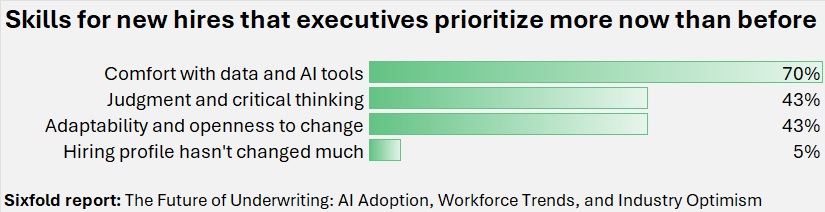
Reflecting on their own talent pools, 77% of executives are concerned that their underwriters might leave for competitors with stronger AI strategies or tools. And like the underwriters, executives said what they look for as they hire new underwriters is changing. Only 5% of executives said the age of AI hasn’t changed their skills priority lists for new hires. Expectedly, most now put “comfort with data and AI tools” high on the list (70%), but 43% are also focused more on “judgment and critical thinking.” Underwriters who are adaptable and open to change are also favored by 43% of the executives surveyed by Sixfold.
The workforce section of the report also documents slightly varying responses from executives and underwriters about how they stay current on AI, with executives a bit more likely to rely on external sources.
The first section of the report, which delves into the benefits that organizations working with AI are seeing, mainly shows underwriters and underwriting executives aligned in their thinking.
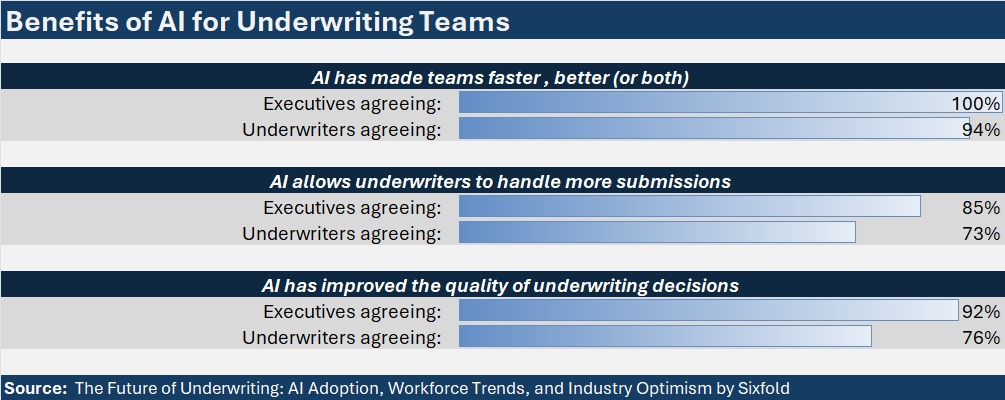
Every underwriting executive surveyed said they believe that AI has made their teams faster, better or both; 94% of the underwriters had a similar assessment. There are wider gaps between executives and underwriters on questions about how AI is impacting the number of submissions they can handle and the quality of their underwriting decisions. For example, 92% of executives reported better underwriting decisions resulted from AI, while 76% of underwriters saw the same benefit.
While more than half of respondents in both groups (52% of executives and 56% of underwriters) said the use of AI has benefited interactions with agents and brokers—fueling more substantive conversations with distribution partners—challenges remain. In fact, 83% of the underwriters reported that they still spend at least 30 minutes—and up to four hours—chasing missing information from brokers on a single risk. Two-thirds of the executives said they wish they had more visibility into the quality of risks coming from each broker and agent.
For the most part, findings in the report offered positive views of the impact of AI on underwriting. Executives expect returns on their investments in AI underwriting tools, with many foreseeing better loss ratios on the horizon. And many underwriters are using the tools when required (38%) or experimenting on their own (33%). But not a single underwriter said they treat AI as a fully trusted part of how they work.
About the Survey
“The Future of Underwriting: AI Fluency, Workforce Trends, and Industry Optimism” was commissioned by Sixfold and fielded independently in May 2026. The study surveyed 543 underwriting professionals (270 underwriting executives, 273 underwriters) across the United States and Europe.
Nearly 76% of the respondents are involved in commercial P/C insurance (38% in specialty E&S) and 46% in L/H insurance.
In terms of experience, 32% of respondents had 3-7 years of experience and 58% had 8 or more years of experience
Respondents were randomly sampled in a double-blind study and each received compensation for participation. All respondents were actively using or piloting AI within their organization’s underwriting workflows at the time of the survey.
Featured image: AI-generated (ChatGPT)
 More Roller Coasters Shut Down as Authorities Probe Fatal Fall Off Georgia Ride
  AI Data Center Boom: Understanding How Risks Are Changing
  Delegation Without Abdication: A Division of Labor for Human-AI Decisions in Insurance
  Federal Bill Seeks to Reduce Work Week to 32 Hours