



















You’re just about as likely to find a commercial P/C underwriter or actuary who is unconcerned about the increased use of AI in insurance as you are to find one that’s afraid of being replaced by AI.
That’s what a recently published report from hyperexponential, an AI-powered pricing and underwriting platform, showed based on a survey of 350 U.S. and UK underwriters and actuaries working in commercial and specialty insurance conducted on the firm’s behalf by Coleman Parkes in September.
Just over half of the survey takers—51 percent of the actuaries and 52 percent of the underwriters—said they were not worried at all or hadn’t considered the prospect of being replaced by AI.
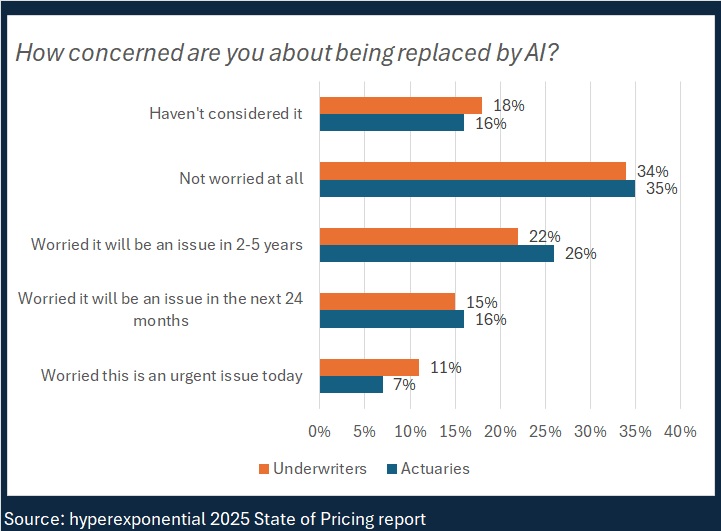
According to hyperexponential, a key takeaway from the survey response snapshot is the marked difference between responses this year vs. responses to a similar survey in 2024.
“Less than half of underwriters (48 percent) and actuaries (49 percent) now fear being replaced by AI, down from 74 percent and 80 percent, respectively, in 2024, suggesting an increasing understanding, ease and pragmatism around emergent technology and how it’s shifting the roles of insurance professionals,” the tech firm said in a media statement about the report.
For both groups, just over one-third of respondents said they have considered the issue of being replaced by AI but that they are not worried at all.
Beyond information about what it terms “FOBO”—fear of becoming obsolete—the “2025 State of Pricing” report reveals trends in insurer tech and automation investments and provides insights on the degree of collaboration between actuaries and underwriters, as viewed from the perspective of each camp.
Noting the collaboration between the two groups of professionals “has long been an aspiration,” the report suggests that this year’s survey indicates real progress. In support of this, the text of the report notes that underwriters ranked pricing actuaries second, just behind operations professionals when asked how effectively they collaborate with other functions. In the previous (2024 State of Pricing) report, underwriters ranked pricing actuaries dead last among collaborators within the companies.
Still, “the inverse remains challenging,” the report says, noting that only 9 percent of actuaries asked about underwriter collaborations ranked them as “very effective.”
“Actuaries build models for underwriters but too often not with them,” the report says.
Charts in the report show that underwriters scored the effectiveness of collaborations with pricing actuaries at 3.5 out of 5, on average. Actuaries put the collaboration ranking score at 3.1 out of 5. That was lower than scores for operations, legal and finance professionals.
Responding to a different survey question—about barriers to maintaining and deploying pricing models—38 percent of actuaries cited “lack of underwriter or business buy-in” as an obstacle. Meanwhile, 45 percent of underwriters said that “pricing models are inaccurate or out of date” when asked to identify barriers to optimal underwriting.
Investments Grow
Much of the report focuses on technology-related investments insurers are making and existing problems they have with the tools they are using.
“Nearly every insurer surveyed identified pricing and underwriting as top priorities for technology investment, showing increased recognition that these functions are the critical engines of intelligent decision-making,” wrote Amrit Santhirasenan, chief executive officer and co-founder of hyperexponential, in a forward to the report.
According to the survey, 100 percent of actuaries surveyed are investing or planning to invest in pricing and rating technology within the next five years, while 98 percent of underwriters are investing or planning to invest in underwriting workbench solutions with the next year.
Responses for each group individually and both groups combined are shown in the chart below:
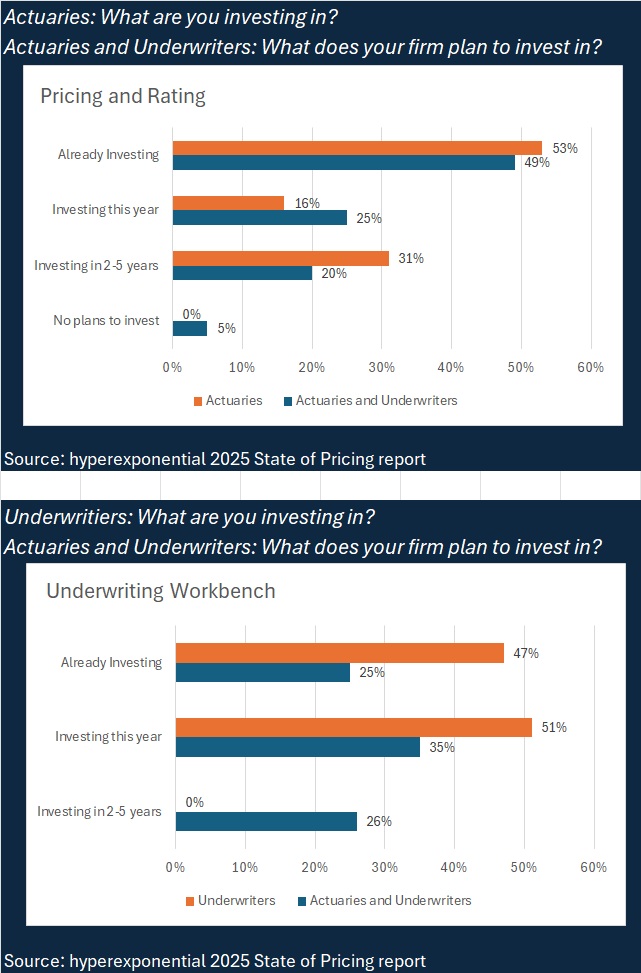
Across both groups, 94 percent said their organizations are investing in pricing and rating tools within the next five years (or already doing so). Data and analytics investments ranked higher, with 95 percent of survey respondents indicating their firms are investing in data over the five-year period (51 percent already investing).
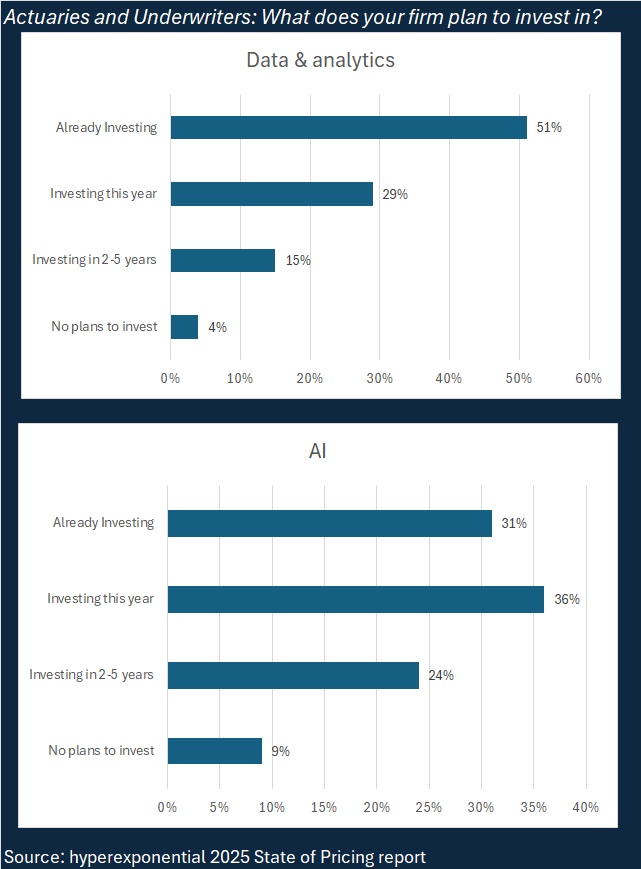
While only 31 percent said their firms are already investing in AI, another 36 percent said their firms are investing in AI this year. All told, two-thirds said AI investments are happening—or will be—within 12 months and 89 percent within five years, with only 9 percent shunning investments in AI altogether.
Commercial and specialty insurers continue to invest in existing and emerging technologies, but 99 percent said they struggle with getting the tools to work as they hope—indicating the tools need fixes characterized as “some improvement” (54 percent) all the way to a complete overhaul (11 percent).
Comparing the 1 percent satisfaction rate with a 22 percent satisfaction rate reported two years ago (in a comparable 2023 report), hyperexponential suggests that the growing frustration gap “doesn’t signal worsening technology but rising expectations.”

Excel Spreadsheets and Inefficient Processes
The 2025 State of Pricing report published by hyperexponential includes the insights of commercial pricing actuaries and underwriters about barriers to their successes and areas where technology can add value to their jobs.
For actuaries, “lack of robust version control in Excel” was cited as the top barrier to maintaining and deploying pricing models.
“With 85 percent of actuaries still relying on spreadsheets as a core part of their pricing stack— and almost half [48 percent] citing lack of version control as a top barrier— the pricing function remains handcuffed,” says the report, which also reveals “time spent on data cleansing” (46 percent) and “lack of underwriting or business buy-in” (38 percent) as commonly cited barriers.
Meanwhile, 45 percent of underwriters said they’re hamstrung by “pricing models that are inaccurate or out of date.” Topping the underwriter list is time spent on low value administrative work and inefficient processes.
Asked specifically about data issues, both groups listed “hours listed rekeying data” among their top three challenges—No.1 for actuaries and the No. 2 issue for underwriters.
For underwriters, the biggest data issue is not having real-time portfolio visibility. Actuaries had a similar issue—”too much siloed data.”
“Actuaries and underwriters have seen what’s possible when data science, automation and AI meet real-world pricing. The bar has been raised, and Excel simply can’t clear it anymore,” the report states.
Concerns Shift to Skills Gap
Beyond these frustrations, the report indicates that while underwriters and actuaries are no longer worried about technology taking over their jobs, they do worry about not being equipped to leverage AI effectively. When asked about their top concerns, each group ranked “not having the right skills for the future” among their top three.
According to a media statement about the report, nearly three-quarters of the underwriters said they feel they need stronger data analysis and reporting skills to keep pace with pricing transformation, and the same percentage said they lack key skills like coding. Among actuaries, more than 80 percent gave the same responses.
In addition, 73 percent of underwriters and 74 percent of actuaries said burnout was a growing concern, the statement said.
“The sense of impending burnout is understandable given underwriters spend up to three hours a day on manual tasks such as data entry, referrals and reporting. Meanwhile, 70 percent of actuaries say faster, more accurate pricing models would transform their role, up from 39 percent last year,” the statement said.
Separately, in September, Accenture posted similar survey responses in an update of a survey published three years ago. According to results of the latest Accenture survey of 215 senior insurance P/C underwriting executives and 215 life underwriting executives published in the firm’s “Underwriting rewritten” report, more than one-third of underwriter’s time is still being spent on non-core activities such as data collection or administrative activities rather than core activities of negotiation, sales, risk analysis and pricing.
Accenture shows some incremental improvement for commercial P/C underwriters, who report spending 35 percent of their time on non-core activities—down from 38 percent three years ago. For personal lines, the movement was greater. Those underwriters also said that non-core activities consumed 35 percent of their time, but that’s down from 45 percent, according to the prior study.
Giving a slightly different take on AI, Accenture asked the underwriters the extent to which they are using various technologies now and within three years’ time. For AI, under 15 percent said they are using various AI-based capabilities today, and 70 percent expected to use them in three years. (An exception was AI tools to cleanse and provide quality data to underwriters—already at 33 percent today and rising to 85 percent in three years.)
Like the U.S. and UK underwriters and actuaries surveyed for the hyperexponential report, most underwriting executives in eight countries surveyed by Accenture are not fearing obsolescence but are foreseeing a need for upskilling.
According to the Accenture report, 81 percent of underwriting executives believe AI and gen AI will create new roles “to a large extent” or “to a very large extent.”
Almost two-thirds (65 percent) said upskilling will be needed as AI becomes integral to creating new roles and augmenting existing ones, according to the Accenture report.
Actuaries and underwriters surveyed for the hyperexponential report were asked to specify what skills will be required for their professions in the future. Expertise in data analysis and reporting topped both lists—52 percent of underwriters flagged this and 62 percent of actuaries.
Their responses indicated a shift away from softer skills. In particular, emotional intelligence was selected by just 14 percent of respondents as a key attribute for the insurance professional of the future.
 Men Sentenced in Multi-State Stolen Construction Equipment Scheme
  The Technology Taking Parametric Insurance Mainstream
  How a Kelvin Wave Is Raising the Sea Level Along the West Coast
  AM Best: US Home Insurers in 2025 Book First Underwriting Profit in Seven Years