

















The reinsurance industry’s robust earnings and abundant capital, evident since 2023, have led to increasing competition and a softening market.
“The key question is whether reinsurers can maintain underwriting discipline or will irrational competition emerge, leading to another traditional soft market cycle,” said AM Best.
The ratings agency says the “question is hardly a new one,” given the experience of reinsurance cycles over many years.
“The next 12 months may ultimately determine whether the market is entering a new era of sustained underwriting discipline or continuing down the path of yet another traditional soft market cycle,” said AM Best in its report titled “Global Reinsurance at an Inflection Point: Can Discipline Survive the Temptation of Record Capital,” published on Aug. 10.
If reinsurers can maintain underwriting discipline and pricing integrity despite record levels of capital, there may be a new market paradigm at work, AM Best indicated. However, time will tell whether the market can buck age-old trends.
“If not, history may once again demonstrate that while market structures change, the fundamental dynamics of supply, demand, and competition remain remarkably persistent,” the report said.
Are Structural Changes Possible?
“Throughout the past two decades, the reinsurance industry has repeatedly debated whether structural changes would permanently alter the traditional underwriting cycle,” said the ratings agency.
However, the resolve to maintain underwriting discipline ultimately faltered for many reinsurers in the face of market competition.
AM Best cited the example of the so-called Bermuda “Class of 2005,” when reinsurers formed in the wake of hurricanes Katrina, Rita, and Wilma. At that time, “market participants questioned whether increasingly sophisticated catastrophe models, improved risk management practices, and new forms of capital would dampen the severity of future underwriting cycles,” said the report.
“Similar discussions emerged during the rapid growth of insurance-linked securities (ILS) and third-party capital in the years following the global financial crisis,” it continued.
“While each period introduced meaningful changes, history ultimately demonstrated that cycles remained present, albeit in evolving forms,” AM Best said.
Few New Reinsurers
The current soft/softening markets has differences from cycles of the past, indicated the ratings agency.
“Unlike prior hard markets, the industry has not experienced a significant influx of newly formed reinsurers seeking market share by underpricing business,” the report said.
“This distinction has helped moderate competitive dynamics, as organic capital growth tends to enter the market more gradually than capital raised by new entrants and be deployed across more diverse underwriting markets.”
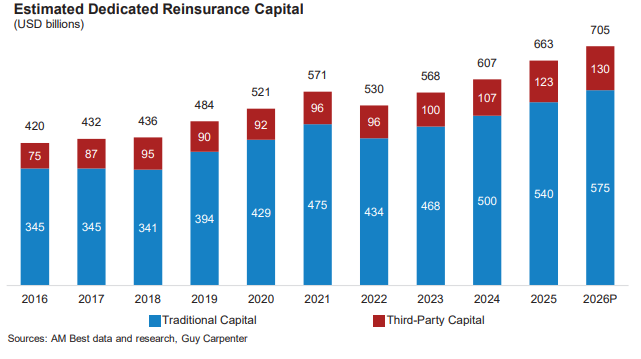
Dedicated reinsurance capital increased from $607 billion in 2024 to $663 billion in 2025 and an estimated $705 billion this year – all generated through retained earnings growth from underwriting profits, along with favorable investment returns, and growth in third-party capital participation.
More Strategic Options
“Whether this dynamic persists remains a critical question,” AM Best said, noting that reinsurers now possess a wider range of strategic options than in previous cycles.
“Almost all leading reinsurers have evolved beyond the traditional pure-play reinsurance model, operating diversified platforms that include primary insurance, specialty underwriting operations, and alternative capital businesses,” the report said.
To deploy their capital, reinsurers’ management teams may increasingly seek acquisitions, business expansions, or by increasing shareholder dividends to return capital accumulated during the hard market, AM Best said.
“These alternatives could ultimately support pricing discipline by reducing pressure to deploy capital solely within the property catastrophe reinsurance market,” added the report. “However, if competitive forces begin to outweigh these alternatives and pricing deteriorates materially, the industry could find itself, once again, with rates below adequate risk-adjusted levels.”
Related:
- Exclusive Member of Reinsurance Class of 2025: Duperreault’s Cedar Trace
- What Happened to Reinsurance ‘Class of 2023’? Hard Market Defies Age-Old Patterns.
This article was previously published by Insurance Journal. Reporter L.S. Howard is the International Editor of Insurance Journal.
 Levers and Guardrails: How Growth Is Being Built at Hippo
  Friend of Suspected FBI Data Thief Warned Teen Not to Hack Bureau
  AI Models May Soon Self-Replicate Across Smart-Home Devices, Anthropic Warns
  The Latest Launches From The Zebra, Sigo Seguros, Applied Systems