

















Arctic sea ice is shrinking in both winter and summer, with satellite records revealing that the region’s remaining ice is becoming thinner, younger, and more vulnerable to melting, according to the NASA Earth Observatory.
Researchers issued a dire warning: Despite a recent slowdown in summer losses, scientists warn that the Arctic could experience a nearly ice-free summer before 2050.
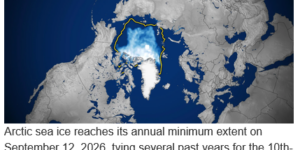
In 2026, Arctic sea ice reached its annual minimum extent on September 12, covering approximately 4.6 million square kilometers (1.78 million square miles).
According to NASA and the National Snow and Ice Data Center (NSIDC), this tied the minimums recorded in 2008, 2010, and 2025 for the 10th-lowest level since satellite monitoring began.
Satellites have continuously tracked the seasonal expansion and retreat of Arctic sea ice since late 1978, revealing a long-term decline that accelerated during the 2000s, leading to a succession of exceptionally low ice levels.
Every summer from 2007 through 2026 ranks among the 20 lowest September sea ice extents in the satellite record. The smallest extent ever observed occurred in September 2012.
Data indicates the rate of summer ice loss has not been consistent.
During the past decade, September sea ice coverage has remained comparatively stable rather than continuing its earlier rapid decline. Scientists emphasize that short-term weather conditions can strongly influence how much ice disappears in any given summer.
The changes extend beyond the shrinking area covered by sea ice. Researchers have also documented a major shift in the ice itself, which is becoming increasingly young and thin.
Historically, much of the Arctic contained multiyear ice, which survives at least one summer melting season. Because this ice can persist and accumulate over multiple years, it generally becomes thicker and more resilient than ice that forms during a single winter.
Satellite observations now show that multiyear ice has declined significantly. As a result, the Arctic is increasingly covered by thinner first-year ice, which forms during the cold months but is more susceptible to melting when summer returns.
The decline is also evident during winter, when Arctic sea ice normally reaches its greatest coverage. In March 2026, the annual maximum statistically tied the March 2025 maximum for the lowest winter peak in the satellite record.
Dur to a combination of natural climate patterns and rising global temperatures, scientists project that the Arctic Ocean could become essentially free of sea ice during the summer at least once before the middle of the 21st century.
NASA Earth Observatory. (2026, October 15). Arctic sea ice hits another troubling low in 2026. ScienceDaily. Retrieved October 15, 2026 from www.sciencedaily.com/releases/2026/10/261015073212.htm
 Why Your Boss Matters More Than Remote or Hybrid Work When It Comes to Burnout and Job Satisfaction
  Nearly 50,000 Cars Damaged by Floods This Year: CARFAX
  AI Models May Soon Self-Replicate Across Smart-Home Devices, Anthropic Warns
  Most Americans Think AI Is Developing Too Fast: Poll