

















After bypassing the April 1 deadline and engaging in weeks of debate and compromise, New York lawmakers have agreed on a $268.5 billion budget that includes auto insurance reforms championed by Gov. Kathy Hochul that are intended to reduce auto insurance costs for drivers and businesses.
The auto insurance reforms target fraud, “runaway” litigation, legal loopholes, non-economic damages and enforcement gaps in an effort to lower insurance costs. They are key parts of a $268.5 billion budget for the 2026-2027 fiscal year that seeks to tackle rising insurance, energy, housing, childcare, education and other everyday costs for New Yorkers.
The new budget is $14 billion more in total spending than the 2025-2026 budget. The new budget does not raise income or statewide business taxes.
The insurance measures include a cap on non-economic damages for drivers engaging in criminal behavior, a clarification of what constitutes a “serious injury,” changes to comparative negligence law and a crackdown on those responsible for organizing staged accidents.
The budget also has consumer protection measures prohibiting auto insurers from basing rates on homeownership status, occupation, education level or zip code; mandating insurers provide policyholders with explanations of why their premium increased; and requiring insurers to return any “excess profits” to policyholders.
Estimated Savings
A study by the Citizens Budget Commission (CBC) found the provisions should reduce a New York driver’s premium by about 10%. CBC, insurers and other supporters of the reforms have cited the success that Florida, Michigan and other states have experienced with similar reforms.
Do New Yorkers Pay Too Much for Auto Insurance?
According to CBC and the Hochul administration, New Yorkers’ auto insurance premiums are among the highest in the country. The average premium in New York in 2023 was $1,896, 32% higher than the national average, 12% higher than New Jersey, and 51% higher than Illinois.
Yet, CBC has noted, despite those high rates, insurance companies have continued to lose money on New York’s auto policies—particularly on liability claims. In 2023, insurers lost 17% on auto insurance in New York after expenses.
Deadline Extensions
The budget was supposed to be ready by April 1. But state lawmakers passed multiple deadline extensions to keep the government functioning until they and the governor could come to an agreement on its many details. Hochul had claimed three weeks ago that her office and lawmakers had agreed on the major policy issues including her auto insurance reforms. However, legislative leaders countered that there was no budget agreement yet because money issues were still to be decided.
Lawmakers Interrupt New York Governor’s Victory Lap on State Budget Agreement
Opposition to the auto insurance reforms by the state’s trial lawyers was a major obstacle, with some lawmakers arguing the insurance provisions did not belong in a budget but should be handled separately.
Trial lawyers have regularly questioned the promise of lower costs for drivers. They argued that the overall changes disadvantage crash victims to benefit insurance companies and firms like Uber. They maintained that capping damages and limiting liability will not lower rates but will mean injured people receive less compensation.
“Insurance profits must not come at the expense of justice, accountability, or the rights of injured New Yorkers,” Andrew Finkelstein, president of the New York State Trial Lawyers Association, told lawmakers.
The group Citizens Action has criticized the focus on restricting claims and damages, pointing to a study by Weiss Ratings that found large auto insurers operating in New York state “closed nearly half of liability claims in 2025 without paying a dime to policyholders.” The same report questions how closely the state has regulated insurers’ pricing, noting that since 2015, the large insurers have generated $42.3 billion in investment and other income, exceeding their $27.9 billion in net underwriting gains.
In the end, lawmakers went along with most of Hochul’s auto insurance measures while adding some consumer protections of their own.
Lawmakers are expected to pass bills that will fully enact the budget’s priorities in the coming days.
Hochul’s Victory
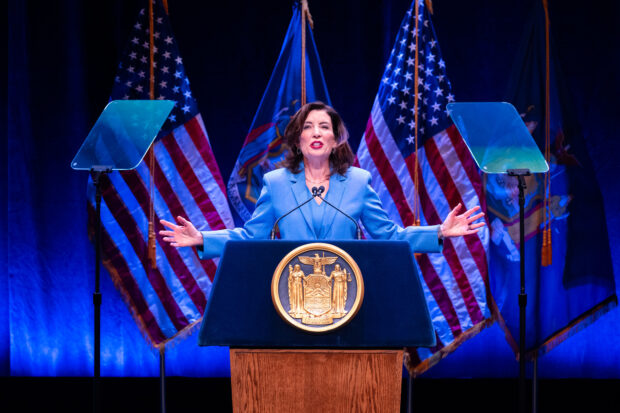
In past remarks, Hochul has singled out the fight over auto insurance as “a battle no one in the past had the fortitude to take on.”
Hochul has campaigned relentlessly for her reforms since she first announced her intention to focus on auto insurance in January.. Since then she managed to get New York small businesses, big businesses, rideshare companies, police and fire unions, insurers, insurance agents, truckers, bus companies, auto repair shops, university professors, district attorneys, mayors, immigrant and minority groups and others to support her reforms.
NY Lawmakers Urged to Have Faith in Auto Insurance Reform Numbers. But Do They?
“This is a win for every single New Yorker who relies on a car to get to work or drop the kids at school or the delivery companies that are passing on those costs,” Hochul said Wednesday in announcing the agreement.
She said the auto insurance measures will lower costs not only for commuters but also for farmers, small businesses and builders who need supplies to get their products to market or their construction projects built.
“This is what it looks like when you start tackling a problem that has been endemic and universal and start saying enough is enough,” Hochul added.
In her remarks, Hochul thanked the media for “really revealing what has been happening in some communities.” She described “a whole racket where you get lawyers, unscrupulous lawyers, who are finding individuals to play the victim, who literally cause a car accident or collision with an MTA bus or another vehicle or a delivery truck. And then they go to a doctor who’s also part of this enterprise, this criminal enterprise, who will exaggerate the extent of the injuries. So we had to also talk about the serious injury elements of the laws and the liability.”
Public Support
A statewide poll of voters, conducted by political polling firm Beacon Research, found support for Hochul’s proposals by more than 80% of Democrats, Republicans and independents, and similarly high support across every region of the state. The survey found that 60% of voters believe auto insurance fraud is common, including staged crashes and fraudulent claims.
The survey results were touted by the group Citizens for Affordable Rates (CAR) which has been advocating for the reforms. The CAR organization, which is backed by Uber, ran a $7 million ad campaign in support of Hochul’s proposals.
“This is a turning point for New York drivers. Families across this state have been crushed by sky-high auto insurance costs for years – paying nearly twice the national average while fraud and dysfunction in the system went unchecked. That’s changing now,” CAR’s James Freedland said in a statement after the budget agreement was announced.
Enactment of the budget was also applauded by the insurance industry.
“New York State is turning a corner. The newly enacted state budget tackles auto insurance fraud and excessive litigation through the most significant reforms to the state’s auto insurance laws in decades,” commented David H. Borg, chair of the insurance agents’ association Big I New York. “With these changes, we anticipate that New Yorkers will finally begin to see relief from some of the highest auto insurance costs in the nation.”
“Governor Hochul is taking an important step to fix a system that has been driving up costs for New York families for far too long,” said Kristina Baldwin, vice president of state government relations for the American Property Casualty Insurance Association (APCIA). “These reforms will promote fairness in auto accident lawsuits while discouraging abuse that ultimately raises premiums for everyone.”
The one change Hochul proposed that did not receive approval from lawmakers had to do with joint and several liability. In situations where some defendants fail to pay, the governor’s proposal would have limited the exposure of remaining defendants with the ability to pay to their share of fault.
New York’s Auto Insurance Reforms
According to the summaries by the Hochul administration, the Big I and other sources, the auto insurance measures in the 2026-2027 New York state budget include:
Serious Injury Threshold
New York no-fault auto coverage requires minimum coverage of $50,000, the highest in the country, which can lead to inflated accident claims because drivers who are “seriously injured” are permitted to sue for damages on top of their no-fault awards even if they are primarily at fault. The new budget clarifies what constitutes a serious injury as a way to restrict suits by drivers with minor or nonpermanent injuries and reserve damages for pain and suffering or emotional distress for those who objectively demonstrate they have suffered a serious injury. According to the Big I, the budget repeals the “90/180 rule,” which allows recovery based on limitations to daily activities during the first 180 days after an accident. Also, juries will be required to determine fault before considering whether a plaintiff meets the serious injury threshold.
Staged Motor Vehicle Accidents
The budget also includes provisions that enable prosecutors to seek criminal penalties against any individual responsible for organizing a staged accident, not just the particular individual behind the wheel. The budget expands the definition of a fraudulent insurance act to include those who “hire, request, encourage, orchestrate, or invite another individual” to stage a motor vehicle accident. It also holds all people involved accountable for the entire loss because of the fraudulent act.
Damages in Cases of Unlawful Conduct
Th budget caps damages for drivers engaging in criminal behavior at the time of the incident to $100,000 as a way to ensure that drivers breaking the law — including uninsured motorists, drunk drivers, and those committing a felony — don’t walk away with a jackpot payday at the expense of everyone else.
Non-Economic Damages for Those “Mostly” At Fault
In motor vehicle injury cases, the budget measure bars a claimant from recovering non-economic losses if they are more at fault than the defendant or defendants combined, but they may still receive no-fault insurance benefits. This puts New York in line with most other states, according to the Hochul administration.
Underwriting and Rating Factors
The budget prohibits Insurers from using occupation, homeownership status, education level, or ZIP code as the primary basis for setting auto insurance rates. There are some exceptions for business-use classification, mass marketing programs, and approved discounts.
Premium Increases
The budget mandates that insurers provide policyholders with clear explanations of auto and home premium increases more than 10%. The notice must include the dollar amount of the increase and the primary rating factors driving it. Policyholders have a right to request an explanation for any increase and insurers must respond within 20 days.
Excess Profits
The budget sets a threshold that prevents insurers from realizing “excess profits” and returns any savings to consumers. Excess profit is defined as underwriting gains over three years that exceed expected profit levels by more than 5% of earned premiums. Last year Progressive Insurance reported nearly $1 billion in excess profits it had to return to Florida auto insurance policyholders under a similar law. The average refund was $300.
Flex Rating
The budget prevents insurers from using “flex rating” to implement personal auto rate increases without regulatory approval. Flex rating decreases of no more than 5% without prior approval are still permitted.
This article was originally published by Insurance Journal. Reporter Andrew Simpson is a freelance writer and editor. He retired as Chief Content Officer for Wells Media Group in July, 2022 after 18 years with the company.
 EL Nino Expected to Drive Warmer Temps North While South, East Will See Wetter Conditions
  Viewpoint: The ‘Unbundled’ Insurer Emerges in Age of AI as Value Chain Fragments
  Workers’ Compensation’s Real Challenge: Orchestration
  Tech Bytes: New Partnerships at The Zebra, LexisNexis Risk Solutions