















Providing its annual report of hail-related claims, State Farm said that it paid out $5.6 billion nationally for such claims in 2025, and $1.4 billion in Texas alone.
The giant insurer’s report on hail claims includes a list of the top 10 states based on payment dollars. Comparing the list to a similar list for 2024 reveals that State Farm’s payouts for Texas hail claims jumped more than 27% year-over-year, with the countrywide total growing about 12%.
Rounding out the top three states, State Farm paid 10% more claim dollars for hail-related damage in 2025 than 2024 for the state of Missouri, which now has the second-highest total, while paying 28% less for hail-related claims in Illinois. Illinois moved down to a third-place rank from a second-place spot on the 2024 list.
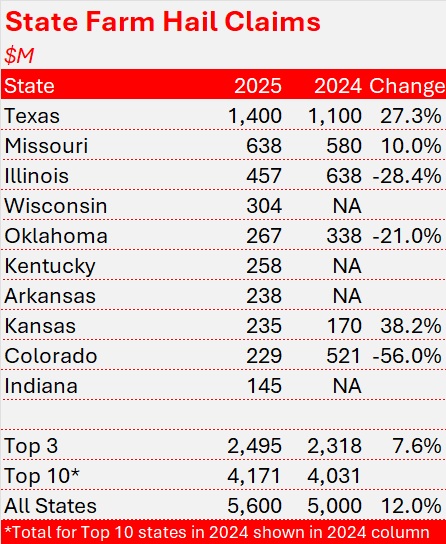
Hail-related claims were less concentrated in 2025, with the top 10 states accounting for about three-quarters of the nationwide total payouts ($4.2 billion of the $5.6 billion). In 2024, the top 10 states represented more than 80% of the total ($4.0 billion for the top 10, compared to $5 billion for the entire nation).
Wisconsin, Kentucky, Arkansas and Indiana were included in the top 10 in 2025 but not on the list in 2024, with total dollars at least doubling for the first three states. The states with the lowest level of hail claim payouts on the 2024 top 10 list—Iowa and South Carolina—each made that list with $109 million in claims paid by State Farm for hail.
Oklahoma in the Spotlight
Another hail-prone state on both the 2025 and 2024 top 10 lists—Oklahoma—saw a 21% drop in claims payouts for hail from State Farm, even though Oklahoma now has the fifth-highest total of State Farm payouts, climbing up from sixth place in 2024. State Farm recently highlighted its payouts of hail and wind claims in Oklahoma as it acknowledged media and legal scrutiny of its handling of roof claims in the Sooner State.
Putting the two-year total Oklahoma payout for both perils at over $1 billion, State Farm pointed specifically to an NBC Nightly News report about a lawsuit filed by an Oklahoma couple (Hursh v. State Farm) over two denied claims that they allege are part of a secret bad-faith scheme that is rigged against insureds. Nightly News also reported last month that Attorney General Gentner Drummond filed a motion to intervene in the case in December, which was appealed by State Farm and is awaiting final judgment from the state Supreme Court. (Source: NBC Nightly News, March 11, 2026, “Oklahoma lawsuit alleges State Farm cheats homeowners“)
State Farm acknowledged that “media reports and lawsuit allegations frame individual claim disputes as evidence of a broader, intentional effort to underpay or deny wind and hail roof claims.” This is an “accusation we take seriously and strongly reject.”
“This coverage is shaping public perception at a time when many homeowners are already stressed by storm damage, rising repair costs, and higher premiums.”
“Oklahoma’s high frequency of wind and hail events, combined with inflation in materials and labor, is a major driver of homeowners insurance cost pressure statewide,” State Farm said in a March 12 statement.
State Farm explained that the Nightly News report described two insurance claims filed by the Hursh family, Oklahoma residents who paid $22,000 out of pocket to replace a roof damaged by separate weather events in October 2023 and May 2024. “State Farm promptly and properly investigated each claim, denying one claim as uncovered damage, and in the second, the covered damages were below the deductible,” State Farm said. “The NBC narrative is inaccurate and misleading. A single homeowner dispute—or even multiple lawsuits—does not prove a ‘scheme.'”
“Allegations in litigation are just that: allegations, driven by billboard attorneys,” the statement posted on State Farm’s website continues, dismissing the media report as “indicative of the political environment” and as a “distraction from the real solutions” needed in Oklahoma.
“When damage is covered, we pay. When coverage doesn’t apply, we explain why and remain willing to consider any additional input from the insured,” State Farm reported.
(Editor’s Note: Separately, Oklahoma Watch, a non-profit local news entity dedicated to investigative journalism, recently reported on another lawsuit filed by a retired judge, alleging that a request to review an adjuster’s report was denied by State Farm. Prior to the NBC News report, the Oklahoma news organization has been following the Hurst case since late last year.)
Built to Serve Customers
State Farm said in its March 12 statement, “We’re built to serve customers, not chase short-term gains,” describing the objectives of a mutual company as distinct from publicly traded competitors. “Our focus is collecting enough premium to pay claims and remain financially strong so we can keep our promises especially after catastrophic weather.”
In yesterday’s statement tallying up hail claims across the country, State Farm said, “Hail is one of the most frequent and costly weather hazards in the U.S., causing major damage to homes, vehicles, and property.”
Already in 2026, March storms fueled more than 50,000 claims in the Midwest, the insurer reported. “On March 10 alone, the National Weather Service reported more than 650 hail events across nine states, including Texas, Kansas, Missouri, Oklahoma, Illinois, and Iowa—six of the top states for State Farm hail claims paid last year,” State Farm noted.
In the media statement, State Farm goes on to advise property owners in hail-prone areas about the importance of knowing information about their roof age, material, and condition and about their insurance policies.
“Regular maintenance and inspections can reduce damage and costs. Work with your insurance agent to ensure you have the right coverage before a storm hits,” State Farm recommends.
In the statement, State Farm also offers tips about avoiding contractor scams, choosing impact-resistant materials and delivers a checklist for storm preparations (checking for loss or damaged roof shingles, securing windows and doors, trimming trees, etc.)
The final tip: “Document Your Property: Take photos or videos of your home and belongings for insurance purposes in case of damage.”
In late February, State Farm reported an underwriting gain of $1.5 billion for its property/casualty businesses in 2025, representing a turnaround from an underwriting loss of more than $6 billion in 2024—and more than $10 billion of underwriting losses in each of the two prior years. While the overall return to profitability prompted State Farm to announce a $5 billion payout of dividends to policyholders, the giant personal lines insurer’s homeowners underwriting results were still written in red ink, with the carrier reporting a homeowners and commercial multiperil combined ratio of 108 for 2025.
Related articles: State Farm Inked $1.5B Underwriting Profit for 2025; HO Loss Persists; State Farm Mutual to Pay $5B Dividend to Auto Insurance Customers
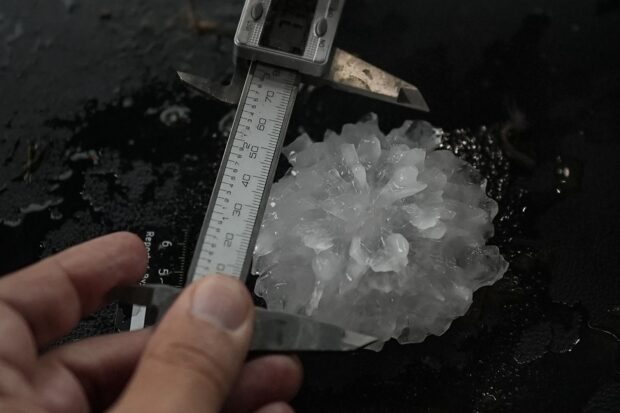
Featured image: Forensic engineer Tim Marshall measure a large hail shaped like a rose between the front seats of Northern Illinois University’s Husky Hail Hunter during a Project ICECHIP operation Friday, June 6, 2025, in Morton, Texas. (AP Photo/Carolyn Kaster)
 Weather Damage Turning Into Long-term Debt for Homeowners: Report
  Highway Safety Agency Plans to Revise Outdated Vehicle Lighting Rules
  The Latest Launches from Vertafore, One Inc., Qumis
  Sedgwick: Property Claims Face Delays, Are Growing More Complex