















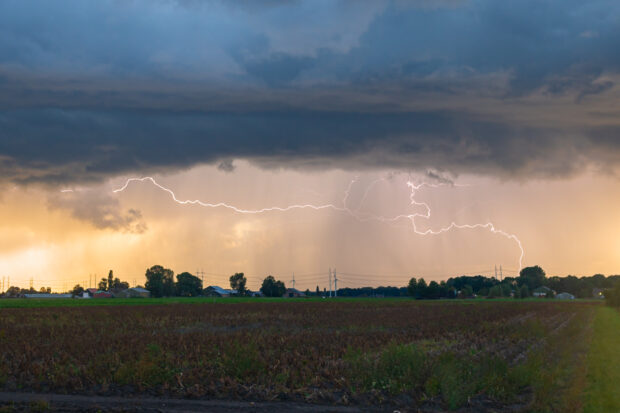
Severe convective storms (SCS) were once referred to by the insurance market as a secondary peril. This classification has since changed to “frequency peril,” as in recent years they drove over $50 billion in annual insured losses in the United States, redefining loss levels that were once catastrophic as now the new norm.
Executive Summary
Severe convective storms have shifted from a “secondary peril” to a high-frequency driver of U.S. property losses, routinely producing $50B+ in annual insured losses—driven less by meteorology than by expanding suburban exposure, elevated repair/rebuild costs, and more vulnerable features like rooftop solar, writes Moody’s Tom Sabbatelli-Goodyer.As losses have climbed, catastrophe models are being transformed to offer more precise resolution suited for small-scale, localized events, and AI and aerial imagery are filling in past data gaps. These support insurers’ efforts to reduce loss severity by offering incentives for mitigation efforts, such as using impact-resistant building materials and to fine-tune underwriting—to find “good risks” even within traditionally restricted zones.
SCS are damaging thunderstorms which, depending on local atmospheric conditions, can bring destructive hail, tornadoes or intense straight-line winds. Despite their meteorological definition, our research shows that the forces behind this escalation in losses are anything but weather-related.
At a macro level, nationwide insured losses are increasing due to expanding (sub)urban areas and growing exposure. The underlying force is simple: the construction and demographic changes of the 21st century, including a 20% expansion in U.S. housing stock and suburban sprawl, has placed more buildings in harm’s way.
Down to the asset level, rising rebuilding costs are increasing repair bills post-event. Following sharp increases during the COVID-19 pandemic, reconstruction and material costs remain elevated, with key materials like lumber and asphalt now about 50% more expensive than a decade ago, according to the Bureau of Labor Statistics Producer Price Index. The increased expansion of rooftop solar panels is adding highly damageable features to buildings already vulnerable to hail damage. If significant losses occur at a regional scale, the demand for material and labor could lead to short-term price increases that exacerbate the repair costs even further.
In total, all of these factors drive higher loss frequency and more frequent billion-dollar outbreaks, increasingly straining insurers and businesses. In response, policyholders are likely experiencing one or a combination of: increasing premiums, increasing deductibles, decreasing limits or cosmetic damage exclusions.
The silver lining in the thundercloud is that these dynamics, coupled with advances in computing power delivered by risk management firms, are transforming the modeling of SCS risk in the insurance industry. Despite their high impact, SCS events have historically been challenging for insurers to accurately and comprehensively model due to their small scale and highly localized structures. But with losses piling up and legacy catastrophe models no longer keeping pace, insurers required more precise modeling to price, underwrite, manage and encourage mitigation against risk before losses climb further.
Newer, high-definition SCS models offer more precise geographic resolution and realistic claims simulation, helping carriers better understand their risk hotspots and make informed risk selections.
Rising losses have also renewed efforts to supply catastrophe models with data that accurately describes a building’s structural features. Although models have always supported this data capture, key information such as year of construction, roof age, roof covering and construction quality are often unavailable or incomplete across the market. Without this detailed information, models may genericize risk estimates based on average property conditions, an assumption that may be costly.
The rise of artificial intelligence and aerial imagery are helping fill the data gap. As these images are taken over time, carriers can understand current and evolving building features that set exposures apart from neighbors, with the potential to increase or decrease modeled risk estimates. This data could also identify “good” risks—that is, properties with low loss potential that exist in zones traditionally excluded by underwriters.
Models also enable cost-benefit analyses of mitigation measures that policyholders can take to reduce their vulnerability. With these analyses, insurers can support their customers affected by rising premiums by offering discounts if specific mitigation criteria are met. State and local policymakers can likewise more effectively address matters such as building codes and land-use planning to look to strengthen community level resilience while reinforcing the need for better risk visibility and adaptation efforts.
All indications show that insured SCS losses have increased by around 10% annually over the last decade. The question is, will insurers allow that trend to continue?
While cost inflation and shifting claims behavior continue to promote volatility, insurers can work with policyholders to capture more accurate exposure data, enter this data into catastrophe models, and offer incentives to employ impact-resistant building materials that reduce loss severity.
The surge in severe convective storm losses signals a structural shift, in which the industry no longer treats as temporary or low priority. Losses are accelerating, and the decisions made today will shape the next era of severe weather impact.
 Levers and Guardrails: How Growth Is Being Built at Hippo
  The Latest Launches from Vertafore, One Inc., Qumis
  Why Your Boss Matters More Than Remote or Hybrid Work When It Comes to Burnout and Job Satisfaction
  U.S. Power Use Expected to Reach Record Highs in 2026, 2027 as AI Surges