

















The insurance industry is entering a phase of artificial intelligence (AI) adoption where the primary constraint is no longer capability.
Executive Summary
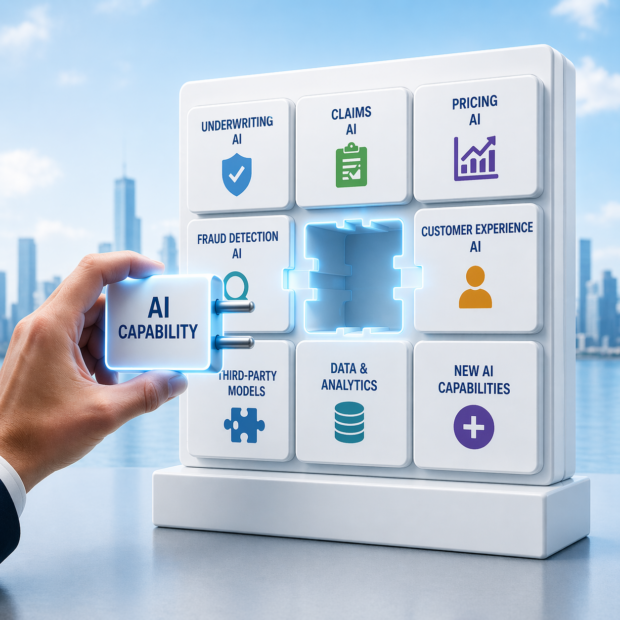
Insurance industry participants need to be building for change, Finys CEO Kurt Diederich believes, revealing parallels between the proliferation of InsurTechs delivering AI tools and the growth of Internet companies in the early 2000s—many of which did not survive. "Carriers that approach AI as a static investment risk are accumulating technical and operational constraints," he writes, supporting his view that a better approach is to "treat AI as a modular capability" that is part of a "plug-and-play operating model," allowing carriers to evaluate, implement, and replace components with minimal disruption as conditions evolve. Here, he also provides tips on designing adaptable systems and testing approaches for AI components.Most core use cases, including submission intake, underwriting support, claims triage, document processing, and customer service augmentation, have already been developed. Many carriers are not deciding whether AI can be applied but determining which solutions merit implementation and how those decisions should be managed over time.
This distinction matters. The challenge has shifted from innovation to selection and, ultimately, to lifecycle management. Given the pace of change in the InsurTech ecosystem, any given solution may be superseded or displaced within a relatively short time. This dynamic is not without precedent.
In the early 2000s, the rapid proliferation of Internet companies created a similarly crowded and volatile landscape, where only a small percentage of vendors ultimately proved durable. The current AI market is exhibiting comparable characteristics, with a high volume of entrants, uneven differentiation, and ongoing capability leapfrogging.
Carriers that approach AI as a static investment risk are accumulating technical and operational constraints that limit their abilities to adapt as the market consolidates and evolves.