













Late last month, State Farm General Insurance Company announced enhanced commitments to customers impacted by the 2025 Los Angeles Wildfires, but the California homeowners insurer’s actions were too late to avoid legal action from the state’s regulator.
The California Department of Insurance announced yesterday that it is taking action against the California affiliate of personal lines giant State Farm Mutual Automobile Insurance Company, following an investigation reportedly showing that the carrier has been mishandling wildfire insurance claims.
A CDI filing alleges violations of the Unfair Insurance Claims Practices Act, including 398 violations identified in a market conduct examination.
Last June, the CDI and California Insurance Commissioner Ricardo Lara ordered the market conduct examination based on consumer complaints that they say documented a pattern of unlawful behavior in more than half of the claims reviewed.
Related: Public Interest Groups Backing California Homeowners Insurance Bills
According to the CDI, State Farm policyholders filed roughly 11,300 residential claims related to the LA wildfires, accounting for nearly one-third of all claims filed across all insurers.
Lara and the CDI say their investigation found that State Farm delayed, underpaid, and “buried policyholders in red tape.” The CDI reportedly reviewed a sample of 220 claims and found 398 violations of state law in 114 (52%) of the claims.
In late April, State Farm issued a statement affirming State Farm General’s support of California’s recovery from the fires, outlining five specific commitments to customers based on their feedback, third-party research, and “lessons learned on the ground.” The first two steps—assigning single points of contact and regularly communicating with customers—would seem to address two of the types of violations the CDI outlined in its enforcement action yesterday. Among other violations, the CDI action specifically identifies the “assignment of multiple adjusters causing policyholder confusion” (as many as 12 in one documented case), and “inadequate and delayed communication with policyholders.”
As part of its stated commitments, State Farm General said it has assigned an executive to handle customer relations for California and noted that the company handled more than 11,300 claims and has paid out more than $5.7 billion.
State Farm responded to a request for comment on the CDI’s action yesterday via email, stating that it strongly disagrees with the Department’s characterization. “Wildfire survivors deserve real solutions—not a distorted picture of State Farm’s response…. We reject any suggestion State Farm engaged in a general practice of mishandling or intentionally underpaying wildfire claims, and we will respond through the process.”
The response calls out the state’s homeowners insurance market as “the most dysfunctional in the country.”
“The state is facing an availability and affordability crisis, and the California Department of Insurance should take responsibility for regulatory delays and uncertainty that have contributed to fewer choices and higher costs for consumers. The Department’s approach is adding uncertainty to a market that already lacks predictability, discouraging participation and leaving Californians with fewer coverage options when they need them most,” the statement continues.
The response was repeated in a lengthier comment posted on the State Farm website headlined, “State Farm is There for Customers, Rejects CDI Allegations.” Responding to the first prayer for relief listed in the CDI filing—a prayer for an order suspending the company’s certificate of authority for a period not to exceed one year—State Farm’s website post also says, “The threat to suspend State Farm General’s ability to serve customers over primarily administrative and procedural errors is a reckless, politically motivated attack that could ultimately cripple California’s homeowners insurance market.”
The CDI action also seeks millions of dollars in penalties and is requiring State Farm to take corrective actions to speed up payments and resolve outstanding claims. Under California Insurance Code Section 790.035, penalties may reach $5,000 per violation, or $10,000 for willful violations.
According to the CDI’s market conduct investigation: State Farm failed to begin investigating claims within 15 days and failed to accept or deny claims within 40 days; made unreasonably low settlement offers and underpaid claims; failed to assign adjusters within statutory timelines; and failed to provide written denials for hygienist and environmental testing.
CDI Findings
“Our investigation found that State Farm delayed, underpaid, and buried policyholders in red tape at the worst moment of their lives. That is unacceptable, and we are taking decisive action to hold them accountable,” Commissioner Lara said.
State Farm Responds
“Using a thin sample of claims to justify sweeping allegations turns regulatory oversight into a political weapon, creating headlines instead of delivering facts and real consumer protection,” State Farm said, referring to the sample of 220 files reviewed for CDI’s market conduct exam and the 11,300 claims received by the insurer.
State Farm added that “most of the issues cited [by CDI] were administrative or process-related—such as notices or letters sent after statutory requirements, documentation, or payee information— not broad failures to pay covered claims.”
Smoke damage claims have emerged as a point of contention between some carriers and consumers. Following the LA fires, Lara created the Smoke Claims and Remediation Task Force, which found wildfire victims were falling through the gaps in smoke damage inspection, testing and restoration rules. A bill to create a statewide framework for handling wildfire smoke damage claims is now making its way through California Legislature.
As of March 3, insurers have paid out more than $23.7 billion to residential, commercial, and auto policyholders impacted by the LA wildfires, according to the CDI.
In recent years, several carriers pulled back or halted writing new policies in the state, and regulators responded with measures including quicker rate request reviews, allowing forward-looking catastrophe modeling and other steps. As a result, some carriers have returned to writing new homeowners policies.
The Travelers Companies last week said it intends to expand its homeowners insurance offerings across California. In January, two carriers announced they were working to expand coverage in wildfire-prone regions of the state in exchange for rate hikes. CSAA Mercury Insurance raised rates 6.9%, a move that was approved under the Sustainable Insurance Strategy. Farmers Insurance in late November announced it would eliminate a cap on the number of homeowners insurance policies it offers in California.
Related: Travelers to Expand Homeowners Insurance Offering in California
For its part, State Farm General also included other customer commitments in its April 22 statement, such as helping customers rebuild stronger to prepare for future wildfires, protecting its own financial strength and being a long-term partner in community rebuilding. The announcement of the five commitments was accompanied by a fact sheet stating the 70% of the 11,300 wildfire claims State Farm General received have closed, and that 98% of claimants with open claims have received payments.
“Open claims often represent significant life decisions customers are making about how to move forward,” the fact sheet says, reporting that 95% of customers with open claims are making decision about rebuilding, relocating, and receiving ongoing benefits like additional living expenses. “Decisions about the future take time. State Farm supports people instead of rushing them to close a claim,” the report says.
Fourteen of the 20 most destructive wildfires in California have occurred in the last 10 years. The January 2025 Los Angeles wildfires, which included the Eaton and Palisades fires (the second and third worst in state history) that cost several large carriers in excess of $1 billion, are seen as a tipping point for the state’s insurance crisis. In response to the LA wildfires, several regulatory changes have been enacted and numerous pieces of state legislation were passed or are making their way through Legislature.
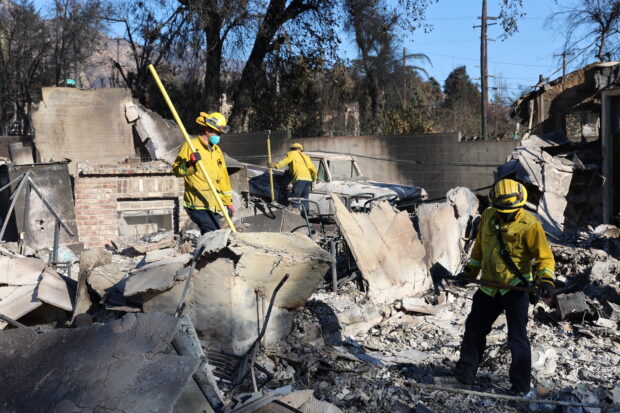
Top photo: 2025 Eaton Fire. Photo by CalFire.
A version of this article was originally published by Insurance Journal. Reporter Don Jergler is the West Coast editor of Insurance Journal.
 Why Your Boss Matters More Than Remote or Hybrid Work When It Comes to Burnout and Job Satisfaction
  Push to End U.S. Changing Clocks Hits Dead End
  Laws to Protect Workers from AI Risks Signed by California Governor
  AI Data Center Boom: Understanding How Risks Are Changing