

















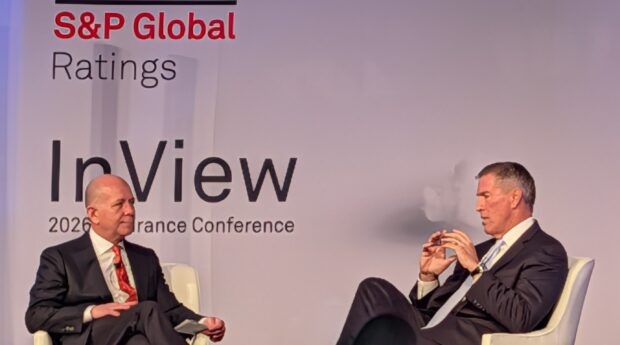
Eric Andersen doesn’t have any more insight into what the next five years will look like than his peers, but the message he delivered to them about the industry’s role in a changing world is clear: The readiness is all.
The chief executive officer of AIG didn’t exactly use that Shakespearian phrase during a CEO Insights session at the S&P Global Ratings 42nd Annual Insurance Conference in early June. But his opening and closing remarks in response to questions from Moderator Lawrence Wilkinson, an S&P managing director, had a similar theme—calling on property/casualty insurers and brokers to remain relevant, in part, by educating alternative capital providers to take on risks the industry can’t handle alone, such as data center risks.
After discussing the evolving role of brokers, insurers, MGAs and insurance-linked securities market participants, Wilkinson specifically asked Andersen to describe the biggest changes he sees ahead for the industry over the next few years.
Turning the clock backward a few years first, Andersen said, “Who knew COVID was going to happen? Who knew Russia and Ukraine was going to happen? Who knew the Middle East conflict was going to happen in the format that it is happening? You’ve got GLP-1 [drugs], and then you’ve got AI… All of that in the last five years.”

“I couldn’t have predicted anything,” said Andersen, who took the helm of AIG on June 1 this year. “What happens in 2031? I don’t know if I can answer that question well. What I would say, though, [for] AIG [and the] industry is we have to be ready…”
“The role we play in the global economy is to help our clients navigate risk. …We want our clients to make investments for their businesses, but nobody will make an investment without protection to that investment … Our ability to help our clients, across industries and across the globe, to have confidence” to make investments that lead to innovation “requires that our company is ready to be with them in that process.”
To Andersen, a former broker leader, insurer readiness means having industry expertise, having technical expertise, having global reach and being in a strong financial position to be able to take risks with customers. Earlier in the session, he noted a growing gap between the AIGs of the industry and insurers who are less ready to prepare for “relentless” AI transformation that will happen over time. He also spoke about the industry’s role in educating “new capital” to tackle the insurance industry’s greatest current opportunity: helping to manage an aggregation of data center risks.
As clients become more innovative, “it puts on us” a responsibility “to be more innovative and more creative with them to be able to help them make those decisions.”
Underscoring his point about readiness, he said, “Our biggest risk is that we’re not as relevant … We need to make sure we’re keeping pace with our clients—that we can stay with them as they innovate.”
Biggest Short-Term Opportunity: Data Centers
The CEO described data centers as the biggest short-term opportunity for the insurance industry. “It’s not just U.S. … This is a global phenomenon,” he said.
But even global insurers cannot provide the total capacity for aggregation of risks involved with data center development. “It’s everything from permitting and credit all the way through to operations. It has construction [risk], marine. It has cyber. It has liability.”
Some clients build data centers and start to operate them while building a new one the next week, he reported, describing “a complex ecosystem” that insurers attack in two ways. Some monoline insurers just want to write property. “That has not been our approach. What we would like to see is a more holistic discussion,” helping hyperscalers think through everything from the financing all the way through to the operations—and where these clients “actually need us to play.”
Insurers and reinsurers are having deep conversations to understand risk aggregation and interconnectedness for data centers. The understanding, he said, gives the industry an opportunity “to continue to educate new capital—[to] be able to explain to them what the risk parameters look like, what the return hurdles look like as a way to draw them into the business.”
“When you look at just capital of the core insurance P/C insurance space, there is concern that we’re not able to solve the limit capacity issues that these clients want,” he said.
“There’s a lot of work going on behind the scenes drawing new capital into the industry,” he said, noting that outside capital is “effectively benefiting” the industry’s underwriting and risk knowledge. “We’re essentially teaching them and bringing them in. [And] once they get comfortable, [that] has long-term impacts in terms of the ability to use that capital for bigger issues down the road.”
Brokers vs. Brokers; Insurers vs. Insurers
As for the direct impact of evolving technology and data inside the insurance industry—in making brokers and insurers more efficient—Andersen, who held leadership roles at Aon before joining AIG, said neither group has an edge over the other.
Data insights allow brokers to give better advice to their clients and allow insurers to understand portfolios better. “It allows them to innovate better because they have a better understanding of the risk and the portfolios.
“So, I don’t view it as across-the-channel conflict. I view it as conflict inside the channel.”
Explaining the view, Andersen said, “If you’re a broker, you are competing with other brokers around technology, around client tools, around insight to advise your client better. And if you are an insurer, you’re using technology to get speed of how you underwrite, speed of claim service–you have to improve the client experience and the colleague experience.”
“That technology race will go on, and we will compete with our fellow insurers to do that,” the AIG executive said, noting that technology has put additional participants into the two “swim lanes.” Managing general agents, for example, now use technology and data and analytics to “start their own thing and draw capital in to support them.” Referring to the ILS market, he added that “new forms of risk takers [have] come into the market using technology and data analytics to understand risk that they really had no access to or insight” into.
“I don’t think the swim lanes cross. I think there’s just more player[s] for each side,” he said.
Scale Matters
Asked by Wilkinson to discuss where AI has the most meaningful impact on the industry, Andersen went on to describe a gap between “big global players”—both brokers and insurers—and the rest of the industry. “There is a resource question that I’ve been trying to work through in my head,” he said, noting that only the big global players are talking publicly about what they’re doing with AI. “If it’s just the top 10 insurers and brokers that have the resources to make these investments, to do these pilots, to partner with the providers, [then] there’s a scale question that comes into play if you are not one of those players.”
“And as we [global players] iterate and get better and better,… I do think you’re going to see a gap of the haves and the have nots,” he said, noting that no service provider has emerged from which the smaller companies can borrow resources. He drew an analogy to business process outsourcing businesses that helped smaller companies gain efficiencies in the past.
“That doesn’t exist yet today” for AI, which means the smaller players are left behind unless and until someone comes along to help them. “The degree of investment required is challenging for them,” he said, noting that AIG has gone “headlong into the core of the business”—underwriting and claims—with its AI transformation.
In underwriting, he said, AIG started with data ingestion. “How do you actually get the information together? How do you get it quicker?” How do you automate “what used to be a manual back and forth between broker and underwriter” by using AI “to populate fields of information that essentially would take weeks to do—and sometimes never happen?” said the former broker executive.
“When you introduce agentic AI, now the question becomes how do you take not just the data ingestion, but how about our modeling capability and our terms and conditions and our pricing—and how do you pull all that together to give the underwriter the opportunity to quickly get to a submission and make a better decision on a higher-end analysis as opposed to spending so much time pulling it all together.”
Essentially, Andersen said AI is creating enormous opportunity for AIG underwriters to get through more submissions. On top of that, he believes it allows the insurer to control terms and conditions better also, noting that AIG pilots are surfacing the higher-end work to humans.
Related article: AIG: Turning One Human Underwriter Into Five, ‘Turbocharging’ E&S
Underwriter experience is improved as well, he suggested. “If you had 10 underwriters sitting up here, nobody would say they love to go to three different systems and piece together information and call a broker that’s not calling them back. All of that becomes very much simplified at much faster speeds.”
“You start to see patterns—what contract language isn’t working, what’s creating ambiguity, and then how do you take that insight and bring it back to the front so that you improve the product and the service that you’re offering to the clients.”
Similarly, in describing the use of AI in claims work, he noted that adjusters have better experiences because they can get back to clients faster. “I think [AI] will help us understand where there are faults in the policy form at the beginning,” he added. “You start to see patterns—what contract language isn’t working, what’s creating ambiguity, and then how do you take that insight and bring it back to the front so that you improve the product and the service that you’re offering to the clients.”
Bottom line, Andersen said, “For us, we’re looking at this not as an expense play. It’s an efficiency play so we can do more. And it is very much centered around our colleagues because we want them to have these tools to be better at what we do, not to replace them.”
He continued: “I do think ultimately there is a relationship aspect to this business that is still really strong, and the ability for our underwriters to be out more with clients and brokers, understanding the industry issues better, will give us a competitive advantage. That’s why we’re making [AI] investments.”
Responding to a question about the ups and downs of technology bubbles, Andersen agreed that the benefits of AI might seem underwhelming in the short term. But the promise is there longer term.
“We’re learning every day by using our pilots in our mid-market business and some of our E&S businesses. I see what we are learning and it does give [me] cause for confidence that over time it will make us a materially better insurer.”
“It may not be tomorrow. It might be a year from now. It might be three years from now. But it’s a relentless transformation that will happen over time.”
 Weather Damage Turning Into Long-term Debt for Homeowners: Report
  Be Mindful: How Workplace Hierarchy Can Shape Even Positive Interactions
  Amazon Cargo Plane Pilots Weren’t Warned About Wind Before Miami Crash: NTSB
  Why Your Boss Matters More Than Remote or Hybrid Work When It Comes to Burnout and Job Satisfaction