


















Spring is not around the corner. It’s more than a month away Punxsutawney Phil predicted on Monday.

But what is going to happen to conditions in property/casualty insurance market?

What lines will experience more softening in 2026? Are insurance prices high enough? Where will combined ratios land? Where are the best opportunities for top-line growth? Will insurers compete away personal auto insurance profits? How will insurers use AI and how will it impact jobs in the industry?

Executives of property/casualty commercial insurance and reinsurance companies offered their prognostications to answer some of the questions during earnings conference calls in January, indicating that even though premium growth looked weaker in the fourth-quarter last year, they’re taking market changes in stride. Diversified portfolios offer promise for 2026, and technology will make them more efficient, fueling more growth, they say.

Below, we share a snapshot of key financial results for P/C insurers and reinsurers that reported fourth-quarter and full-year 2025 in January to gather some more clues about what lies ahead, followed by excerpts from executive commentary on the most recent January conference calls—AXIS Capital, The Hartford and Selective. (Editor’s Note: Subheadings in this article flag sections related to each individual carrier to help readers navigate through the text by skipping to the section most helpful for benchmarking.)

For commentary from executives of other insurers that hosted January conference calls, refer to these related articles:

The Early Returns

On average, the collection of seven publicly traded North American insurers that reported on last year’s earnings in January recorded 5% growth in fourth-quarter 2025 net premiums over the level reported in fourth-quarter 2024, together with just over one point of improvement in the fourth-quarter combined ratio.
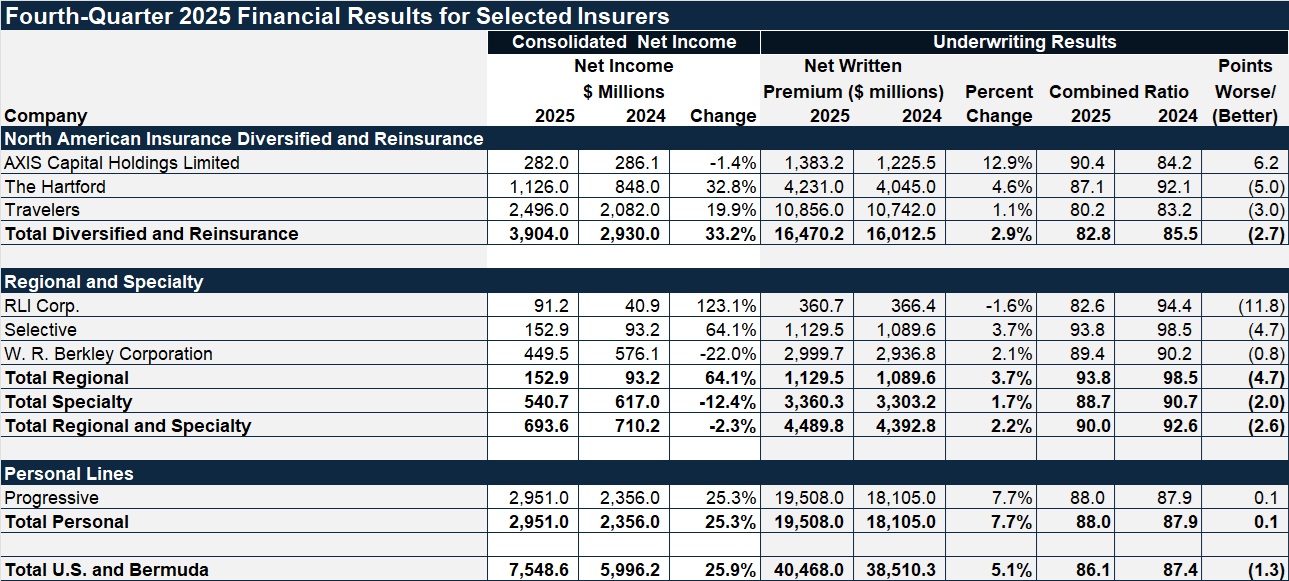
The figures for the fourth quarter were weaker than full-year results. For the year, average growth for the cohort neared 8%, and combined ratios improved two points.
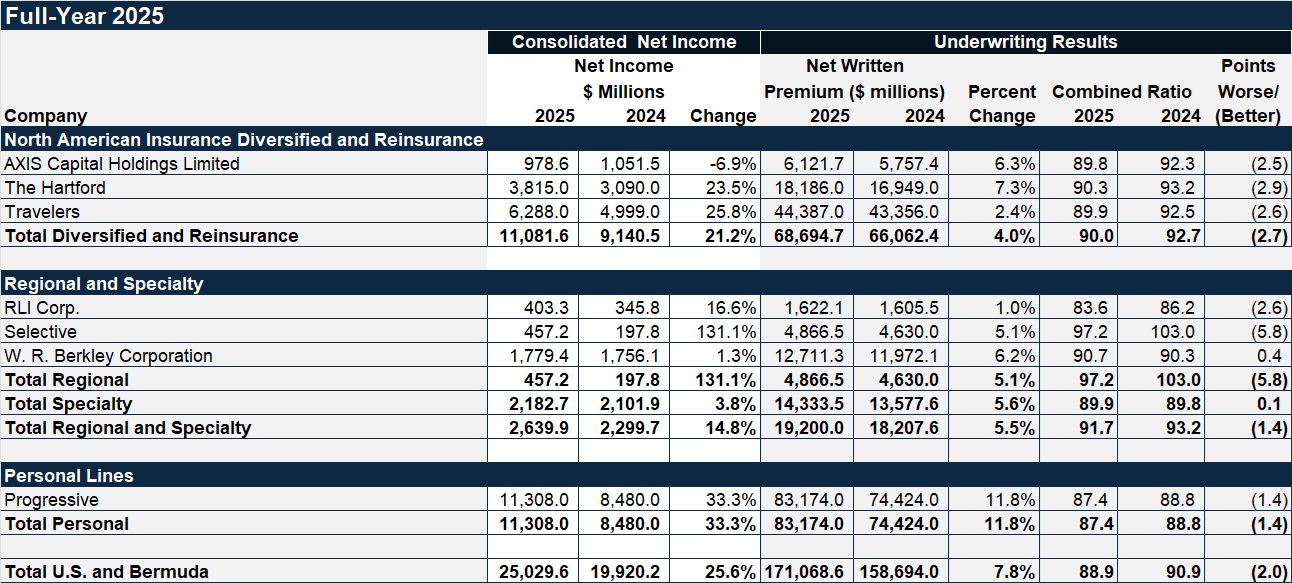
In both the fourth-quarter and full-year periods, these companies all reported combined ratios below breakeven, with most below 90. The average 2025 combined ratio was roughly 89 for the seven insurers, compared to nearly 91 in 2024.

In 2024, the U.S. P/C insurance industry as a whole recorded net written premium growth of 8.7 percent and an overall average combined ratio of about 96.5, according to AM Best and Verisk.

The only carrier of the seven early reporters to record double-digit growth for the full year last year was Progressive, with the 11.8% jump in premiums coming mainly from 15% increase for personal auto rates. Progressive’s fourth-quarter 2025 premiums growth dropped to single-digits, rising 7.7% above fourth-quarter 2024 levels, and the combined ratio stayed flat about 88.0. While Progressive’s business is mainly personal lines, and heavily weighted toward personal auto, other carriers with more balanced personal and commercial lines books of business and greater proportions of their personal lines books in property (Travelers and The Hartford, for example), reported slower personal lines growth than Progressive for the full year, and dips in personal lines premiums for the fourth-quarter.

On the commercial lines side, year-over-year changes in fourth-quarter net premiums ranged from a 1.6% drop for specialty insurer RLI to a jump of 12.8% for AXIS Capital.

“We don’t measure success by how fast we grow,” said RLI’s Chief Executive Officer Craig Kliethermes on an earnings conference call. “We measure it by how well we grow and whether today’s decisions stand the test of time,” Kliethermes stated, noting that market conditions remain competitive in specialty insurance.

Related article: RLI Inks 30th Straight Full-Year Underwriting Profit

Speaking specifically about rate changes on policy renewals, Travelers CEO Alan Schnitzer said renewal premium change for business insurance was up 6.1% (excluding national accounts), with auto, commercial multiple peril and umbrella in double-digits territory. Separately, W. Robert Berkley, Jr., CEO of W.R. Berkley said fourth-quarter rate growth for the lines his company writes other than workers compensation were up just over 7% on average.

(Related articles: 20,000 AI Users at Travelers Prep for Innovation 2.0; Claims Call Centers Cut; We’re No Longer Pressured to Push for Rate ‘Across the Board,’ Berkley Says)

The table below captures specific renewal premium and rate changes reported by executives for individual lines and account sizes.
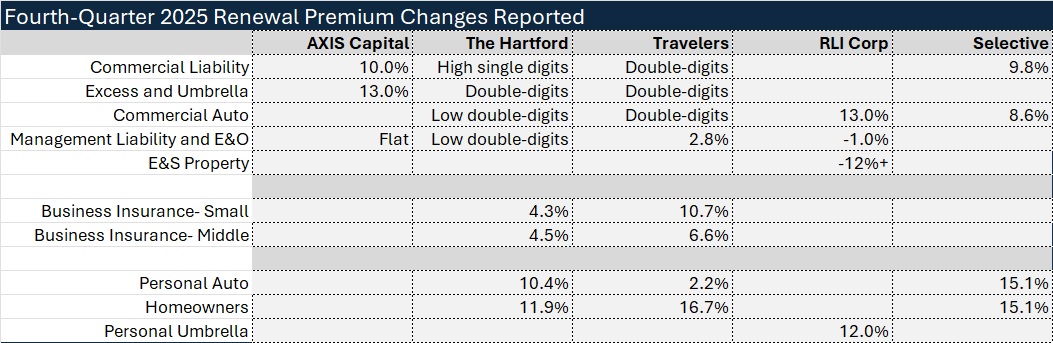
+ RLI COO Jen Klobnak said that hurricane rates dropped 12% and earthquake fell 15%. Executives of other companies generally said property pricing varied, calling out “shared-and-layered” large account business and E&S property as the most competitive areas. The Hartford executives attributed lower overall rate growth on small buiness accounts to “moderating” property pricing for package policies.

Reports of specific rate changes for property lines was sparse, with executives using words like “moderating” and “varied,” and generally calling out shared-and-layered large accounts as the most competitive area of the market. Only one insurer, The Hartford, was specifically asked to address the impact of Winter Storm Fern losses so far. The insurer reported less early claims activity compared to winter storms of recent years, before Verisk and KCC issued industrywide estimates of $4 billion and $6.7 billion.

Related articles: What Analysts are Saying About the 2026 P/C Insurance Market; Q4 Global Commercial Insurance Rates Drop 4%, in 6th Quarterly Decline: Marsh

AXIS Capital: Expanding Insurance Business, Declining Re Book

The highest growth figure recorded by any of the carriers in the fourth-quarter and full-year comparisons was a nearly 13% jump in fourth-quarter net written premiums for AXIS Capital. The Bermuda-based insurer and reinsurer also reported 6% growth for the full year.

With roughly three-quarters of the book in insurance rather than reinsurance, CEO Vincent Tizzio attributed the growth to mainly to “new and expanded classes of business” during an earnings conference call. In fact, Tizzio said that nearly $150 million of added premiums in the fourth quarter came from these classes alone. (Gross insurance premiums grew by nearly $200 million in the quarter.)

“We leaned into attractive specialty markets, drove increased profitable growth that was largely propelled by our new and expanded business classes, and further enhanced our operating efficiency,” Tizzio said, summing up some contributors to 2025’s 18% operating return on equity and an 89.8—the lowest recorded for the company since 2010.

“Our growth has been bolstered by our highly premium-adequate, lower middle market units, both in the U.S. and U.K.”

Vincent Tizzio, AXIS Capital

Looking ahead, retiring Chief Financial Officer Peter Vogt said AXIS expects mid‑ to high‑single‑digit insurance growth in 2026. On the other hand, “our overall reinsurance gross premiums could be down in 2026, even up to double digits,” he said, referring to forecasts for a liability and specialty-focused reinsurance business in a competitive mark.

“We maintain a cautious and highly selective stance in professional and liability, and our caution has only escalated, reflecting our view of a misalignment of risk and reward,” Tizzio said, referring to increasingly challenging reinsurance market conditions for bottom-line focused company.

While stressing the underwriting discipline being maintained in the insurance businesses, the executives explained insurance growth with reference to contributions from units of the company dedicated to lower middle market accounts—in particular, property insurance growth for middle market business—and the launch of AXIS Capacity Solutions, a third-party capital unit, last year. The ACS unit is “dedicated to developing and supporting structured, and multi-line portfolio capacity deals on both a facilitated and delegated basis,” according to an announcement last year.

A culture of “strong cycle management” continues, Tizzio said, referencing actions to cut back on some primary casualty, cyber and public D&O writings at AXIS in recent years.

He reported varying market conditions across the lines of business in which AXIS participates today.

  • Liability rates were up 10% in the fourth quarter, an AXIS grew 6%
  • In U.S. Excess Casualty, AXIS generated a 13% rate increase and 4% growth.
  • AXIS grew its property book by 12% across eight underwriting units worldwide, experiencing different degrees of competitive pressure. “Our growth has been bolstered by our highly premium-adequate, lower middle market units, both in the U.S. and U.K., as well as by taking advantage of the innovation we’ve brought to the market through ACS,” Tizzio said.
  • In professional lines, AXIS grew 19% although rates were flat, Tizzio said, explaining that the high rate of growth was attributable to transactional liability and new and expanded E&O lines, including allied health, miscellaneous E&O, and enhancements to a design professionals offering.
  • Without revealing a number, Tizzio reported “solid growth” in the private D&O business.
  • “We… do not see cyber as a growth area for the foreseeable future unless a better risk-reward outcome is realized,” he said. Increasing ransomware attacks and an environment that is being “made worse by the potential of AI enabling more effective and sophisticated ransomware threats,” as well as “increasing competition from MGAs [that are] placing downward pressure on [cyber] price adequacy” are other factors driving caution.

Another talking point during this quarter’s early conference calls was the impact of technology on insurance companies, and how investments in technology would impact expense ratios and growth. At AXIS, Tizzio referenced a “How We Work” transformation program in his opening remarks, along with increased investments earmarked for scaling new and expanded lines and “integrating a new AI-enabled front end.”

Vogt said that investments in technology and operations, and in hiring teams, as well is a fourth-quarter increased in “variable compensation for a very successful year in insurance” pushed the company expense ratio up a point (to 33.4). “Our investments in operations have significantly reduced submission, quoting, and ingestion times, particularly as we employ AI tools, and we are still at the early days of implementation,” he said.

Tizzio suggested that more investments in talent will be part of AXIS’s 2026 story, responding to an analyst’s question about the prospect of “opportunistic hiring.”

“We want to reserve the right to remain very strategic in how we go about hiring teams. We have some scheduled for the 2026 year. I don’t really want to reveal how many or in what lines of business. But suffice to say, my business leaders are certainly active,” he said.

The Hartford: With an AI-First Mindset, ‘Sky is the Limit’

At Hartford, where executives reported net written premium growth of 8% for business insurance and a “pivotal year” of returning the personal auto line to profitability last year, CEO Christopher Swift explained, “The effectiveness of our strategy and investments in innovation are strengthening our competitive position and ability to generate superior returns for shareholders.”

“We have moved to the next phase of our innovation agenda, reimagining our processes and workflows with an AI-first mindset.”

Christopher Swift, The Hartford

The carrier leader devoted a good chunk of his opening remarks to highlighting his company’s progress on technology and innovation. “Over the past decade, we have modernized core platforms, strengthened data and analytics and advanced digital tools across the enterprise…. With foundational work across platforms, data and cloud largely complete, we have moved to the next phase of our innovation agenda, reimagining our processes and workflows with an AI-first mindset.”

Describing this phase as a “multiyear journey,” Swift said, “We have allocated investment spend to accelerate our progress,” providing examples of early wins in claims (record summarization), underwriting (data-rich insights), and operations (Amazon contact center tech enhancing customer interactions.

Related article: 20,000 AI Users at Travelers Prep for Innovation 2.0; Claims Call Centers Cut

“Our approach remains focused on practical, high-impact applications that augment human talent and drive improved experience for customers, employees and distribution partners,” he said.

Giving more details of fourth-quarter and full-year financial results and market conditions, Swift highlighted The Hartford’s industry-leading position in the small business and longstanding relationships with agents and brokers as differentiators continuing to drive growth. In particular, he noted the recognition of benchmarking firm, Keynova Group, which has ranked The Hartford first for its digital experience tailored to small businesses for seven years. “Investments in middle and large are replicating our industry-leading small business capabilities,” he added. “Whether you describe that as AI, automation, speed, accuracy or leveraging rich data assets, these investments are enabling a more efficient underwriting process while delivering seamless agent, broker and customer experiences,” Swift said.

In personal lines, executives referred to cloud-based auto and home offering known as Prevail, launched for direct business in 2021, which was extended to agents in 10 states in 2025—with plans on agency rollout in 30 states by 2027.

Across all segments of commercial insurance, the company recorded 6.5% growth in net premiums in the fourth quarter, and a combined ratio of 83.6. Personal lines growth turned negative (down 2.4%), while the personal lines fourth-quarter combined ratio came in below 80.

On the insurance pricing front, Swift said:

  • Business Insurance renewal written pricing was 6.1% in the fourth quarter, excluding workers compensation.
  • “While property pricing continued to moderate this quarter, the line remains highly profitable and an attractive area for growth for the organization,” he said, also noting that rates for commercial auto and general liability “remained firm and above loss trend.”
  • Commercial auto remained stable in the low double-digits.
  • General liability primary lines remained in the high single-digit range.
  • Excess and umbrella pricing increased further into the double-digits.

Breaking down the commercial insurance pricing trends for small, middle market and large accounts, CFO Barbara Bombara said:

  • Small business renewal written pricing for the fourth quarter was 4.3% for all lines (or 7.7%, excluding workers comp.), and net written premiums rose 9%.
  • Small business pricing was lower than in the third quarter, primarily because of “property components of the package product and E&S,” she said, forecasting that package property pricing will stabilize in 2026 and that high-single-digits liability package pricing will stay firm.
  • Renewal pricing for middle market and large account business was 4.5% in the quarter (6.2% excluding comp), and this business had written premium growth of 5%.
  • For Global Specialty business, renewal pricing was 3.9% for the quarter, and written premiums rose 5%.

Said Swift, “As we enter 2026, our priority is to sustain industry-leading ROEs through disciplined underwriting and risk selection. That approach, supported by the focus on the SME segment, enables us to execute through the next phase of the cycle.”

As for personal lines, Bombara reported double-digit price increases in the fourth quarter for both auto and home—10.4% and 11.9%, respectively. Written premium in personal insurance declined 2% however, even though agency premium grew 15% over the prior year, she said.

“In 2026, we expect to grow policy count for both auto and home in the agency channel,” said Swift. “Within the direct channel, given market competitiveness, policy count growth will remain challenged. The long-term objective is to expand market share while sustaining targeted profitability.”

During the Q&A session of the earnings call, analysts asked the executives about strategies to sustain positive renewal premium change in the small business segment, about their references to a stabilizing property insurance market amidst market discussion of property price softening. They also asked whether Prevail will rival The Hartford’s AARP affinity program as an engine of personal lines growth, and prodded the executives for 2026 forecasts of overall business insurance profit margins for The Hartford.

“We have built a wonderful smooth-running machine that is differentiated in the marketplace,” Swift said, commenting on small business growth potential related to the company’s digital capabilities, a “world-class BOP product,” and “E&S capabilities that will be embedded in our workflows.”

“For us, really, the sky is the limit,” he said, predicting “healthy levels” of go-forward growth in small business from The Hartford. “The broad market is willing to do business with fewer carriers that meet all their needs,” he added, suggesting that his company would be “a clear beneficiary” of this “structural strategic shift.”

Commenting on property pricing, President Mo Tooker said the “starting point really matters. We’ve got a very sophisticated filing strategy” and closely watch competitor filings. Echoing the other executives, he said that The Hartford expects some deceleration in pricing on the property portion of package policies “to flatten out here relatively shortly,” adding that pricing on the liability portion has continued accelerating.

“All of the products in the small business space are meeting target margins—are highly profitable. So, we really feel good about the starting point,” Tooker stressed.

Responding to a question about the limited insurance budgets of small business customers and the potential of price competition for these customers, Swift said it’s important to take “steady bites at the apple” on rate rather than shocking them with excessive rate need, adding that The Hartford’s rates have been keeping up with loss trend.

“There’s [also] an agency angle,” Tooker suggested. “Our brokers and agents can’t afford to touch the small business very much. So, they want to put it in a home that’s predictable, consistent…..We are that predictable, consistent home right now,” he said.

Neither Tooker nor Swift gave a specific range of expected profit margins for business insurance or its underlying segments but instead referred to the starting point of an underlying combined ratio of 88.5 (excluding catastrophe losses and prior-year reserving changes). Swift said that beyond the innovative growth mindset, “we’re also a disciplined underwriting company” that won’t chase growth for growth’s sake.”

“We’ve instructed our underwriters to try to hold on to margins to the extent possible–be disciplined and try to grow if it makes sense. And if it doesn’t, we’ll accept the outcome of a slower top line,” he said, still expressing confidence in the ability to grow at or above market rates.

Tooker reiterated that digital capabilities and Hartford’s agency base are tailwinds for the small business component of business insurance, noting that global and middle market accounts are more dependent on market conditions.

Selective Insurance Group: Expanding Geographies, But Underwriting Profit

At Selective Insurance, executives did provide an expected range of combined ratios for 2026—falling between 96.5 and 97.5—which is similar to the recorded full-year 2025 combined ratio of 97.2. Excluding an assumed catastrophe load of 6 points, the underlying combined ratio is expected to come in around 90, they said.

Net premiums written growth was 5% last year. CEO John Marchioni reported that this level of growth reflected “deliberate actions to improve underwriting profitability.”

“This remains our primary focus. However, we are also executing strategies to support future growth opportunities, including expanding our geographic footprint and broadening E&S distribution capabilities with retail access,” he said. “We believe we have the capabilities and strategy to further diversify our premium and outpace industry growth in coming years.”

“We are also executing strategies to support future growth opportunities, including expanding our geographic footprint and broadening E&S distribution capabilities with retail access.”

John Marchioni, Selective

Among the seven insurers captured in this report, Selective had the most improved full-year combined ratio, 5.8 points, and nearly 5 points of improvement in its fourth-quarter combined ratio as well. The favorable comparisons were largely attributable to meaningful amounts of unfavorable prior-year loss development that added 7.1 points to the full-year combined ratio and 8.8 points to Selective’s fourth-quarter combined ratio in 2024.

Selective continued to prior-year reserves for 2025, with the commercial and personal auto lines driving additions for recent prior accident years—mainly to react to problematic loss trends in the carrier’s home state of New Jersey. (In fourth-quarter 2025, favorable development for workers comp. offset additions.)

Related articles: Recent Years’ Commercial Auto Loss Costs Dog Selective Insurance in NJ; The Year So Far: Liberty Improves Most Among Nationals; Discipline Tested

During the insurer’s earnings conference call, Marchioni spoke about expanding to other states and emphasized ongoing, meaningful investments in technology, including AI, that are improving underwriting, pricing accuracy and claims outcomes.

“We expect our 2026 expense ratio to increase by about half a point as we make strategic technology investments to support scale, enhance decision-making and improve operational efficiency,” he said.

In spite of the expense ratio impacts, Marchioni highlighted the benefits of tools to improve risk selection and overall underwriting profits. Referring to standard commercial lines—”our earnings engine”—the CEO said, “We have the sophisticated pricing and risk selection tools in the hands of our talented underwriters that are necessary for taking granular action across the portfolio. We are improving mix by achieving stronger rate and retention differentiation based on expected profitability while continuing to focus on overall rate adequacy. This is not new, but we expect the amount of differentiation to increase.”

He added that the company is leveraging these tools and granular to drive higher renewal retention on its best-performing business while meaningfully lowering retention on our poorer performing business through appropriate rating actions.

“While overall rate increases could moderate in the short term, we expect these mix improvement actions will deliver improved profitability,” he said.

Giving specifics on pricing, CFO Patrick Brennan said:

  • The average renewal pure price increase for standard commercial lines was 7.5%, or 8.5% excluding workers comp., driving premium growth of 5% in the fourth quarter of 2025.
  • General liability pricing increased by 9.8% and commercial auto pricing increased by 8.6%.
  • While there was some deceleration in commercial auto pricing for physical damage, commercial auto liability price increases continue to exceed 10%.
  • For property, renewal premium change was 12.2%, including 4 points of exposure growth.
  • For excess and surplus, average renewal pure price increased 7.8% for the quarter.
  • For personal lines, renewal pure price for the quarter was 15.1% but net premiums written declined 8%. Still target business in the mass affluent market was up 5%.

Asked to discuss the long-term impact of technology investments on Selective by an analyst who noted that some carrier executives are touting future expense ratio improvements, Marchioni said, “Clearly, we’re in the camp that our investment in technology has continued to ramp up as a percentage of premium over the last several years, and we expect that to continue.”

Related articles: Expense Ratio Analysis: AI, Remote Work Drive Better P/C Insurer Results; 20,000 AI Users at Travelers Prep for Innovation 2.0; Claims Call Centers Cut

He added, “When you look at it at the highest level, we expect the investment in technology to continue to rise as a percentage of premium and the cost of labor—the percentage of premium that goes to labor—will be coming down over time as a result of gaining the benefit of these technology investments.”

“We’re not setting aggressive targets, but we think there are real opportunities here, not just to drive operational efficiency, but to improve decision-making and improve outcomes—across underwriting, pricing [decisions] and claims outcomes,” he said.

Related articles: What Analysts are Saying About the 2026 P/C Insurance Market; Q4 Global Commercial Insurance Rates Drop 4%, in 6th Quarterly Decline: Marsh