

















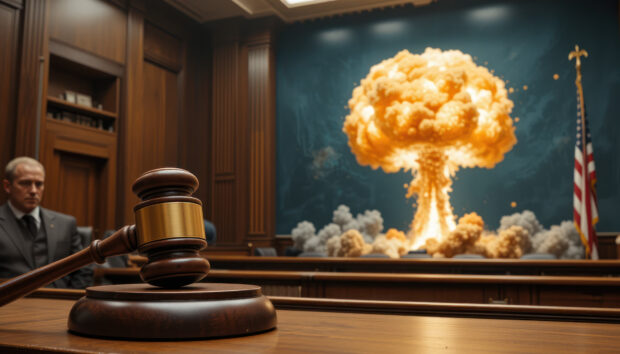
Runaway jury awards, known as Nuclear Verdicts®, have been an escalating problem for years. By our count, between 2023 and 2025, American juries awarded over $71 billion in nuclear verdicts.
Executive Summary
“You can write your congressman about tort reform or complain about litigation funding and attorney advertising, or that jurors have just gone crazy. Or we can do something about it today.”Robert Tyson and Cayce Lynch of Tyson & Mendes believe it’s time for the industry to “break the pattern of nuclear verdicts, embrace new defense strategies and restore sanity to the jury deliberation room.” They provide four practical steps that insurers and defense team can take, using data they have compiled to support the strategies.
The insurance industry and the customers it serves simply cannot sustain these rising indemnity costs. Nuclear verdicts fuel social inflation, one of the biggest threats to our industry.
Despite these existential threats, what has the insurance industry done to stop nuclear verdicts? Anything? Has anything changed? Are nuclear verdicts going away this year? Do we even know what is causing these unjust verdicts and settlements?
Well, now we do. We recently conducted a painstaking analysis of 100 real nuclear verdicts from across the country and discovered a universal pattern driving each of them. This article details four practical steps we can all take to break the pattern.

The Problem
Nuclear verdicts are a constant source of national news. Back in 1994, when a jury awarded plaintiff Stella Liebeck $2.9 million in the now-infamous “McDonald’s hot coffee case,” the response was outrage and confusion. Fast-forward 30 years, and the response is much different.
Less than a year ago, a jury returned a $50 million award to a plaintiff who sustained burns from hot tea in a Starbucks drive-through. There was no outrage. Rather, multiple jurors reportedly cried because they wanted to award $100 million more.
The problem? Nuclear verdicts are fueled by emotions instead of facts.
The Why
Why is there a registered mark on this article?
While a lot of insurance professionals toss around the phrase “Nuclear Verdicts,” not everyone knows that Robert Tyson, one of the co-authors of this article and the author of “Nuclear Verdicts®: Defending Justice for All,” trademarked the term. In a contribution to Carrier Management’s “What I Care About” series of articles, published in 2022, Tyson explained why and described innovations his law firm is working on the help insurers do something about Nuclear Verdicts®.
What is causing nuclear verdicts to rise in frequency and severity?
The answer is simple: Plaintiffs’ attorneys have changed the way they work up and try lawsuits. They have studied human psychology to learn what arguments work for them with juries. They have pivoted the emotional target at the heart of their arguments after realizing anger is a better motivator than any other emotion. They know that angry jurors will use their verdicts to “send a message” and prevent this kind of “harm” from recurring, even when punitive damages are not on the table.
Multiple psychological studies have confirmed anger’s impact on jury deliberations, as did our recent line-by-line analysis of 100 real nuclear verdicts.
Plaintiffs’ attorneys now regularly talk to jurors about money, tapping into the powerful psychological phenomenon of “anchoring” to drive large awards. They realized a simple but powerful truth: The only way to get big numbers is to ask for big numbers. And ask (and receive), they do.
The Analysis
To help our clients and fellow defense attorneys better understand how to prevent runaway jury awards, we went straight to the source: trial transcripts. We tracked over 65 separate data points in every case to learn what’s truly driving these results. There is, in fact, a pattern, and there are opportunities for the defense to rewrite the narrative.
The How: Four Practical Steps to Prevent Nuclear Verdicts
Fueled by our data analysis and trial experience, we built a blueprint for the defense to use at every stage of prelitigation, litigation and trial. It is called The Apex. At the heart of The Apex are our Core Four strategies: personalize the defendant, accept responsibility, give a number, and argue pain and suffering. At the pinnacle (or apex) of this approach lies our No. 1 goal: defuse anger.
Our data showed that where the defense accepted responsibility for something, damages were reduced by over 62%. However, the same research showed the defense failed to use this critical tool 85% of the time.
Every element and level of The Apex works together and builds upon one another. It is designed to help the defense fight back against even the most effective plaintiffs’ tactics while delivering on empathy and human psychology to truly deliver justice—for all.
Our analysis confirmed that in cases where the defense failed to useany of the strategies, verdicts averaged almost 50% more than plaintiff’s ask. Put another way, the jury was so enraged in those cases that they awarded every penny of plaintiff’s ask, plus almost 50% more.
To help prevent these unjust awards, the defense must apply the following Core Four strategies in every trial:
Step 1—Personalize the Defendant.Defense counsel must humanize and personalize the corporate or entity client for the jury. Showcase the people that make up the company through storytelling. The jury should understand the positive impact the company has on the lives of its employees, customers and surrounding community, and why these people do what they do.
Step 2—Accept Responsibility. Accepting responsibility (not necessarily liability) is the easiest way to defuse anger by validating it. Accepting responsibility for something de-escalates feelings of annoyance, irritation and anger while demonstrating the reasonableness of both the defendant and the defense’s arguments. Even while seeking a defense verdict, accepting responsibility is a critical tool for the defense. Our data showed that where the defense accepted responsibility for something, damages were reduced by over 62%. However, the same research showed the defense failed to use this critical tool 85% of the time.
Step 3—Give a Number.Plaintiffs’ attorneys have come to understand there is a simple but powerful way to get a nuclear verdict from the jury: ask for it. To combat this at trial, The Apex calls for the defense to give a number in every single case. The data revealed that when the defense gave a number, damages were reduced by over 75%. And yet, in our analysis, the defense refused to give a number 54% of the time.
Step 4—Argue Pain and Suffering. Noneconomic damages, also known as general or pain and suffering damages, make up the largest damages component of nuclear verdicts. Punitive damages are not even on the table in most cases that go nuclear. This is no accident. It is a tried-and-true approach by the plaintiffs’ bar. The Apex requires the defense to argue pain and suffering in every single case through a two-pronged approach rooted in reasonableness, even when seeking a defense verdict. Defense counsel who remain silent lose a critical opportunity to connect with the jury on a human level. Unsurprisingly, our data revealed that a failure to argue pain and suffering correlates with higher damage awards overall, yet the defense still refuses to address pain and suffering a shocking 69% of the time.
The Takeaway
Nuclear verdicts are getting worse. You can write your congressman about tort reform or complain about litigation funding and attorney advertising, or that jurors have just gone crazy. Or we can do something about it today. It is time for our industry to break the pattern of nuclear verdicts, embrace new defense strategies and restore sanity to the jury deliberation room.


AI Got Beat by Traditional Models in Forecasting NYC’s Blizzard
Reinsurance Program Could Wipe Out Need for Calif. FAIR Plan: Legal Exec
Large Scale Cargo Ring Busted in LA, $5M Recovered
Premium Slowdown, Inflation Factors to Lead to Higher P/C Combined Ratio: AM Best