

















The commercial auto insurance industry may be approaching a tipping point, and dashcams are at the center of it. Telematics-based safety programs are increasingly embedded in commercial auto insurance offerings, using a range of go-to-market strategies from premium subsidization to mandatory participation. In parallel, usage-based insurance programs are provided by specialized MGAs such as Nirvana and HDVI, as well as carriers including Progressive, Amerisure and GEICO.
Executive Summary
The IoT Insurance Observatory’s Matteo Carbone and Azuga’s JD Hassan make a case for dashcams moving from optional technology to an underwriting standard for commercial insurers writing auto insurance for fleets, also proposing that insurers subsidize the costs for smaller fleets to accelerate their adoption—driving the ultimate insurance benefits of reduced claims costs and safer roads.Among the different telematics-based solutions, dashcams are emerging as one of the key tools for building an effective connected commercial auto program. Even the regulatory framework is becoming favorable to their adoption: starting from January 2026 in Louisiana, insurers are required to communicate, and justify with actuarial evidence, the amount of discount they will offer to fleets equipped with dashcams and sharing the data.
All of these forces are shaping a landscape in which video recognition becomes an essential capability for the future commercial auto insurer.
Dashcams: From Accessory to Risk Tool
Dashcams are no longer just passive recording devices. Modern fleet cameras incorporate AI-powered features such as:
- Forward collision alerts
- Driver distraction detection
- Lane departure warnings
- Harsh braking and acceleration monitoring
- Real-time cloud uploads
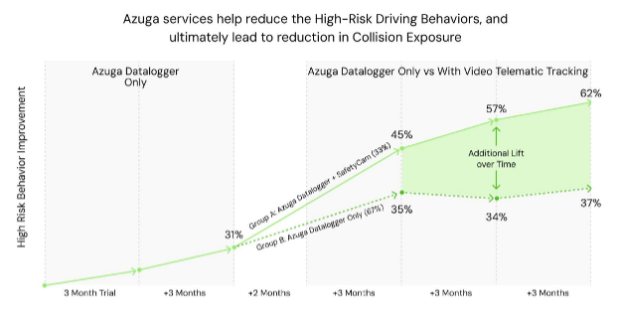
Many fleet operators worry that AI-powered cameras will feel invasive to drivers, but real-world results show the opposite. Fleets that have implemented Azuga Next Gen SafetyCam alongside coaching-first video solutions see higher driver engagement, improved safety scores and lower turnover. Azuga’s experience shows the usage of video telematic brings a lift of 36% in the reduction of high-risk driver behaviors within a year.
Dashcams help in building a culture of safety with proactive insights. The key isn’t just collecting data—it’s using it effectively. AI-powered fleet cameras empower drivers to make better decisions in real-time while giving fleet managers the tools to track risk trends and continuously improve safety performance.
A recent Azuga white paper analyzed the uplift that a dashcam can generate for a commercial auto insurance business. For commercial auto operators, these tools serve two primary purposes: reducing accidents and defending against fraudulent claims.
In a claims environment where nuclear verdicts and staged accidents are on the rise, video evidence has become one of the most powerful loss-control tools available. Fleets with dashcams frequently report faster claims resolution, lower litigation costs and fewer disputed liability cases.
Dashcams are increasingly proving to be a practical tool for reducing high-risk driving behaviors such as speeding, distracted driving and unsafe following distances. When drivers know their actions may be recorded and reviewed, they tend to adopt safer habits, while fleet managers gain objective footage that can be used for coaching, training and incident review.
For small to medium-sized fleets, however, the upfront cost of purchasing and installing dashcams across multiple vehicles can be a barrier to adoption. This creates a strong opportunity for insurance carriers to help subsidize dashcam implementation, as the technology can lead to fewer collisions, lower claim severity and improved loss ratios. By supporting partial funding, premium incentives or equipment partnerships, insurers can accelerate adoption among smaller fleets while ultimately benefiting from safer roads and reduced claims costs.
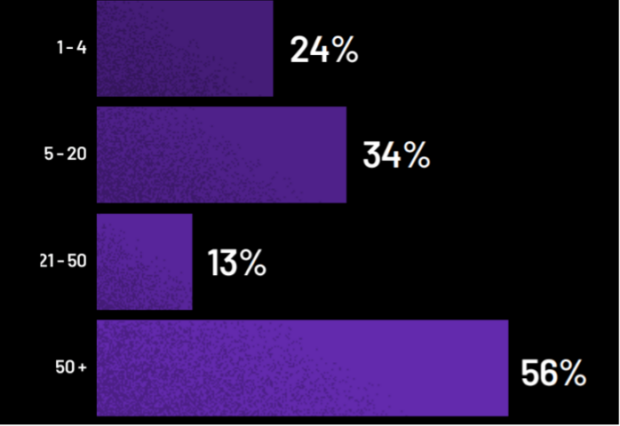
Dashcom adoption split by fleet size
Why Insurers Should Take Notice
As shown by the figure above, dashcams are getting adopted by fleets. However, smaller fleets need help to implement life-saving, cost-reducing and productivity-increasing technology.
For traditional commercial auto insurers, the implications are clear:
- Competitive Pressure – Aggressive discounts tied to verifiable safety technology could attract safer, tech-forward fleets, leaving higher-risk accounts concentrated elsewhere.
- Loss Ratio Impact – Fleets using dashcams often demonstrate reduced claim frequency and severity, improving underwriting performance.
- Data Advantage – Insurers who leverage video and telematics data gain deeper insights into driver behavior and risk patterns.
The Economics Make Sense
The cost of implementing dashcams across a fleet is often modest compared to the potential premium savings and avoided claims expenses. If a carrier offers meaningful premium credits and ensures a fleet safety program is in place, utilizing the video and telematics data, fleets can achieve a strong ROI within the first policy year. Likewise, if the carrier chooses to subsidize the dashcam along with the underlying telematics solution on behalf of their insured, assuming the above-mentioned effective usage of the data, the ROI to the carrier on this investment is expected to be over 300% on loss reduction alone in an average commercial auto portfolio, according to IoT Insurance Observatory analysis.
For insurers, incentivizing dashcam adoption can also reduce litigation exposure, accelerate claims handling, allow better underwriting decisions and even pricing sophistication.
A Technology Adoption Moment
The latest Market Segment Outlook: US Commercial Lines by AM Best confirms a nuanced reality: commercial insurers, in aggregate, remain profitable, with underwriting discipline, improved investment income and sound capitalization supporting returns that remunerate the cost of capital. Composite combined ratios remain in the mid-90s, and operating returns are robust, bolstered by fixed-income yields and prudent pricing.
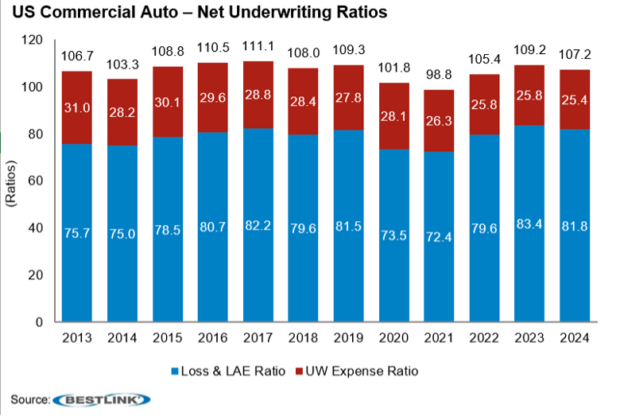
However, within these commercial lines portfolios, commercial auto continues to underperform on average, with combined ratios persistently exceeding 100 and consuming capital due to adverse severity trends, social inflation and nuclear verdicts. (Source: AM Best, Best’s Market Segment Report, “Stuck in Reverse: Commercial Auto Losses Keep Mounting, published Sept. 22, 2025)
A growing group of carriers and MGAs has shown that commercial auto can be managed profitably when underwriting is strengthened by granular data, disciplined risk selection, and technology-enabled loss prevention and claims management.
Related article: The Growth of a New Wave of Distribution Startups in Commercial Auto Insurance
This cross-functional application of the connected insurance model reduces expected losses, enhances risk-aligned pricing, and improves both the speed and quality of claims handling. In doing so, it not only restores margins and strengthens returns but also contributes to safer roads and enables business owners to obtain appropriate coverage at more affordable premiums, expanding both the availability and accessibility of insurance solutions.
From this perspective, the use of telematics in commercial auto insurance can be viewed as a social good, and regulatory support—such as that seen in Louisiana—may become increasingly common.
Video recognition provides a sensing capability that extends well beyond the traditional data captured by insurers’ standard telematics sensors, materially strengthening their ability to interpret risk and act. In many insurance use cases, dashcams outperform other telematics solutions, and this advantage could rapidly shift from a “nice-to-have” feature to an underwriting expectation for commercial auto coverage—much as sprinkler systems became a standard requirement in property insurance over the past century.
 AI Agents’ Access to Personal Information Raises Privacy Concerns
  Viewpoint: Pricing Wildfire Risk Is Not the Same as Reducing It
  AI Data Center Boom: Understanding How Risks Are Changing
  Tech Bytes: New Partnerships at The Zebra, LexisNexis Risk Solutions