












The polar vortex and related harsh weather conditions in many parts of the U.S. last winter led to elevated risks of pipe-freeze incidents from the Northeast and Midwest all the way down through the otherwise warmer South and Southwest regions.
Executive Summary
Experts from a weather and climate geospatial consulting firm and a provider of catastrophe risk management analytics list six critical indicators insurers should monitor to anticipate and mitigate pipe-freeze risks, including building characteristics, temperature trends, wind exposure, aging infrastructure, abnormal weather patterns, and occupancy status. They also underscores the growing vulnerability of southern and western regions to extreme cold events and the importance of predictive modeling, GIS analytics, and proactive communication for effective risk management
Although actual insured losses haven’t been compiled yet for 2024-2025, State Farm reported losses of more than $800 million in 2022-2023 for pipe freeze and water damage claims.
(Editors Note: State Farm published pipe freeze claims tallies for 2024-2025 after this article was first published on Carrier Management in December. See related article, “Frozen Pipes Lead to $628M in Losses for State Farm” for the update.)
While pipe freeze incidents are significant and costly, they are also often preventable. Understanding when and where pipes are at risk of freezing can enable insurance companies and homeowners to take steps for effective mitigation.
Accordingly, insurers need to obtain accurate risk information and communicate it effectively and on a timely basis to reduce insurance claims and property damage. With that in mind, here are six warning signs for insurers to anticipate and respond to significant potential pipe-freeze events.
- Construction and building characteristics
Construction methods and characteristics are critical for assessing the potential for pipe freeze exposure. Pipe-freeze damage probabilities are impacted not only by below-freezing temperatures, but also by the persistence of below-freezing temperatures relative to the typical temperatures a region experiences in the coldest months of the year.
In the southern United States, building characteristics are often not sufficient to address sharp, rapid and extended drops in temperature. So, it’s not surprising that they tend to be more vulnerable to occasional prolonged below-freezing weather.
Existing building codes can fall short during occasional extreme cold events, increasing the risk of pipe freeze. Pipe freeze damage is often most severe across southern states where historically milder temperatures have driven decisions about building codes and construction. In these regions freezing weather can have widespread impacts on homes, businesses, and local infrastructure.
Snow, rain and prolonged periods of cold weather can cause water in pipes to freeze in any areas, but when these conditions appear in regions where they occur infrequently, pipe freeze losses become widespread. Snow and ice can accumulate on roofs and around buildings, potentially reducing the effectiveness of insulation, allowing cold air to penetrate and reach pipes.
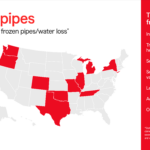
State Farm reported over $806 million in frozen pipe and water damage claims from August 2022–2023, affecting over 32,000 claims. Among the top five states for pipe freeze claims that season, Georgia ($100 million) ranked first; Tennessee ($61.9 million) was third; and Texas ($58.1 million), fourth.
- Temperature trends and extreme cold
Not all cold weather events have the same impact on residential and commercial properties. Risk for pipe freeze events can result from consistently low temperatures or short-term extreme cold snaps. Indeed, persistent extreme cold temperatures that extend from several hours to days or longer are key indicators of pipe-freeze threats.
That stated, not all freezing weather leads to pipe freeze and not all pipes that freeze will burst. When extreme cold events occur, they can be accompanied by other damaging weather causing power outages, and reduced transportation; in these cases, pipes freezing can be a cause for concern for water availability.
Inland regions tend to have more extreme temperature swings and lower nighttime temperatures putting them at a higher risk for pipe freeze events. Oceans and large bodies of water help moderate temperatures, keeping coastal regions milder in winter. Nonetheless, sudden cold snaps can still pose a risk to coastal regions.
When cold weather conditions are predicted for a region, underwriters should carefully monitor current and near-term weather forecasts and consider them in the context of the region’s infrastructure. This assessment is often critical to developing effective response and mitigation strategies.
- Surface wind and gusts
Sustained surface wind and wind gusts can increase the risk for pipe freeze in structures or homes that are not airtight. Windy conditions can increase drafts to pipes when insulation and construction methods are outdated or low-quality, increasing the conditions for the freezing process.
The location of pipes within a building is another risk factor with respect to surface wind. High winds can accelerate freezing of pipes that are located near gaps in insulation or ventilation. In these windy conditions, pipes in attics, crawl spaces, or exterior walls are also more vulnerable to freezing.
- Building age and pipe systems
The age of a residential or commercial building is a key factor in assessing pipe freeze risk as insulation values may decrease over time. In warmer climates, such as central and southern Texas and Florida, water pipes are often placed in attics above the insulation. These construction methods place at-risk pipes above the heated space, significantly increasing the vulnerability to pipe freeze.
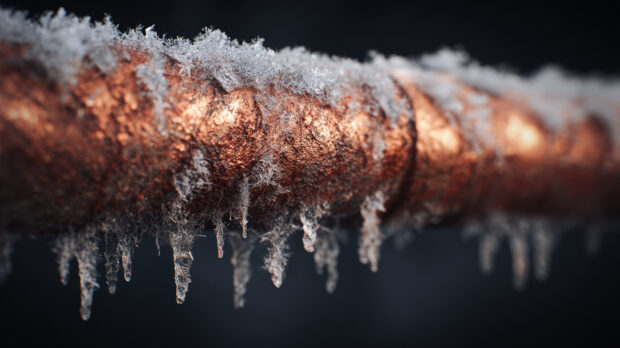
 Older homes often contain copper pipes, which are thin-walled and tend to lose heat rapidly, making them susceptible to freezing. They are also rigid and tend to split under pressure instead of expanding. Similarly, PVC and CPVC pipes are plastic materials that become brittle in cold weather and may fracture when frozen. On the other hand, PEX pipes are known for their flexibility and are considered more resistant to freezing damage.
At the same time, frozen galvanized pipe will rarely split along its length; instead, the expanding ice inside will push along the pipe until it encounters a Tee or 90-degree bend. Older homes with galvanized steel pipes can experience delayed failures, leading to larger long-term claims.
- Abnormal regional weather patterns
Regions that are most significantly affected by pipe freeze events are those where infrastructure is not designed to withstand below-freezing temperatures or extreme cold conditions. While areas in the Northeast and Upper Midwest frequently experience harsh winters, their buildings and infrastructure are generally constructed to endure such conditions on a regular basis.
By contrast, regions such as the Southeast typically lack the design considerations necessary to manage prolonged or severe cold weather events. Even in the Southwest, dry cold air events can cause severe pipe-freezing even in sunny conditions. In terms of infrastructure, snowstorms and extremely cold weather events can cause power outages, leading to unheated areas in the home, which in turn, makes pipes more vulnerable to freezing.
Mitigation for pipe freezes should focus not only on increased insulation but also on reducing hydraulic pressure.
Historically, insurers focused much of their attention on pipe freeze risk in northern regions. However, major pipe-freeze events in recent years have revealed significant vulnerabilities in the Southeast, including Georgia, Alabama, Mississippi, and Florida; the Southwest, especially Texas, Arizona, and New Mexico; the Western states of Nevada, and California; and the Pacific Northwest, including the cities of Portland and Seattle.
At the same tie, pipe risk varies in urban and rural areas. Notably, properties in rural areas typically have longer recovery times due to limited emergency plumbing services, leading to higher claim payouts. Urban properties experience faster intervention but higher infrastructure-related failures, such as municipal water pressure drops during extreme cold or entire apartment buildings with multiple freeze points.
- Building occupancy
Not surprisingly, vacant properties and buildings under-construction tend to be more vulnerable to freeze events. College dormitories, vacation homes, seasonal resorts, and short-term rental properties tend to be at higher risk of impact from freezing pipes due to undetected freezing and lack of proper preparation leading up to a pipe freeze event.
Pipe freeze bursts in vacant buildings may not be caught in a timely manner leading to increased claim costs and more extensive damage.
Buildings under construction may be particularly at risk. They frequently lack functional heating systems, leaving exposed pipes vulnerable to freeze damage. Similarly, those undergoing significant renovation may lack sufficient heat in work areas exacerbating the pipe-freeze exposure.
Monitoring and responding to freeze events
With respect to analytics, weather and GIS modeling can be helpful in predicting future pipe freeze risks but can also be applied historically. Historical pipe-freeze risk combines on-the-ground observations with GIS-powered weather enhancements to estimate whether regions were at risk of pipe freeze in the past.
As freezing conditions unfold, the accuracy of predicting its impact increases dramatically as the event approaches, reaching 90 percent in the final 24 hours before a freeze event. This gives insurers the ability to pre-stage adjusters and emergency resources for high-risk zones.
Meanwhile, commercial property owners should have the insights needed to communicate on a timely basis with building managers and residents and provide recommended actions to help prevent costly pipe freeze damage.
When pipe-freeze losses occur, forensic modeling enables precise claim analysis to eliminate or reduce the likelihood of fraudulent claims. This can facilitate faster claim processing for legitimate cases in verified high-risk areas.
In communicating with policyholders about pipe freeze risk, insurers may want to point out that pipes do not always burst simply because ice expands outward against pipe walls. Instead, ice formation causes a complete blockage, which results in extreme pressure buildup in trapped water (up to 4,000 psi) before rupture. Thus, mitigation for pipe freezes should focus not only on increased insulation but also on reducing hydraulic pressure.
As the pipe-freeze risk landscape continues to evolve insurers should carefully consider all the criteria affecting this exposure. Along with monitoring warning signs of pipe freeze events, insurers with concentrations of properties in high-risk regions might consider new and more robust predictive modeling techniques to identify the potential for significant pipe-freeze risks with greater precision.
Armed with these timely insights, carriers may be better positioned to make more informed underwriting decisions. They also will be equipped to alert policyholders of developing exposures and to respond to unfolding incidents faster and more effectively to prevent large losses.
 State of Emergency Declared in California in Anticipation of More El Niño-driven Storms
  Nearly 100% of U.S Now Covered by NOAA’s Flood Mapping Tool
  Cargo Theft a Top Concern for Majority of Retail Loss Control Leaders
  FEMA’s New Flood Maps Mean More Homes Require Flood Insurance: Cotality