

















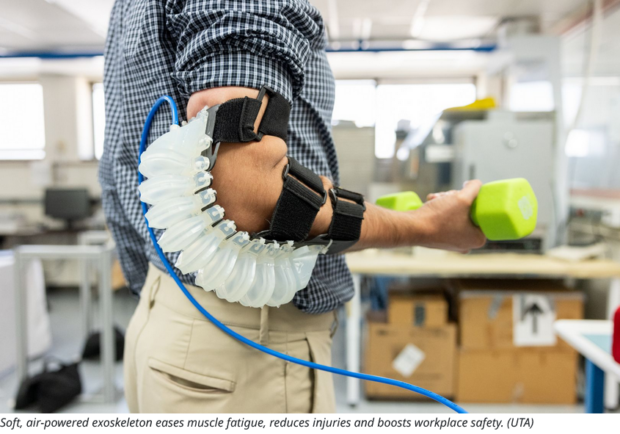
Engineers at the University of Texas at Arlington have developed a soft robotic exoskeleton that promises to help workers in jobs that require hours of lifting and repetitive motion by reducing the load.
The Pneumatically Actuated Soft Elbow Exoskeleton (PASE) uses a lightweight silicone “pneumatic actuator” – a soft, air-filled mechanism that helps move the arm—to assist movement during everyday industrial tasks such as lifting, assembling, and drilling.
By reducing strain on the arm and elbow, the flexible design aims to lower the risk of developing work-related musculoskeletal disorders, which account for about 30% of all workplace injuries in the U.S. and cost an estimated $45–54 billion annually in workers’ comp and recovery.
Designed as a single-piece pneumatic actuator, PASE minimizes weight and mechanical complexity while maximizing comfort and freedom of movement.
Constructed from silicone and mounted on a carbon-fiber onyx base plate with a soft neoprene outer layer, the device provides precise assistance aligned with natural elbow motion.
“Our goal was to create a preventive, assistive device that reduces muscle strain before injuries occur,” said Eshwara Prasad Sridhar, graduate research assistant in the Department of Industrial, Manufacturing, and Systems Engineering. “By using the pneumatic systems already available overhead in most manufacturing facilities, this exoskeleton can be easily implemented in real-world settings.”
In a study involving 19 participants aged 18–45, the researchers tested the exoskeleton across three tasks: manual weightlifting, basic assembly, and power drilling. When the exoskeleton support was engaged, muscle activity in the biceps and triceps decreased by up to 22% during lifting tasks, and participants reported 8–10 point reductions in perceived physical and mental workload using NASA’s Task Load Index compared with when the support was off.
“Even delaying or preventing a single workplace injury makes a huge impact,” said Dr. Erel, who leads UTARI’s soft robotics efforts. “Projects like this show how engineering can directly improve people’s quality of life by reducing fatigue, preventing strain, and creating safer work environments.”
The study, “Design, Development, and Evaluation of a Pneumatically Actuated Soft Wearable Robotic Elbow Exoskeleton for Reducing Muscle Activity and Perceived Workload,” was published in the Journal of Rehabilitation and Assistive Technologies Engineering.
Building on this success, the team has submitted a National Science Foundation proposal to expand the concept into a full upper-limb exoskeleton that can assist the elbow, wrist and fingers simultaneously.
Information provided by Brian Lopez of UTA.
 Amazon Cargo Plane Pilots Weren’t Warned About Wind Before Miami Crash: NTSB
  Levers and Guardrails: How Growth Is Being Built at Hippo
  Lyft to Pay $272M to Settle California Rideshare Drivers’ Wage Theft Lawsuit
  The Impact of Claims Experiences on Trust