

















For the second year in a row, Super Bowl Monday will set a record for the number of U.S. employees who plan to miss work, according to UKG’s annual Super Bowl Fever Absenteeism Survey.
It’s estimated that 26.2 million workers will miss work the day after the big game, surpassing 2025’s record-setting 22.6 million employees and potentially costing upwards of $5.2 billion in lost work and productivity.
The good news is that Americans are planning ahead, the AI workforce platform said, with many hoping their employer will do the same, ensuring everyone can win.
Here’s how some of the 26.2 million employed Americans who may miss work plan to do so:
- 13.1 million plan to take a pre‑approved day off, compared to 12.9 million in ’25 and 10 million in ’24;
- 6.5 million plan to swap shifts with a co-worker, compared to 4.8 million in ’25;
- 3.3 million intend to call out sick despite not being ill, similar to 3.2 million in ’25; and
- 1.6 million plan to ‘ghost’ work without notifying their employer, compared to 3.2 million in ’25.
Of those who intend to work on Monday, approximately 4.9 million workers plan to arrive late, without letting their manager know in advance.
“Last year’s record-breaking prediction preceded Super Bowl LIX being the most-watched program in the history of broadcast television — and data shows employees are not only planning for it, but also hoping for an assist from their employer,” said Julie Develin, senior partner, HCM Advisory at UKG. “This year, it appears that fewer employees plan to ghost work, and others are proactively swapping shifts. That kind of workforce understanding and insights is a net positive because unplanned absences can quickly add up — potentially costing businesses more than $5 billion in lost productivity.”
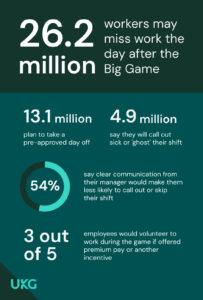 More than half of employees (56%) say that if managers started coverage planning weeks before the Super Bowl, it would reduce last-minute call-outs at their workplace, and 54% say clear, early communication from their manager about Super Bowl coverage would make them less likely to call out or skip their shift.
Nearly half of those surveyed, 48% (up from 43% in 2025), agree Super Bowl Monday should be a national holiday.
“More than 80% of the workforce are in frontline roles where working holidays and weekends are the norm. Whether the Super Bowl is played on a holiday weekend or not, frontline-heavy organizations will need to employ creative staffing techniques,” said Develin. “Shift swaps are a practical reality for frontline teams — trading working Thanksgiving for Christmas, weekends for weekdays — yet other UKG research shows half 9 (50%) of employees say it’s difficult to change shifts at the last minute.”
Many employees who want to watch will still be working:
- 6.6 million employees are swapping shifts Sunday with another co-worker who wants to watch the game;
- 18 million are planning to work their Sunday night shift but watch at least some of the game; and
- 3 in 5 employees (60%) say they would volunteer to work during the Super Bowl if their organization offered premium pay or another incentive for working that shift.
More than two-thirds of employees (67%) agree their manager does a good job recognizing how pop culture events, holidays, and other external factors can affect work. In fact, nearly two-thirds of managers (63%) say they plan to ask employees directly about their Super Bowl time-off plans — compared to 56% in 2025.
Many workers are still on the fence, with 8.2 million employees saying they will make a last-minute decision about what to do about work on Monday.
“That’s a lot of people waiting on the sidelines over their plans for Super Bowl Monday. There’s still time to drive active conversations with employees to ensure the business is covered,” said Develin.
It doesn’t stop with the Super Bowl. U.S. employees cited several events in the first half of 2026 that might impact attendance:
- Feb. 6-22, Winter Olympics: 26.2 million (16%);
- March 17-April 6, NCAA Men’s March Madness Tournament: 18 million (11%)
- June 11-July 19, FIFA World Cup: 36 million (22%); and
- Taylor Swift-Travis Kelce Wedding: 13 million (8%).
“The Super Bowl still holds the trophy for what could be the largest single day of potential work-related absence, yet these multi-week, must-watch moments can be even trickier to plan labor,” said Develin. “Organizations should set reminders several weeks ahead to start staffing conversations early. That kind of long-term workforce planning helps ensure work is covered and prevents last-minute staffing gaps.”
 Weather Damage Turning Into Long-term Debt for Homeowners: Report
  Texas Reports Downward Trend in Home, Auto Insurance Rates
  Amazon Cargo Plane Pilots Weren’t Warned About Wind Before Miami Crash: NTSB
  The Latest Launches from Vertafore, One Inc., Qumis