
















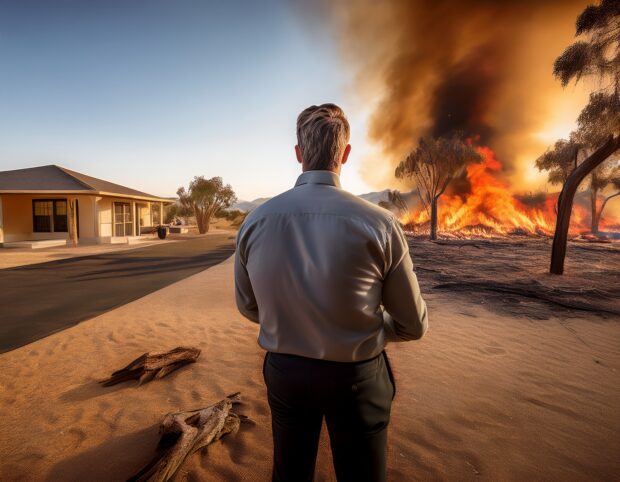
Life could not have been better for Merritt Farren.
Executive Summary
Having lost his home in the Palisades Fire, a former attorney at Disneyland and Amazon has launched a months-long legal battle against insurer State Farm and the California Insurance Department, with notable success.After a high-level career as Amazon’s Associate General Counsel and then Disneyland’s General Counsel, he formed Farren Law LLP to provide legal and corporate development services to emerging and established companies. He and his family lived in a charming home surrounded by caring neighbors on Mount Holyoke Avenue in upscale Pacific Palisades, nestled like a jewel between the Santa Monica Mountains and the Pacific Ocean.
On Tuesday, Jan. 7, 2025, Farren’s idyllic life changed irrevocably when hurricane- force winds rekindled a small wildfire from a week earlier north of the Palisades. His home and those of his neighbors burned to the ground. Farren subsequently filed an insurance claim with State Farm, California’s largest home insurer.
The insurance company handled the claim expeditiously and fairly, he felt. The family relocated to a house eight miles away in Westwood, so his 12- and 14-year-old sons could continue their schooling relatively uninterrupted.
Upon returning to the charred remains of the Palisades a few weeks later, Farren encountered several neighbors. Many were also insured by State Farm. While thankful to have coverage through the insurer—State Farm had non-renewed approximately 30,000 homeowner policies in California the previous year—they were experiencing difficulties involving the claims they had filed. Among their concerns were the insurer’s extensive document requests, extended delays in claims processing, claims denials for smoke damages and lowball rebuilding estimates.
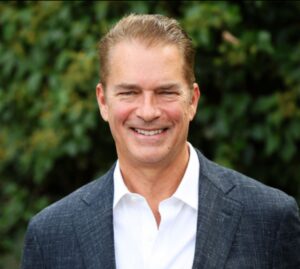 “I felt there were flaws in the rate-setting process because it didn’t consider an insurer’s treatment of consumers during the claims-handling process in determining whether a rate increase was justified. I felt the absence of [an insurer’s] detailed claims performance was a crucial problem that should be addressed during the rate request process.” — Merritt Farren
Farren was surprised, given his own claims experience. As time progressed, however, he read in neighborhood online chat forums and social media groups that many residents of the Palisades whose homes State Farm insured were in similar distress. “The shock for them was as traumatizing as losing their homes,” Farren recalled in a series of recent Zoom interviews.
Having worked for many years at Amazon and Disneyland, whose brands and long-term success rely on exemplary customer service, Farren was dismayed. Despite the extraordinary upheaval in his family’s life, he decided to learn why many of his neighbors received claims services inconsistent with his own.
His research reached a new level of concern on May 13, when California’s insurance commissioner, Richard Lara, approved a 17 percent emergency interim rate hike requested by State Farm, 5 percent less than the insurer’s initial request.
Shouldn’t a rate increase in some way be linked to an insurer’s claims practices, he wondered.
Related articles: Is State Farm General Too Big to Fail? Calif. Rate Hearing Concludes; State Farm’s Emergency Homeowners Rate Hike Gets OK in California; State Farm Still Wants a 30% Rate Increase in California
On May 22, Farren formally filed a 28-page petition to the California Department of Insurance to intervene in the department’s ongoing rate review proceedings involving State Farm. Typically, such interventions are made by professional consumer advocacy groups like Consumer Watchdog, which had challenged the interim rate hike, and not a private citizen.
In his petition, Farren contrasted State Farm’s claims-handling procedures with those of other insurance companies like USAA, Chubb and PURE. Citing reports from their policyholders, Farren wrote that the insureds had received claims payments “rapidly, either in full, no questions asked, up to policy limits … with little requirement for exhausting and time-consuming itemization of losses.” The experiences of State Farm’s claimants, by contrast, were “strikingly different” and “strikingly inferior,” designed “as a means for State Farm to reduce its exposure by frustrating insureds to a point of surrender,” he wrote.
The alleged inconsistencies in State Farm’s claims-handling practices should be an intrinsic part of the insurance department’s rate justification process, Farren argued, providing the following example to illustrate his point:
“If we had a state commissioner responsible for approving the price of automobiles, would we think it appropriate that the commissioner look only at the profitability of the companies making the cars, and not at the nature of the cars themselves and the after-sales warranties they include? No, of course not. Yet that’s what the California insurance commissioner is doing here.”
Related article: Unpacking a Consumer Intervenor’s Novel Idea
The Official Inquiry Begins
Both State Farm and the California Insurance Department opposed Farren’s petition to intervene. The insurer’s legal counsel maintained that the claims-handling issues Farren raised were irrelevant to the rate-setting process, which typically relies on historical loss data and financial projections. They argued that his participation would significantly delay the rate proceedings. The department echoed these concerns, asking the judge overseeing the rate hearing to prioritize the rate hike request and to defer a review of claims-handling issues to a later date.
Coinciding with these objections, Insurance Commissioner Lara formally announced on June 2 a market conduct examination of State Farm’s claims-handling practices, due to a significant number of consumer complaints.
“Some troubling patterns that my staff will investigate include the frequent reassignment of multiple adjusters with little continuity in communication, inconsistent management of similar claims, and inadequate record-keeping or information-sharing among claims teams,” said Lara. “These issues create unnecessary stress, prolong recovery and erode trust.”
The commissioner’s concerns appear to independently validate allegations in Farren’s petition.
One day later, on June 13, Farren participated in a formal public hearing regarding his motion to intervene before Administrative Law Judge Karl-Fredric J. Seligman. Under California’s Proposition 103, the hearing process for rate application proceedings are overseen by such judges.
On July 3, Judge Seligman issued an official order granting Farren full intervenor status. The judge stated that his “concerns regarding claims-handling practices are not necessarily merely philosophical; to the extent they bear directly on actuarial components such as trend factors, loss development and catastrophe-related adjustments, they are materially relevant.”
Farren now had legal standing to become an official participant in the hearings challenging State Farm’s rate requests, with the right to present evidence and cross-examine witnesses. Little did he realize the immense work this would entail. Intervening in the state’s rate request proceedings requires formidable technical expertise and specialized resources to scrutinize complex insurance company data, in addition to the financial means to absorb the related costs. A consumer advocacy group typically possesses such dedicated capabilities.
He was utterly on his own.
A Quiet Life Shattered by Wind and Flame
Farren was born in Monterrey, Calif. His father, a U.S. Navy pilot, was stationed in the area at the time. The family moved briefly to Virginia and then Pennsylvania, where his mother was from, and then back to California when he was nine. Well-liked and smart, he was elected student body president at El Camino Real Charter High School in Woodland Hills in Los Angeles County. He subsequently earned a B.A. in International Relations from Stanford University and a law degree from UC Berkeley’s School of Law.
In late-December 2024, Farren, his husband Michael and their two sons, ages 12 and 14, celebrated the holidays in France, where they own a house surrounded by organic walnut orchards. Michael and the boys returned to Pacific Palisades right after the New Year, but Farren stayed on to attend to the orchards. “There’s always a lot to do,” he said.
On the morning of Jan. 6, he received a series of cellphone warnings of a life-threatening wind event in Southern California forecast by the National Weather Service. Coupled with a prolonged drought and dry vegetation, the conditions were highly conductive for a wildfire.
The next morning, Michael, a real estate executive, was in his office in Santa Monica when he saw smoke rising from the hills above the Palisades. The wildfire was at least two miles from the house on Mount Holyoke Avenue, and he figured it would be extinguished well before it reached the street.
Upon receiving an evacuation notice on his cellphone, Michael returned home quickly and packed a few essentials for the family. He called a friend to pick up the boys at Paul Revere Middle School and take them to a safer location, and then jumped into his car with the family’s dog to drive to Brentwood. The five-mile trip took two-and-a-half hours.
Insurance Journalist Russ Banham, the author of this profile of Merritt Farren and a resident of La Cañada Flintridge, shared his family’s experience evacuating from the January wildfires and their preparations for the future in a two-part series published by Carrier Management earlier this year. Read An Insurance Journalist’s Perspective on Southern California’s Wildfires and Revisiting California’s Wildfires: A Personal Journey for Banham’s personal accounts.
As Los Angeles went to sleep, day broke in France, where Farren tracked the fires throughout. News reporters and media outlets showed harrowing scenes of houses burning sequentially in the Palisades. Firefighters were initially overwhelmed, fighting a battle that appeared impossible to win. But as the sun came up, neighbors began sending images from their functioning security cameras. The photos suggested the family home had survived the destruction.
The next morning, Jan. 8, the fire reached Mount Holyoke Avenue. “The entire neighborhood was flattened like a nuclear bomb went off,” Farren said.
Decades of Community, Devastated in Days
Since the devastation, a lot has been written about the unique character of the Palisades, a place where people knew each other and looked out for each other. Many residents owned their homes for decades. This was very much true on Mount Holyoke Avenue. Farren knew most of his neighbors and regularly stopped to chat with other residents walking their dogs. He and Michael hosted a Christmas open house at their home and invited everyone on the block. “It was a great group, our neighbors,” he said.
His next-door neighbor, a woman in her 80s—the widow of a schoolteacher—died shortly after the fire. She had lived in the house for more than 40 years. “According to her daughters, she was heartbroken by the loss of the place she so loved,” he said.
Farren and his family felt the same anguish. Initially, they planned to rebuild their house, which had been recently remodeled, and discussed options with an architect and general contractor. Aware of the plans, their 14-year-old son offered his thoughts on the subject, commenting that by the time the new house was built he would be away at college. “He wanted to move forward. We agreed to stay put in Westwood,” Farren said.
In the weeks and months following the fire, Farren kept in touch with neighbors on WhatsApp. Stories were circulating about many homeowners’ adverse insurance claims experiences. Meanwhile, local newspapers carried stories about the enormous cost of the disaster for insurers. When Farren read that State Farm sought an emergency rate increase of 22 percent—the first such request in the state’s history—the information contrasted sharply with his neighbors’ ongoing distress.
Related article: LA Fire-Related Capital Hit Prompts State Farm Emergency Rate Request
“I felt there were flaws in the rate-setting process because it didn’t consider an insurer’s treatment of consumers during the claims-handling process in determining whether a rate increase was justified,” he said. “I felt the absence of [an insurer’s] detailed claims performance was a crucial problem that should be addressed during the rate request process.”
On July 14, State Farm filed an objection to Farren’s motion to extend the discovery deadline. Four days later, the insurance department filed its own objection and also proposed that the judge split off the consideration of State Farm’s claims practices into a separate proceeding to follow the conclusion of the rate increase hearings. Judge Seligman rejected the proposals, effectively liberating Farren to gather evidence through the discovery process to determine whether State Farm’s claims-handling processes had changed, making its historical loss data a poor predictor of future losses. The deadline for Farren to file a request for information to State Farm was set for Sept. 5.
He made the deadline and asked the insurer for its claims adjuster manuals, rules and settlement practices. His goal: to compare versions and identify possible changes in how State Farm handled personal property losses, calculated repair estimates and dealt with smoke damage claims. He also asked for data showing how much State Farm paid out to the policy limits within specific periods of time during earlier California fires. Farren will compare this information to data related to the most recent fires, to ascertain whether changes in the insurer’s claims-handling practices have resulted in slower payouts.
Formal hearings were set for October. After several back-and-forth discovery motions and responses by all parties—Farren, Consumer Watchdog, the insurance department and State Farm—the rate request hearing is now scheduled to commence on Jan. 27, 2026, unless a subsequent order modifies the date.
One-Man Crusade for Transparency
Farren’s extensive efforts continue, despite the time-consuming rigors entailed. Former attorney Lisa McDonald, a classmate of Farren’s at Stanford University, has followed the proceedings and is not surprised by her friend’s persistence.
“Merritt is completely motivated and determined to help his damaged community,” she stated in a phone interview. “He has an even larger fight for transparency and fairness for all California consumers. He’s a very creative, passionate and smart person who is a lifelong problem-solver. He’s not an insurance expert, but neither was he an expert in walnut orchards. He’s undaunted—just digs in and figures it out. It’s David versus Goliath.”
Farren acknowledges that he is outmatched by State Farm’s legal representation—Hogan Lovells. The firm’s principal attorney is Vanessa Wells, a Bay Area lawyer with decades-long experience in insurance rate proceedings, he said. “There’s no question they have far greater experience than I do in these things, but that does not intimidate me,” Farren said.
If State Farm is found to have acted improperly in the aftermath of the Palisades fire, the repercussions could include financial penalties, legal exposure to private lawsuits and mandatory changes in its business practices, altering how it assigns adjusters, manages records and calculates reconstruction costs. Fines alone could be punishing: For engaging in unfair practices, the insurer can be fined up to $5,000 for each act, or up to $10,000 for each willful act. Given the thousands of claims filed, the cost could exceed tens of millions of dollars.
Farren is confident that his actions to ensure fairness in the rate setting process by illuminating an insurance company’s claims-handling processes is the proper way forward. In a June 8 written response to State Farm’s objection to his petition, he wrote that the insurer’s position “suggests that it operated under the misperception that doing right by the consumer, and generally striving to be customer centric, is somehow bad for business.”
This was his experience working at Disneyland and Amazon—to “deliver a magical experience for all guests” and to become “the most customer-centric company in the world,” he wrote in his petition, explaining, “I’m a reasonable person who’s reasonably intelligent, with a lot of experience handling consumer rights matters from inside two companies that prioritize consumers.”
Ultimately, what turned him into a disruptive force was his neighbors, their neighbors and their neighbors. “Seeing and hearing their shock and distress was a revelation, motivating me to do what I could,” he said.
McDonald thinks that Farren’s sons also factored into his resolve to make a difference. “I will just say that he’s a great dad. It matters to him to show the boys by example that it’s not just enough to say the words, you have to dig in and take actions to help others and fight for justice,” she said. “That is really important to him.”
Blueprint for a Fairer Insurance System
The deeper Farren digs, the more he finds to uncover. Over much of the last year, he has become insurance-savvy and a public figure of note on insurance matters. Consequently, he has put his education to work in support of reforms to help solve the homeowners insurance crisis in California.
He has thrown his support behind CAL Reinsure, a reinsurance program shifting 100 percent of the risk of a community’s fire losses from insurers to a state reinsurance entity. Community fires, a fire that destroys at least three homes, are a specific risk touching a small percentage of homeowners in the state that nonetheless causes tremendous harm to the local economy, he said.
He also favors new legislation to require a full 100 percent payout to the full policy limits in the event a homeowner experiences a total loss. This would help reduce the stress of post-fire claims handling practices, he said. He’d also like to put an end to rotating claims adjusters and complicated insurance contracts with incomprehensible insurance jargon. He wants the insurance department to establish a task force charged with preparing and publishing estimates of home rebuilding costs by ZIP code and require insurers to provide the estimates to current and prospective policyholders. “He has an unshakable belief in a cause,” McDonald said.
That cause stems from the compounding miseries caused by the Palisades and Eaton wildfires, extending far beyond the initial trauma. “We cannot allow the story to be repeated,” Farren wrote in an email. “The massive incompetence and massive failures that allowed the Palisades to burn. No. We need to do all that we can do to see that it is not repeated.”
Featured image: AI-generated (Firefly/Adobe)
 More Roller Coasters Shut Down as Authorities Probe Fatal Fall Off Georgia Ride
  Broad AI Exclusions in Insurance Policies Could Create Uncertainty, Marsh CEO Says
  AI Models May Soon Self-Replicate Across Smart-Home Devices, Anthropic Warns
  The Latest Launches from Soteris, CLARA, Cozmo AI