


















If negotiation is the job, as Ronald Morrison wrote in the first article of this series, then the first offer is often the moment that defines success.
Executive Summary
Concert Group’s Ken Carter explains the concept of anchoring science and why it matters in claims.“The first offer is what gives you room to move strategically. A well-reasoned opening creates context for concessions later, allows you to demonstrate flexibility and keeps the conversation within a range you define. It shifts you from passively reactive to a position of leadership and influence,” he writes.

The article is the second installment of a multipart educational series, “Negotiation Reclaimed,” conceived by Guest Editor Taylor Smith, founder and president of Suite 200 Solutions.
Smith introduced the idea in his recent CM article, Taking Back Negotiation: Why Claim Professionals Must Lead the Next Chapter
Read Part 1: Negotiation Is the Job: Reframing Defense Work in an AI-Enhanced Era
Read Part 3: Rebuilding Negotiation Talent: Why This Skill Is Missing and How to Fix It
Read Part 4: Negotiation by Design: Why Writing Beats Talking
Read Part 5: From Skill to System: The Next Chapter in Insurance Claims Negotiation
Behavioral economists Daniel Kahneman and Amos Tversky first described the anchoring effect in 1974—the tendency for initial numbers to pull subsequent judgments toward them, even when the starting point is arbitrary.
In insurance negotiations, this bias is not theoretical. It’s the gravitational force that shapes every later discussion about value, reasonableness and fairness.
Every demand letter or opening offer is an anchor. It establishes a frame: what’s “high,” what’s “low,” what’s “reasonable.” Once that frame exists, even seasoned professionals unconsciously adjust around it. That’s why skilled negotiators try to control that frame early. Whoever sets the first credible number usually sets the boundaries for the eventual outcome.
The plaintiff bar has understood this for years. Their opening demands are not just numbers—they are narratives designed to define the story of loss and responsibility before the defense even speaks. Too often, defense teams start reactively, allowing the plaintiff’s anchor to define the playing field.
It’s time to reclaim that space.
Why Going First Usually Wins
If you’ve been in claims long enough, you’ve heard it or said it yourself: “Let’s ask them for a demand, then maybe propose mediation.”
It sounds prudent. It feels safe. Waiting seems like a way to preserve flexibility and avoid revealing our hand too soon. But in negotiation science, this instinct to wait and react is often a costly illusion.
Study after study—across corporate dealmaking, salary negotiation and litigation settlement—confirms that the first credible offer creates psychological inertia. Once a number is stated, every subsequent discussion, every compromise, every justification revolves around it. Even experienced negotiators adjust toward that first figure more than they realize.
Our minds rarely start from zero. The first number gives us that “somewhere” to start from, and the rest of the negotiation becomes an act of adjustment. Behavioral researchers have identified a tendency of insufficient adjustment, and it’s remarkably consistent. People rarely move far enough away from an initial anchor, even when they know it’s unreasonable.
That’s why plaintiffs’ counsel almost always go first. They understand that the first offer doesn’t just influence the number—it defines the story of the case. It establishes the moral tone, the emotional scale and the perceived magnitude of loss. Once that frame is accepted, even implicitly, it’s difficult to dislodge.
Related article: Injury Severity and the Power of the Anchor: Swiss Re’s Juror Analysis
In contrast, many claim teams and defense attorneys hesitate to go first because they fear appearing unreasonable or being “boxed in.” They worry an early offer may set the floor too low or reveal too much. The truth is almost the opposite: The first offer is what gives you room to move strategically.
A well-reasoned opening creates context for concessions later, allows you to demonstrate flexibility and keeps the conversation within a range you define. It shifts you from passively reactive to a position of leadership and influence.

“Anchoring early is not about domination. It’s about framing.”
When we lead with a defensible, evidence-supported offer, we’re not being imprudent. We’re being proactive architects of reasonableness. We’re setting the reference point for fairness before someone else does it for us.
Moreover, going first does more than shape numbers; it shapes tone. It communicates confidence, preparation and authority. It signals that our side has done the work—that we understand the exposure, we’ve evaluated the evidence, and we’re not guessing.
The party that appears most certain about value often becomes the reference standard, even in the opposing counsel’s own discussions with their client.
Anchoring early is not about domination; it’s about framing. If we fail to set the first credible anchor, we are effectively negotiating inside the other party’s version of reality. When we do set it, we invite them into ours.
That’s why leaders should encourage and train their teams to go first when the case warrants it. It’s not reckless; it’s informed. The goal isn’t to “win” the opening round but to control the context in which every round thereafter is fought.
When to Lead — and When to Counter
While anchoring research favors the first mover, practical wisdom adds nuance. There are moments when restraint is strategic.
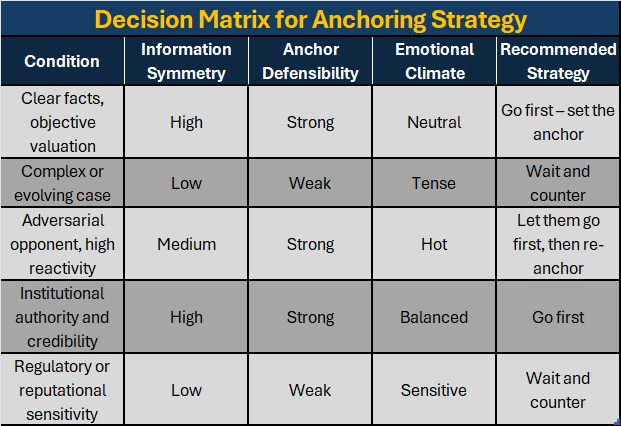
Lead with the first offer when:
- You have a strong evidentiary foundation—valuations supported by comparables, expert reports or quantifiable damages.
- The information environment is symmetrical; both sides know the key facts.
- You (or your organization) hold recognized authority and credibility.
- The emotional tone is stable, and early framing can shape expectations before escalation.
Hold back and counter when:
- Key facts or damages remain uncertain.
- Your position could be easily attacked or undermined.
- You need diagnostic insight—to see how the opponent values the case.
- The optics of an early low offer could appear insincere or create bad-faith exposure.
- The opposing party is highly reactive and predictably rejects early proposals out of hand.
The decision to go first or respond isn’t philosophical; it’s situational. Skilled negotiators gauge defensibility, information symmetry and emotional climate before deciding who should draw first.
The Written Offer: Anchoring With Evidence
The first article of this series, “Negotiation Is the Job: Reframing Defense Work in an AI-Enhanced Era,” emphasized the importance of the written word. Nowhere is that truer than in anchoring.
A written offer package isn’t just a courtesy; it’s a strategic tool. It allows you to:
- Explain your theory of value. Don’t just name a number—show your reasoning.
- Visualize exposure. Use forensic evidence, verdict data, charts or medical cost summaries to make the logic visible.
- Preempt emotional framing. Facts and logic can neutralize narrative-driven demands.
- Create permanence. Written arguments can be shared, studied and absorbed long after the call ends.
In many files, the defense’s written offer is the only message the plaintiff’s attorney reads carefully. That moment deserves design. Anchoring with evidence turns a number into a story of thoughtful analysis and fairness.
Offer Packages as Strategic Tools
A persuasive opening offer package has structure and sequence. Think of it as a mini-brief designed to move minds, not just numbers.
- Chronology – Outline the factual sequence that frames causation logically.
- Liability Analysis – Summarize defense strengths clearly and respectfully.
- Exposure Discussion – Present non-economic and special damages realistically.
- Venue Data and Comparables – Ground your valuation in empirical context.
- The Offer Itself – Present it as the rational and natural conclusion of your analysis.
Each section supports the same goal: to make your anchor feel inevitable.
A well-built offer package reframes risk perception—shifting focus from emotion (“what happened”) to probability (“what outcomes are likely”).
The Psychology of Counter-Anchoring
Even when the other side anchors first, all is not lost.
You can re-anchor by introducing competing frames:
- Reference objectivity: “Settlement data in this venue shows a median outcome near $x.”
- Reframe probability: “Even assuming liability, the chance of damages being awarded as claimed is low.”
- Redirect focus: Shift discussion from dollar amounts to decision points—liability apportionment, causation arguments or coverage issues.
Counter-anchoring works not by rejecting the initial number but by redefining what “reasonable” means.
Practical Techniques for Claim Professionals
- Prepare before numbers are exchanged. Establish internal valuation ranges early.
- Practice anchor inoculation. Role-play extreme demands to strengthen calibration.
- Avoid echoing the opponent’s anchor. Say “we’re not in that range,” not “we’re not near your $5 million demand.”
- Use mediators strategically. Let neutrals reposition midpoint expectations toward your frame.
- Debrief every negotiation. Ask: Did our anchor hold? Was it credible? Did we concede too soon?
The Ethics and Optics of Anchoring
Anchoring isn’t manipulation—it’s structured advocacy.
When supported by evidence and presented in good faith, a strong first offer promotes transparency and efficiency. The ethical risk isn’t in anchoring; it’s in letting unreasonable numbers dictate the narrative unchallenged.
Anchoring ethically means being transparent about your rationale, using verifiable data and respecting the other side’s decision-making process.
Controlling the Frame
Anchoring is inevitable. The only question is whose anchor will define the frame.
In today’s environment—where plaintiffs use data science, narrative design and AI—the defense cannot afford to start second.
Anchoring early, credibly and in writing transforms negotiation from reaction into leadership. It reclaims control of perception—and, ultimately, of outcomes.
Because in negotiation, the first number isn’t just a proposal.
It’s the story of what fair, reasonable and accurate looks like.

Interested in the complete set of articles in this series?
Download the PDF titled, “The Art of Negotiation: How to Lower Claims Costs by Controlling Social Inflation Internally” containing all the articles in the Negotiation Reclaimed Series.
 Viewpoint: Surplus Lines Insurers Offer Vital Cover for Growing Tech-Driven Industries
  Drivers Widely Overestimate Driving Ability Despite Engaging in Risky Habits: Survey
  Florida OIR Approves Four More HO Rate Cuts as Citizens Keeps Shrinking
  Humans Still Matter to Insurance Consumers, Says Big ‘I’ Survey