
















Last week, the National Transportation Safety Board reiterated recommendations to accelerate the phasing out of DOT-111 tank cars.
The agency raised concerns about the safety of DOT-117R railcars transporting hazardous materials following its investigation of a 2024 derailment in North Dakota.
The transportation safety agency also called for the safer placement of hazardous material cars in train consists.
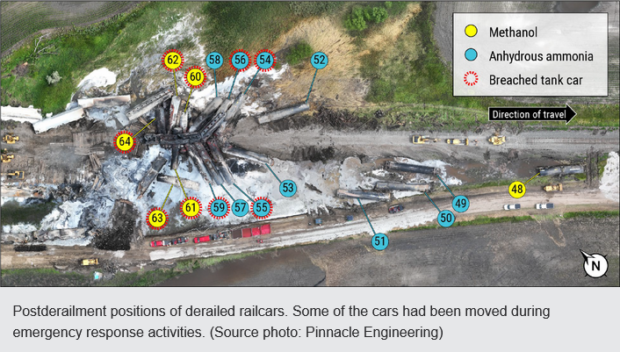
The Canadian Pacific Kansas City Railroad freight train derailed 29 railcars, including 17 hazardous material tank cars, when the train ran over a broken rail caused by a track bed collapse from a degraded culvert in Bordulac, North Dakota, on July 5, 2024. The derailed tank cars included DOT-111s, DOT-112s, and DOT-117s.
Methanol, a flammable hazardous material, was released from some of the derailed tank cars and led to a fire. The heat from the fire caused the release of anhydrous ammonia, a poisonous-by-inhalation gas, from other derailed cars. Three tank cars carrying anhydrous ammonia showed evidence of thermal tears due to fire exposure, the agency stated.
Although all nine hazardous material tank cars were breached during or after the derailment, releasing their contents, no injuries were reported.
This accident was one of the first major derailments involving a hazardous materials release that the NTSB has investigated since the 2023 Norfolk Southern Railway derailment in East Palestine, Ohio.
As in East Palestine, DOT-111 tank cars released hazardous materials in the Bordulac derailment.
The Bordulac investigation found that the continued use of DOT-117R tank cars, which are retrofitted DOT-111 tank cars with a thinner shell thickness, has not resulted in the same safety improvements as newly built DOT-117J tank cars.
“NTSB investigations have long shown that DOT-111 tank cars are dangerously inadequate, particularly because they are highly vulnerable to puncture during derailments,” a release on the subject stated. “The NTSB has repeatedly warned that these cars do not provide adequate protection and has called for stronger tank car designs to reduce the risk of hazardous materials releases, fires, and explosions.”
Among the new safety recommendations, NTSB recommended the Pipeline and Hazardous Materials Safety Administration:
- Issue guidance for the selection of an optimal pressure relief device based on the characteristics of the poison inhalation hazard material transported in a tank car.
- Develop and implement new thermal performance criteria for tank cars carrying liquefied gases classified as poison inhalation hazard materials that allow for no release of the tank car’s lading during a fully engulfing pool fire except through reclosing pressure relief devices.
- In coordination with the Association of American Railroads, identify the appropriate amount of separation between tank cars transporting poison inhalation hazard materials, including anhydrous ammonia, and those transporting flammable hazardous materials to reduce the likelihood of poison inhalation hazard tank cars being exposed to pool fire conditions.
The NTSB also recommended that the Association of American Railroads revise the formula for required pressure relief device flow capacity and the requirements for pressure relief devices and thermal protection systems to ensure the survivability of tank cars carrying poison inhalation hazard materials in engulfing pool fire conditions.
In addition, the NTSB recommended that CPKC revise its culvert inspection procedures to require every culvert to be inspected internally, either on foot when safe or by using technology, such as cameras or remotely operated vehicles.
 Finding Safer Ground: How Parcel-Level Data Is Redefining Wildfire Risk in California
  The Technology Taking Parametric Insurance Mainstream
  Vehicle Theft Continue to Drop, Down 21% in First Half of 2026
  States Question Safety, Challenge FAA Review of Commercial Drone Delivery Rules