











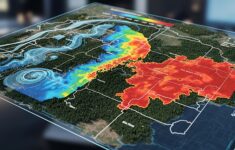



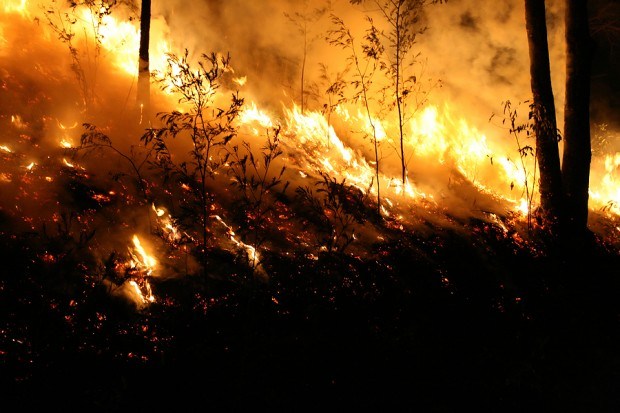
A new report highlights the $1.4 trillion in exposure to 2.5 million U.S. properties due to wildfire risk and how the key to identifying such properties lies in determining how wildfire spreads.
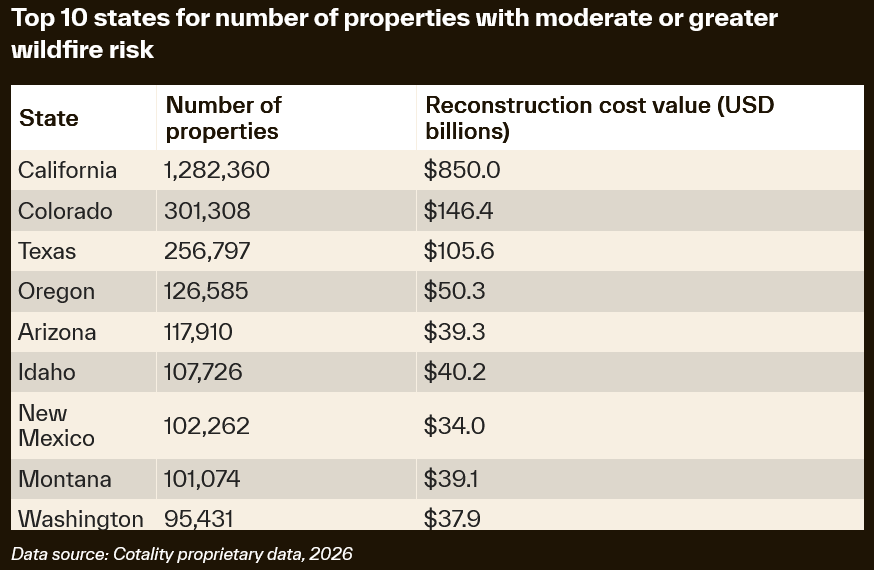
Ten states across the western U.S. carry a moderate or great risk of wildfire, according to Cotality’s 2026 Wildfire Risk Report, released this week.
The report identifies four key factors — risk assessment, property-level mitigation, insurance coverage, and dynamic landscape changes — that show how localized wildfire risk can escalate into broader exposure.
California carries the greatest share of exposure, with 1.28 million at-risk properties representing $850 billion in RCV.
The report found that nearly half of all at-risk properties in the top 10 states (49.9%) are located outside California.
Colorado and Texas hold nearly 560,000 at-risk properties and $252 billion in RCV, an amount that nearly matches the $277 billion carried by the remaining seven states combined.
Oregon, Arizona, Idaho, New Mexico, Montana, Washington and Utah round out the 10 most exposed states.
Los Angeles remains the largest exposed metro, with nearly 250,000 at-risk properties and $209 billion in RCV.
Four of the 10 most exposed metro areas are located outside California: Austin, Texas leads with over 100,000 at-risk properties and $49.2 billion in RCV, followed by San Antonio, Denver, and Spokane, Washington.
Lack of conflagration assessment leaves insurers with a critical blind spot
Conflagration — when the fuel for fire moves from wildland into a neighborhood, spreading home to home — is reshaping the geography of wildfire exposure and revealing a significant vulnerability that traditional risk models can overlook, Cotality modeling showed.
Layering conflagration potential onto a traditional wildfire risk score can create a more holistic view of a property’s risk and add as many as 40 points to its risk score, pushing meaningful hazard risk deep into neighborhoods legacy maps previously classified as low risk, the data assessment provider said.
According to Cotality’s property-level mitigation score — which weighs community protections, conditions on and around the property, and how fire-resistant a home is built — homes in the top 10% carry expected losses roughly 78% below the statewide average. The bottom 10% runs more than 10 times that average, about $47 in expected loss for every $1 on the best-prepared homes.
“Hearing that a property has a higher risk score than previously thought should not be thought of as a bad thing. It shows that new data and analytic capabilities create an opportunity to protect properties more effectively in the evolving wildfire environment we’re facing,” said Jamie Knippen, Cotality’s director of hazard insights. “This represents a significant opportunity for the entire market: it empowers carriers to move away from broad-brush risk assessments and safely expand their underwriting footprint, and actively rewards homeowners who invest in resilience.”
“New property-level data now empowers insurers to identify what additional steps homeowners can take to mitigate the risk on their properties and leverage that additional resilience in their decision-making. Expanding the assessment means going beyond terrain and vegetation to look at factors like structure density, building materials, wind patterns and ember exposure,” continued Knippen. “Carriers that account for these factors upfront can make sure homes are properly insured for the catastrophe they actually face – not just the forest fire, but the fire next door.”
When insurers drill down to property addresses to assess risk, they can then share that information with homeowners and provide mitigation incentives. A Cotality analysis of 6.8 million single-family residences found that modeled loss costs fall exponentially as mitigation improves.
In addition, the report found that static valuations are problematic because they contribute to the protection gap. Consistent analysis of repair and rebuilding costs in real time will reduce the gap.
Finally, by pairing real-time post-burn exposure with long-term pre-burn trends, carriers avoid risk assessment surprises as natural fuels regenerate, Cotality added.
 Zurich Insurance Group Completes Acquisition of Beazley, Names New Leadership for Insurer
  Nearly 100% of U.S Now Covered by NOAA’s Flood Mapping Tool
  Men Sentenced in Multi-State Stolen Construction Equipment Scheme
  Why Organic Mentorship Is Insurance’s Best Retention Tool