

















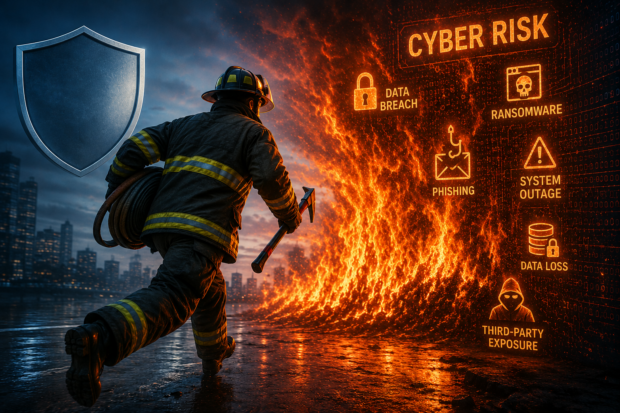
Does an estimated $10.5 trillion in damage costs related to cyber crime around the globe really represent an opportunity that the insurance industry should be tackling?
The question came up during the Casualty Actuarial Society’s Seminar on Reinsurance this week, after veteran insurance leader Mike McGavick pointed out that cyber insurers are paying loss amounts in the tens of billions—a drop in the bucket compared to the oft-cited $10.5 trillion amount. During a keynote address, McGavick asserted that involvement in the transfer of cyber and emerging AI risks is part of the industry’s purpose.
Related article: Exclude It, Harness It, Get Greedy: McGavick’s Take on Insurers’ AI Playbook
An actuary listening to McGavick’s remarks countered the view. There’s a school of thought that says the presence of cyber insurance fuels higher ransomware demands from bad actors, the actuary said. In addition, some risk analysts believe that “agentic AI is going to essentially make all encryption moot,” making it possible to hack super-complex 20-key-long passwords.
“So, is this risk that the insurance industry should be taking on? And are we going to have policies with so many exclusions that our ultimate policyholders are not going to find them valuable and not even want to buy them?” the actuary asked the former leader of XL Group and Safeco, who now serves as non-executive director and adviser to mea Platform, which uses AI to deliver end-to-end automation across all aspects of insurance operations.
“The challenge is not can we take on that whole loss profile by ourselves. The challenge I’m offering is what piece of it can you take off. Are there bits of it that do work in an insurance setting with an insurance mindset?” he said, expanding on a point about alternative capital markets participation that he made earlier during the Q&A session when describing the role of reinsurance brokers in an insurance world transformed by AI-assisted underwriting.
“My favorite example of where we came up with something that was more trusted and changed the sector is the whole alternative capital market in [property-catastrophe] reinsurance. That is the story we should all be looking to as we think about these new products.”
“If we can get casualty over the line so that we can have better modeled risks and can start packaging for additional capital participants, that’s going to be a magic moment… If we were attacking that problem I’ve described—the $10.5 trillion, if we could figure out any pieces of that to break off and solve through modeled and parametric trigger approaches—we would have capital chasing us down the street.”
Agreeing with the actuary, McGavick said, “You cannot go into this just throwing around limits or you’ll go bankrupt in no time. But we are hardly making a dent … We’re doing almost nothing and yet it’s one of the biggest risks the society faces.”
“Our job is to face risk. That is what we do. We don’t run from the fire. We should be going toward the fire—carefully, thoughtfully—and find if there are pieces that we can hive off.”
McGavick said he too worries about the level at which encryption may be defeated. “But it’s just going to be a war between the good guys and the bad guys. And it’s been [that way] with every technology that’s ever been invented …”
“That’s life and that can be modeled. But I don’t think that running from it is the right answer.”
“I think the reverse—or else we’re just saying we don’t care about the fastest-growing thing that matters in the world…”
“It doesn’t seem logical to me …. If you’re not there to try and protect some of that value, you just become increasingly irrelevant,” he said.
Later, he noted that it will take a government backstop to make cyber an insurable space. “The risks are so catastrophic that the industry doesn’t have the balance sheet to take that on. It’ll take a partnership that encourages more pieces to be taken off,” he said.
While much of McGavick’s keynote centered on the idea that domain-specific language models and AI agents for insurance will give underwriters the time and information they need to create products that make insurers more relevant to society, others worried that AI assistants make human assistants irrelevant, eliminating the need for anyone below the level of expert underwriter or actuary.
“That human assistant team wasn’t just waste. There were people growing and developing and learning,” one actuary said.
“Experts became experts by learning through doing detail work earlier in their careers. If AI replaces that work, how do we create experts to handle AI agents 10 to 20 years in the future?” another asked.
“I actually don’t think the assistants go away. They become wildly better used and better centers of profit,” McGavick said, responding to the first. “The work product that comes from all of you driving those agentic assistants is going to be unspeakably larger”—and insurers will be able “to take on more risk, to underwrite more cases and hopefully to spend some found time thinking through the problems we’ve been talking about. That’s where I hope that energy goes.”
“There’s the big debate: Is this now the coming [of] massive unemployment, or is this an explosion of human creativity? I’m on the side of it’s an explosion of human creativity. We’re all hungry to make a difference,” he said.
As to the question of how to create future experts, McGavick said, “We will simply need to. There’s not going to be some option. There’s not a world where the regulator’s going to say, ‘Let the AI robots do whatever they want.’ There’s going to be a constant requirement [for a] sign-off [by] some human who asserts they know what’s happening and why it’s happening.”
“That is a growing field of people, not a declining group of people. It’s different work, but it winds up being the same—because the tells of bad behavior are going to be the same. All those things are still going to be true. And we still have to have our head above the parapet at what’s going on in the broader society and how does it shape what we’re doing.”
“None of that disappears. We just become better at it… It’s similar to the question of how do we train new people in the industry? Because we need to and because we’re going to have more and more to govern than we’ve had before. We still have to be able to assure the world at large and the regulators that guide us that we’re doing these things responsibly, fairly, ethically… That doesn’t get rid of the humans. In fact, it just makes our translation of trust more valuable,” McGavick concluded.
 Your Rating Rules Survived the Migration. Did Your Prices?
  Viewpoint: Pricing Wildfire Risk Is Not the Same as Reducing It
  Building a Glass Box Not a Black Box at Elara Spatial
  Weather Service Confirms 2 Tornadoes Touched Down in Arizona Last Week