
















Merritt Farren, a former high-ranking legal executive at Disneyland and Amazon, has launched a bid to become California’s next insurance commissioner. His platform focuses on stabilizing the state’s insurance crisis by enticing private insurers back to the state.
Executive Summary
Consumer intervenor Merritt Farren is running for California Insurance Commissioner on a platform to revive the private market and make the state’s FAIR Plan—the insurer of last resort—obsolete.Farren contends the current system is fundamentally broken, particularly the state-mandated FAIR Plan. He cites critical flaws, such as a lack of transparency and chronic undercapitalization, which leave the plan unable to handle mass wildfire claims without additional funding from private insurers. The threat of such unpredictable financial demands has become a major disincentive for carriers to operate in the state, ultimately fueling a crisis of availability and affordability for homeowners.
More than 668,000 property owners presently buy high-priced insurance from the FAIR Plan, more than double the number from 2022. The unprecedented surge in FAIR Plan enrollment has pushed its total financial exposure to $724 billion, a sizable 230%increase since 2022. The surge is attributable to the state’s most recent wildfire-related losses. Insurers have paid out more than $22.4 billion for claims resulting from the January 2025 Palisades and Eaton fires, according to the California Department of Insurance.
Rapid expansion, combined with the catastrophic losses from the Palisades and Eaton fires, has placed a severe financial strain on the FAIR Plan.
As Carrier Management previously reported, Farren’s family home was destroyed in the Palisades fire. He subsequently filed an insurance claim with State Farm. Although the claim was handled fairly and expeditiously, his neighbors experienced significant frustration and distress, including extended delays in claims processing, excessive documentation requests, claims denials for smoke damages, and lowball rebuilding estimates. “The shock for many was as traumatizing as losing their homes,” he said in November 2025.
Related article: The Good Neighbor
Having worked for many years as Amazon’s associate general counsel and Disneyland’s general counsel—companies often extolled for exemplary customer service—he successfully petitioned the state to permit him to intervene in the insurance department’s ongoing rate review proceedings involving State Farm, based on his conviction that the insurer had little regard for customers. Such interventions typically are made by professional consumer advocacy groups like Consumer Watchdog, not private citizens. Undeterred, Farren applied his intellectual rigor to learning all he could about insurance regulation in California, as well as in Florida, Texas and other states, and even across Europe.
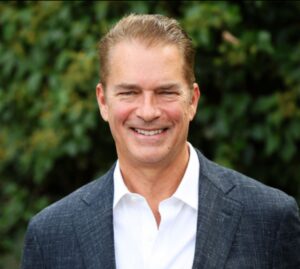 “Running for office is the most effective way for me to pursue the urgent regulatory changes required to solve this longstanding issue,” Farren said. “While those who created the FAIR Plan had good intentions, it was fundamentally flawed from its inception.”
Merritt Farren
After gaining a deep understanding of the industry, Farren developed a series of regulatory reforms aimed at increasing market competition and ensuring fairer pricing. These changes are specifically designed to modernize the system and eventually eliminate the need for the FAIR Plan. Following extensive consultations with industry experts and state legislators, he has now announced his candidacy for state insurance commissioner, seeking to succeed Richard Lara when his term concludes on Jan. 4, 2027.
“Running for office is the most effective way for me to pursue the urgent regulatory changes required to solve this longstanding issue,” Farren said. “While those who created the FAIR Plan had good intentions, it was fundamentally flawed from its inception.”
The CAL Reinsure Alternative
Originally created as a temporary safety net of last resort, the California FAIR Plan’s rapid expansion is blamed by many for actively deterring private competition among private insurers. Carriers are mandated to fund the plan’s losses based on their market share, creating massive, unpredictable liabilities. This possibility struck in February 2025 following the devastating Eaton and Palisades fires, when the plan levied a staggering $1 billion assessment on member insurers to cover its shortfall. “These sudden financial hits can erase years of profit, scaring off new entrants and destabilizing established companies,” Farren said.
Other regulatory impediments also dissuade carriers from doing business in the state. Under California’s Proposition 103, insurance rate increases are subject to a lengthy public review process that often drags on for over a year. The delay prevents insurers from quickly adjusting their actuarial assumptions to rising wildfire risks and inflation, causing systemic mispricing. Cautious over such potential losses, major carriers have exited the market or halted writing new business, forcing more homeowners into the FAIR Plan. This increased exposure heightens the risk of FAIR Plan assessments, which further repels private insurers from market participation—a self-reinforcing loop that cannibalizes the state’s voluntary insurance market, Farren maintained.
Related articles:
California vs. Florida: A Tale of Two Insurance Markets
Calif. Commish Calls for Biggest Reform Since Prop 103; Planned Fixes Detailed
Sorry, Wrong ZIP Code: Regulators Move Forward With California Reforms
Farren is not alone in grasping the underpinnings of the state’s insurance crisis. In response, the California Insurance Department put forth its Sustainable Insurance Strategy, which modernized regulations in January 2025 to attract insurers back to the state. For the first time, carriers can use forward-looking catastrophe models and pass on their reinsurance costs to policyholders. In exchange, insurers must commit to “writing a minimum of 85% of their statewide market share in high-risk, underserved areas”—meaning their presence in wildfire zones—to reduce reliance on the FAIR Plan.
Strengthening this effort, state leaders introduced the Make It FAIR Act in February 2026 to improve the plan’s transparency, hire more staff to address consumer claims and complaints, and mandate more comprehensive coverage options. The legislation would require the FAIR Plan to establish a formal capital and liquidity management plan, ensuring it remains solvent after future disasters.
Related article: Bill Introduced to ‘Transform’ the California FAIR Plan
Farren argues these efforts don’t go far enough to quickly reduce the hundreds of thousands of people trapped in the FAIR Plan, nor do they prevent its further expansion after the next catastrophic wildfire. “While the FAIR Plan provides a vital service to consumers, it creates a fundamental disincentive for insurance companies to operate here. Rather than tinker with fixing the plan, we should be finding ways to eliminate the need for it entirely,” he said.
“While the FAIR Plan provides a vital service to consumers, it creates a fundamental disincentive for insurance companies to operate here. Rather than tinker with fixing the plan, we should be finding ways to eliminate the need for it entirely,” Farren says.
To that end, and after consulting with a core group of advisers including veteran insurance brokerage executives Alex Rosenfeld at Acrisure and Dave Lebental of Heffernan Insurance Brokers, Farren has proposed “CAL Reinsure.” The initiative is designed to pull the state back from a total market collapse by transferring the catastrophic risks of community-wide fires away from private insurers. By removing the threat of massive, unexpected assessments after a wildfire, this single action would allow companies to write statewide policies again with confidence, restoring a stable and competitive insurance market for all Californians.
A Novel Solution Emerges
Under Farren’s proposed system, a “community fire” is defined as a fire that destroys at least three homes. This risk for every insured homeowner and renter in California would be pooled into a new, state-organized entity (CAL Reinsure). If a home is lost in such a fire, policyholders would receive their full coverage amount almost immediately. “There would be no delay, no arduous process of cataloging lost items, and no negotiating rebuilding costs,” Farren explained. In effect, a “community fire” acts as a parametric trigger, by passing the traditional claims process for an instant payout.
“A $1.5 million policy means an immediate $1.5 million payment,” he said. “This eliminates all the post-destruction friction and associated costs that currently plague the claims process, reducing consumer costs and ensuring immediate financial relief. Having the payment in hand will end the devastatingly slow pace of rebuilding the homes of families traumatized by loss.”
The $1.5 million payment, he clarified, would be provided for three components of a total loss: the cost of rebuilding the home, declared contents, and temporary lodging. While CAL Reinsure absorbs total losses, partial damage from a community fire would remain covered under the general fire risk provisions of a homeowner’s existing policy.
Here is how the system would work:
- Normal Policies: Insurance carriers would still write homeowner policies as they normally do today, covering the broad range of general risks.
- The Component Fee: A specific fee for the community fire component would be included in the cost of coverage charged to the insured.
- Total Risk Transfer: 100% of the risk of total loss under this specific Community Fire component would be reinsured by CAL Reinsure, fully relieving the private insurance carrier of that liability.
- Fee Flow: 90% of the component fee paid by the insured would be passed from the insurance company to CAL Reinsure to build its reserves. The insurance company retains 10% for administration and writing the coverage.
- Funding: CAL Reinsure would be funded by these component fees and also by a percent levy placed on all non-medical/dental insurance policies written in the state.
- Prompt Payouts: In the event of a total loss from a community fire, the insured is entitled to a 100% payout to policy limits within 30 days. The insurance company pays the insured and is then promptly reimbursed by CAL Reinsure.
In the event that massive community fire losses deplete CAL Reinsure’s capital, the state-backed entity would issue bonds to cover the shortfall. These bonds would be secured by a mandatory, ongoing fee applied to all insurance policies sold in California, creating a reliable income stream to attract investors and repay bondholders over several years. In effect, this structure ensures the entity remains solvent and capable of meeting its obligations even after a historic catastrophe.
This strategy is modeled after Florida’s state-backed hurricane insurance program, the Florida Hurricane Catastrophe Fund, which has the authority to issue bonds to pay claims if cash reserves are exhausted after a major storm. If capital markets fail and bonds cannot be sold, the State of California would provide short-term, interest-bearing loans to ensure immediate liquidity for homeowners who have lost their homes.
France’s wildfire catastrophe compensation plan, Régime d’indemnisation des catastrophes naturelles, also informs Farren’s concepts. That system suggests that climate change risk is a societal challenge beyond the scope of private underwriting. Funded by a broad levy on property insurance and backed by a state guarantee, the French model serves as a global example of how public reinsurers can maintain market stability in an era of increasing environmental risk, he asserted.
“Just like here, many homeowners suffer losses related to climate change in France—from those who lose homes to increasingly common wildfires in the oak forests of Provence and the resin-filled pine forests west of Bordeaux to farmers whose crops fail due to drought,” said Farren, whose family owns a walnut oil-producing orchard in the country.

He further noted that CAL Reinsure would not be prohibited from entering the global reinsurance market, where industry giants like Swiss Re or Lloyd’s could “slice and dice” the risks into layers according to their specific risk appetites. While these varied financial features may appear complicated, the internal “mechanics” are designed to be seamless for the consumer, he said.
“The bottom line is that by shifting the entire risk of massive wildfires off private insurance companies’ balance sheets, carriers can write policies statewide without the constant fear of going bankrupt from the FAIR Plan’s financial unpredictability,” Farren wrote in an email. “By isolating a community fire from less catastrophic risks, CAL Reinsure will stabilize the entire insurance ecosystem and eliminate the need for the FAIR Plan, allowing the insurance market to function properly once more.”
Aside from these key features, Farren’s plan posits that robust home insurance coverage is vital to protect not just homeowners but entire communities and the local economies that drive California’s prosperity. Today, he maintains, homeowners remain dangerously underprotected. “The dismal post-fire rebuild statistics following recent California community fires are a testament to how poorly the current system works, devastating families and slowing community recovery,” he said.
The scale of the crisis is evident in the numbers. One year after the January 2025 wildfires in Altadena and the Pacific Palisades, fewer than a dozen of the thousands of homes destroyed had been fully rebuilt. Such delays are part of a troubling historical trend: of the more than 22,500 homes destroyed in five major California fires between 2017 and 2020, fewer than four in ten (38%) had been rebuilt by 2025, according to an analysis by the Los Angeles Times.
Related articles: Homeowners Critical of FAIR Plan, State Farm A Year After LA Wildfires; The LA Fires Destroyed 11,000 Homes. Less Than 10% Have Permits to Rebuild
CAL Reinsure addresses the recurring crisis, in part, by building in direct incentives for prevention, said Farren, noting that the actuarial risk assessment will account for the degree to which a home has been hardened for fire protection. “This creates a clear financial signal for homeowners to invest in fire-safe building practices—a crucial step in driving down long-term costs and building truly resilient communities,” he explained.
A Delicate Balancing Act
At press time, Farren had presented the idea for CAL Reinsure to California Deputy Commissioner and Legislative Director Josephine Figueroa and Deputy Commissioner for Consumer Services & Market Conduct Tony Cignarale. “They suggested that I introduce it to California legislators,” he said.
Regarding his candidacy for insurance commissioner, he anticipates significant pushback, commenting that one political figure told him a campaign is won by
“beating up on insurance companies because their reputation is so bad,” he said. Farren refuses to do that. His strategy is to approach the issue with a balanced perspective, believing that typical politics ultimately distracts from problem-solving. “We need a system where insurance companies can serve consumers and do well at the same time and not be mutually exclusive,” he asserted.
Before officially launching his campaign, Farren sought counsel from J. Robert Hunter, a figure who spent his career balancing the interests of carriers and consumers. Hunter’s extensive resume includes serving as a federal insurance administrator, Texas insurance commissioner, and founder of the National Insurance Consumer Organization. “Bob’s background spoke to me personally, particularly his work with Ralph Nader and his lifelong support of the ‘little guy,'” Farren said. “He encouraged me to run.”
While the field for insurance commissioner includes a former San Francisco supervisor and both former and current state senators, Farren believes his approach is the only one that addresses the root cause of the insurance crisis. He argues his plan doesn’t seek to “fix the unfixable” FAIR Plan but to replace it with a functioning market. “With CAL Reinsure, competition will return,” he said. “It provides a path for the hundreds of thousands currently trapped in the FAIR Plan to finally access affordable coverage.”
His timing may be critical. In a move that underscores the urgency of the crisis, the FAIR Plan recently proposed an average rate hike of 35.8%, set to hit policy renewals starting April 1, 2026, according to California news reports.
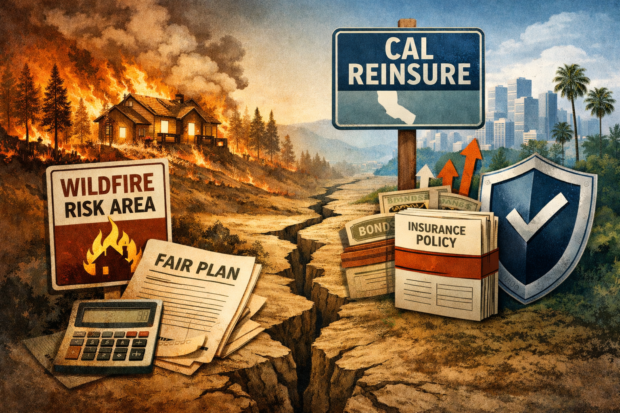
* Featured images were AI-generated (ChatGPT and Copilot)
 Register: AI Tools for FNOL & Digital Claims Intake ‘Demo Day’ on September 16
  Nearly 100% Chance of a Mediterranean Tsunami Within Next 30 Years
  In Bots We Trust? For Insurance?
  Building Trusted Insurance Brands: Less ‘Gotcha’ at Farmers