




















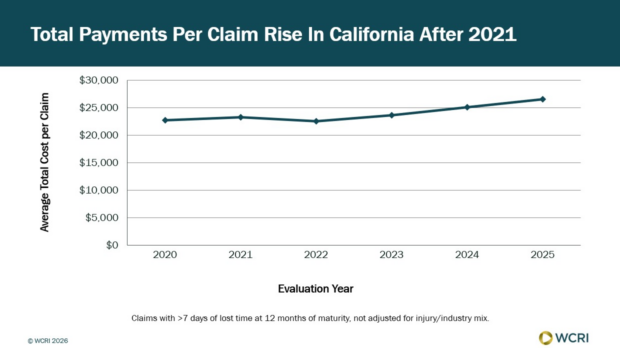
Newly released data highlights how total payments per claim in California’s workers compensation system have risen steadily since 2021, according to the Workers Compensation Research Institute (WCRI).
The report, CompScope™ Benchmarks for California, 2026 Edition, authored by William Monnin‑Browder, examines how costs and system performance in California’s workers compensation system have changed between 2020 and 2025 in comparison to other states.
For claims evaluated in 2025, total payments per claim that included more than seven days lost time increased by about 6%. The rise closely follows the increase seen between 2022 and 2024, the data showed.
Indemnity benefits, medical payments and benefit delivery expenses per claim all increased in 2025.
Modest growth was seen in indemnity benefits per claim, which increased by 4% in 2025, a 3-4% reduction seen between 2022 and 2024.
Medical payments per claim grew 7% in 2025, following a 5% increase in 2024 and little change in prior years, the report found.
According to Monnin‑Browder, injured worker wage increases were a persistent factor contributing to growth in indemnity benefits per claim, “while year-to-year changes in indemnity benefits per claim were affected by fluctuations in key measures of permanent partial disability (PPD)/lump-sum settlements.”
Benefit delivery expenses per claim grew 9% in 2025, following increases of 5-8% from 2022 to 2024.
California had higher total costs per claim for all paid claims than in other study states due to a higher percentage of claims with more than seven days of lost time.
Data showed that the average cost per claim for claims with more than seven days of lost time in California was typical of other states studied.
The state also held the top spot for the longest duration of temporary disability (TD) benefits with PPD benefit systems (22 weeks), higher benefit delivery expenses per claim, and more frequent PPD/lump-sum settlement payments compared with other study states with PPD benefit systems, while the average PPD/lump-sum settlement payment was typical, the report found.
Other states’ TD benefits duration grew after 2022.
All 18 states studied saw an increase in total costs per claim between 2022 and 2025. California’s growth came within the median range, as Kentucky and Arkansas saw double-digit increases.
Professional services costs increased, on average, by 2% in most states.
Medical cost containment expenses represented 25% of medical costs, the highest share among the states studied.
Defense attorney involvement increased, but payments have remained stable since 2019, data showed.
The report outlines key factors that could have contributed to the changes in the study states, including changes to demographics and the job market, rising comorbidities and health issues, provider shortages leading injured workers to seek care from advanced practitioners, and provider integration impacting care.
Factors that may have impacted California’s workers comp cost increases include a higher unemployment rate between 2023 and 2025, a drop in job openings to pre-pandemic levels, and an increase in hourly wages.
“In California, as in most states included in our study, total payments per claim rose steadily after 2021,” said Sebastian Negrusa, vice president of research at WCRI. “Understanding what is driving this growth requires looking beyond a single year and examining longer‑term trends and system features.”
To learn more about the study visit:
https://www.wcrinet.org/reports/compscope-benchmarks-for-california-2026-edition/.
 Who Structures the Problem in AI-Assisted Insurance Decisions?
  Insurers Say French Supermarkets’ Cyber Insurance Unlikely to Cover Food Losses
  Insurance AI’s Next Test: Can Carriers Trust the Data?
  Vehicle Finance Fraud Now a $10.4B Industry: NICB