


















Three technologies are having a profound impact on how insurance can help manage and mitigate risk:
- Internet of Things (IoT) technology is supplying large amounts of risk data, often in real time.
- The proliferation of artificial intelligence (AI) tools allows companies to rapidly make sense of that data.
- Advances in data storage, such as cloud storage and blockchain, provide a secure repository for storing and sharing risk data.
Internet of Things
The insurance sector is increasingly adopting IoT technology to transform traditional risk transfer models into risk prevention and mitigation strategies.
Real-time data from sensors and automated systems are used to detect and respond to incidents, leading to more informed decision-making and potentially reducing claim frequency.
The insurance sector’s embrace of IoT and connectivity represents a significant evolution in its approach to risk management, potentially offering customers a greater degree of protection.
Artificial Intelligence
AI’s impact on the insurance value chain is multifaceted, enhancing underwriting accuracy, streamlining operations, and improving risk assessment and pricing.
ChatGPT, a generative AI program garnering attention, has become the fastest-growing consumer application in history with over 100 million monthly active users.
In managing risk, AI tools are being used to provide new insights and predictive models for a wide variety of hazards, including flood risk, vehicle collisions, electrical surges and more.
Data Storage
With the proliferation of cloud storage for managing unstructured data and advances in blockchain technology, there are now more accessible ways to manage data.
Blockchain is a complex, ledger-centric technology that has a multitude of benefits, such as enhanced data security, immutability and optimized data sharing.
For one example, parametric insurance, in which a payout is triggered by a specific predefined event, is increasingly being looked at for various climate risks, such as a community’s flood losses. Blockchain can be used to automate all or part of a parametric smart contract.
Related article: CEO Viewpoint: Predict and Prevent Just Makes Economic Sense
***
Read More 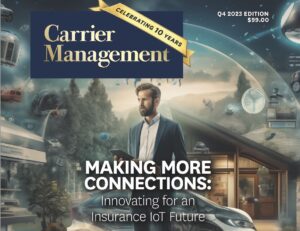
Carrier Management has previously published articles about the Predict and Prevent approaches described by Peter Miller of The Institutes in the accompanying article.
Most recently, CM published a collection of these articles in a special magazine feature describing insurer IoT use cases for personal and commercial lines, “Making More Connections, and in articles about AI used in wildfire modeling, “California Insurance Market in Crisis.”
Selected articles include:
- Creating the Tipping Point for Insurance IoT: How HSB and Its Partners Are Creating a Playbook for the Future
- Repeat, Repeat and Repeat Again: How The Hartford Embeds IoT Capabilities in Commercial Insurance Businesses
- Real-Time Data and Mitigation: How Tokio Marine Is Changing Risky Behaviors
- The State Farm Vision: Ecosystem Capabilities for the Insurer of the Future
- Grid-by-Grid: How One Tech Firm Dissects California Wildfire Risk to Sell Insurance and Reinsurance
- California Wildfires Dwindle as Premiums Surge
- A Community-Based Solution: How Actuaries and Fire Chiefs Can Tackle WUI Risk Together
The use of AI and geospatial information technology for flood was detailed in an earlier edition, “Eyes in the Sky: Geospatial Information Systems,” including these articles:
 How Insurance Can Turn Maintenance Into Measurable Competitive Advantage
  More Insurance M&A Deals on the Horizon?
  Report Reveals Mixed Collision Trends as Fleets Work to Implement Safety Programs
  NY Lawmakers Urged to Have Faith in Auto Insurance Reform Numbers. But Do They?