














Supply chain shocks extend beyond the Strait of Hormuz, according to research from Verisk Maplecroft, which finds roughly one-third of major ports and airports are exposed to ‘high’ or ‘very high’ risks of disruption.
The risk intelligence company assessed risks to the world’s 500 busiest ports and 50 busiest airports from one or more acute threats related to geopolitical risk and conflict, natural hazards and domestic security.
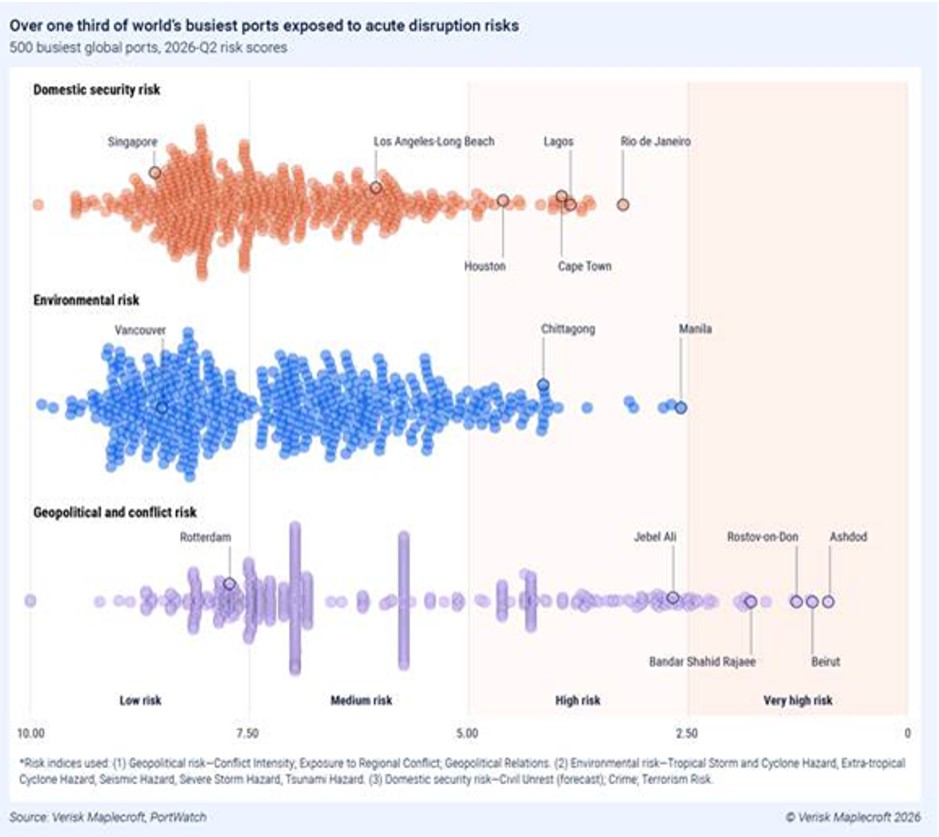
Ports handle 80% of global trade by volume and are central to the continuity of global trade, the company said in a media statement, which also revealed that Verisk Maplecroft identified 176 out of the 500 ports as ‘high’ or ‘very high’ risk for at least one of the three overarching threat factors. Among the three, the geopolitical risk and conflict pillar that stood out, with 23% of 500 ports sitting in the ‘high’ and ‘very high’ risk categories.
The Verisk Maplecroft report flags Jebel Ali Port (UAE) and Salalah Port (Oman) as those disrupted by the closure of the Strait of Hormuz, adding that major port closures elsewhere stemming from interstate or civil conflict have also occurred in Odesa (Ukraine), Tripoli (Libya), and the Port of Sudan in recent years.
Ashdod, Israel’s busiest commercial seaport, is rated the highest risk port in the geopolitical and conflict risk rankings. Others in the top 10 are:
- Beirut (Lebanon)
- Haifa (Israel)
- Rostov-on-Don, Azov, Novorossiysk, Tuapse (Russia)
- Bandar Shahid Rajaee (Iran)
- Pakistan’s two largest ports
As for airport threats, air freight accounts for an estimated 25%-35% of world trade by value for urgent, costly and perishable goods, including semiconductors, pharmaceuticals, fresh produce and ecommerce shipping. As is the case for ports, geopolitical risk and conflict is the biggest concern—with potential disruptions ranging from “grey zone tactics,” such as geopolitically motivated drone overflights, to direct attacks on airports.
Half of the 10 highest-risk airports for geopolitical risk and conflict in the Verisk Maplecroft assessment are presently in the Middle East countries of Qatar, UAE, Saudi Arabia and Turkey.
Other Threats: Domestic Security and Natural Hazards
As for domestic security threats to ports, only 5% of port cities are rated “high” or “very high” risk. Two of them are in the U.S.—Houston (18th) and Baltimore (19th). Others around the world include top-ranked Rio de Janeiro (1st), as well as Lagos, Nigeria (6th) and Cape Town (10th).
In total, 9% of port locations are rated “high” or “very high” risk for environmental risk, with Manila ranked first. Others in the “high” and “very high” environmental risk categories are: Manzanillo (3rd), Osaka (7th), Tokyo (13th), Nagoya (14th), and Chittagong (16th).
According to Verisk Maplecroft, roughly one-third (32%) of all Japanese ports are rated “high” or “very high” risk.
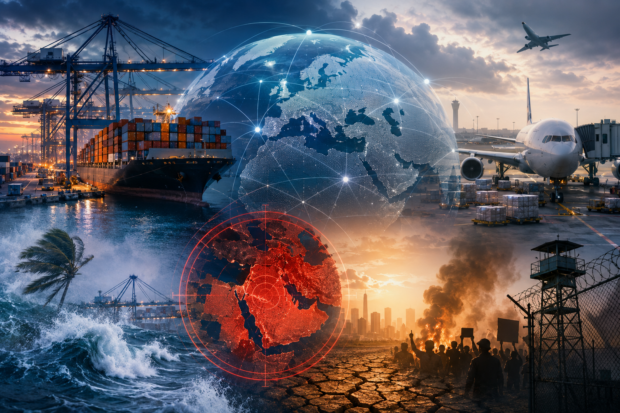
Featured image is AI-generated (ChatGPT)
 The Technology Taking Parametric Insurance Mainstream
  Why Your Boss Matters More Than Remote or Hybrid Work When It Comes to Burnout and Job Satisfaction
  US States Allege Corteva Spinoff a Bid to Evade PFAS Liabilities
  Amazon Cargo Plane Pilots Weren’t Warned About Wind Before Miami Crash: NTSB