



















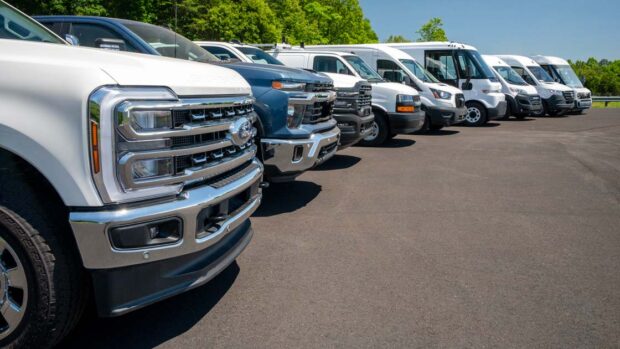
The Insurance Institute for Highway Safety has released results of its first evaluations of commercial vehicles.
Four of the first nine heavy-duty pickups and cargo vans to be assessed come with a suite of features that IIHS considers essential for driver protection — including standard front and side airbags, advanced seat belt technology and effective seat belt reminders.
IIHS plans to evaluate these same vehicles for attributes that can protect other road users, including automatic emergency braking and headlights.
“For decades, IIHS has helped consumers prioritize safety in their car-buying decisions,” IIHS President David Harkey said. “These initial evaluations mark our first foray into commercial vehicles, which for too long have been an afterthought when it comes to regulations and safety information.”
In 2023, 6,535 people were killed in crashes involving heavy- or medium-duty trucks or light vans, accounting for 16% of all roadway fatalities in the U.S. Reducing that toll is a key part of the Institute’s 30×30 vision of reducing fatalities 30% by 2030.
Many government standards for passenger vehicles don’t apply to delivery vans, box trucks, tractor-trailers and certain work pickups, the IIHS noted, meaning features as basic as airbags are not required on these vehicles.
Headlight performance that meet government standards varies widely, and U.S. regulators do not currently require automatic emergency braking (AEB) or other advanced driver assistance systems for commercial vehicles, especially important for heavy trucks and vans, whose large size makes them a greater danger to other road users.
The initial evaluations focus on cargo vans and Class 3 pickup trucks. Class 3 pickups have a gross vehicle weight rating (GVWR) of 10,001 to 14,000 pounds. The GVWR is the maximum weight a vehicle can carry safely, including passengers, cargo and the weight of the vehicle itself.
Plans for assessments are underway for larger, Class 4-6 trucks with a GVWR of 14,001 to 26,000 pounds.
Vital safety features
The driver protection assessment focuses on airbags, seat belt force limiters and pretensioners, and belt reminder systems because they not always included in commercial vehicles.
Research on passenger vehicles has shown that front airbags reduce driver fatalities in frontal crashes by 29%, while side airbags reduce the risk of driver death in a side crash by 25%-52%.
Seat belt pretensioners help to tighten the belt around the driver the instant that a crash occurs. Force limiters reduce the stress on the driver’s body with a controlled extension of the belt a split second later, making it less likely to cause chest injuries. In passenger vehicles, IIHS crash tests have demonstrated that the two technologies are often the difference between acceptable and excessively high chest injury metrics.
Loud and persistent seat belt reminders are important because commercial vehicle operators may neglect to buckle up when making frequent stops for pickups and deliveries — even if company policies require drivers to be belted. An IIHS study of part-time belt users showed that persistent belt reminders increased belt use by 30%.
Driver protection checklist
To evaluate driver protection, IIHS uses manufacturer documentation and other sources to determine whether airbags, pretensioners and force limiters are included as standard equipment on the driver side. Crash testing was not performed to evaluate their effectiveness.
Engineers evaluate seat belt reminders on the Institute’s test track. The evaluation is similar to the one IIHS uses to rate passenger vehicles but only considers the driver seat.
To be considered effective, the seat belt reminder must include a visual warning light or indicator and a persistent audible tone that is loud enough to be heard easily over the background noise in the vehicle cabin. Both alerts must begin within 30 seconds when the driver’s belt is unfastened and the vehicle is going 6-24 mph. At faster speeds, they must begin within two seconds. The tone and visual indicator should continue for at least 90 seconds or until the driver’s belt is fastened.
In contrast, current federal standards only require the audible signal to last 4-8 seconds, though stricter rules are slated to go into effect for passenger vehicles and some of their commercial counterparts in 2028.
How they stack up
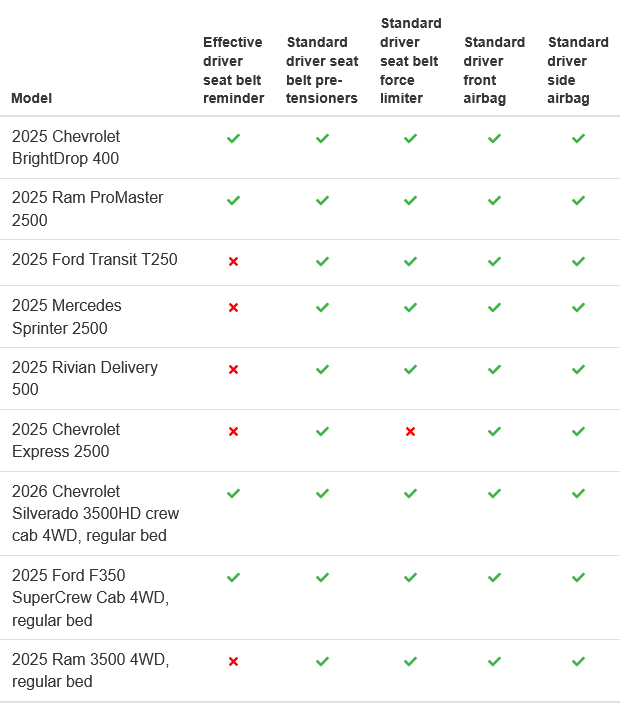
Two of the three pickups evaluated — the Chevrolet Silverado 3500HD and Ford F350 SuperCrew — check all the boxes for driver protection. The Ram 3500 comes with the necessary airbags and key seat belt technologies but lacks an effective seat belt reminder.
Two cargo vans — the Chevrolet BrightDrop 400 and Ram ProMaster 2500 — also have all the essentials. However, the Ford Transit T250, Mercedes Sprinter 2500, Rivian Delivery 500 and the Chevrolet Express 2500 lack effective seat belt reminders. The Express 2500 is also missing standard force limiters.
Complete results for all models are available in the table below.
 How a Kelvin Wave Is Raising the Sea Level Along the West Coast
  Zurich Insurance Group Completes Acquisition of Beazley, Names New Leadership for Insurer
  Kin Offers HELOC to California Homeowners
  Finding Safer Ground: How Parcel-Level Data Is Redefining Wildfire Risk in California