


















Underwriter, production underwriter, manager, underwriting director, and commercial underwriter officer are just a few of the titles that Nationwide’s Tony Fenton has held over the course of a 25-year career in commercial insurance underwriting.
It’s fair to say that Fenton, who started his insurance career with Allied Insurance in 1997 as a commercial lines intern, has seen a lot of change in the underwriting function. “Every number of years the industry continues to change,” he said during a recent interview.
As part of Carrier Management’s series of articles on the use of AI and automation in commercial underwriting, Fenton shared details of the latest changes at his company from his vantage point as vice president of Commercial Lines Underwriting & Product at Nationwide today, where he is responsible for driving operational performance through underwriting leadership and strategic alignment between cross functional units. Nationwide is modernizing the way underwriters do their jobs, with a focus on preparing the workforce with new skills—not just new technology—and a goal of being relevant to its distribution partners and customers.
To start off, Fenton said he views the underwriting role as “a decision artist.” In the world of small commercial, he added, the name of the game is “speed, ease and efficiency, and being able to utilize data and understand the portfolio at scale.” In contrast, going back to 20 years ago, “each individual risk was individually underwritten. The role is very different, and the skills that are required to be successful continue to be very different,” he said.
“Much of this is made possible through modernizing the core systems to ingest data, to modernize your products, as well as modernize the way you underwrite. In small commercial, it’s been quite a transformation over the last few years at Nationwide,” he said, giving a portfolio view of the changes.
At our request, Fenton also narrowed the macro view to detail Nationwide’s relationship with a new technology partner—NeuralMetrics, a data provider using natural language processing to power a real-time quoting experience for small commercial business. In March of this year, Nationwide announced the partnership, saying that NeuralMetrics technology is giving a boost to Nationwide’s small commercial quoting tools, with agents entering client information just once—business name and location for businesses that are visible online—and technology prefilling data to evaluate underwriting exposures and quickly generate quotes.
Excerpts of the interview with Fenton are set forth below. NeuralMetrics CEO Prakash Vasant spoke to CM separately about his company. (Related article: Small Biz Commercial Underwriting Needs Real-Time Data, Transparency: NeuralMetrics CEO)
First things first. “Having a system that can ingest data at scale is critically important because it allows you to do it efficiently throughout your entire operation. So, whether it’s on the policy center side of the equation or the claims piece of the equation, being able to modernize the core systems to ingest data is foundational for a carrier,” Fenton instructed.
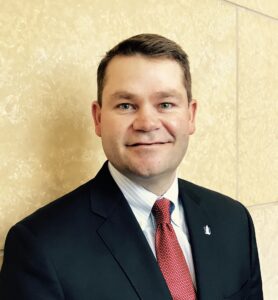 “You have to be very much data fluent. You have to also be digitally literate, and you have to have portfolio skills versus one-over-one risk underwriting skills, which is something that we’re investing in for our teams.”
Tony Fenton, Nationwide
“Then, the second piece is once you have a modernized system, how do you yield that to your advantage? I think that’s where you think some of the data sources that carriers are ingesting like a NeuralMetrics, like a Planck, …are a core piece of the equation.”
(Editor’s Note: Both NeuralMetrics and Planck use AI to provide real-time data insights for small businesses. In mid-2020, Nationwide announced a venture capital investment in Planck. Planck mines and collects billions of data points about small businesses across the web and then applies deep-learning algorithms to produce risk insights for commercial insurers. Related article: Planck’s Mission: Extracting Data Gold—and Truth—From Thin Air)
Q: When did Nationwide’s journey to modernize the core systems and transform the commercial underwriting process start? I read a press release from 2012 about adopting a Guidewire system. Was that the starting point?
Fenton: That probably wasn’t quite the starting point, but that’s when we were embarking on the journey. It is multi-year investment to get to the other side, and especially if you’re a large national carrier like Nationwide…It’s been a number of years and we’re nearing sort of the finale of that, which is really exciting because that’s when you really get the efficiencies—when you’re on one platform. And you live into all the advantages you get when you modernize the system.
Q: Why did Nationwide embark on the journey? What were the original goals?
Fenton: From my perspective, it’s about being relevant to your distribution partners as well as customers because if you’re not able to create that speed, ease and efficiency in terms of decisioning, you ultimately won’t be a selected partner to do business with. So, for Nationwide, it was really reacting to what we believe is the market, which is our distribution partners and customers…
All carriers will be faced with the conundrum, “Do you invest and modernize, or do you just try to make it with the legacy systems? For us, it was really about being relevant for our customers and distribution partners.
Q: Are there distinctions to highlight in terms of transformation for different types of business at Nationwide? For example, small vs. middle market or standard vs. specialty?
Fenton: In small, it’s really about getting a fast “yes” or a fast “no” for a customer or agency partner. Said another way, using the data and automation to create a decision quickly—first time final—getting a “yes” or a “no” is really important. No distribution partner wants a “maybe” on a thousand-dollar account. They want to know if you can write it, at what price and move forward.
That is unique and different [from] middle market, where it’s really about the expertise and about using the underwriting skill but augmenting the data with the underwriting skill. I do see middle market a little bit different—where automation and data in middle market are really utilized to speed up or inform the decision process. But there’s so many different inputs, if you think about loss control, you think about claims analysis. The art of a middle-market underwriter is the ability to see all that data in one spot and make a fast, good, educated decision. There’s always going to be the art because really the value proposition in middle market is the expertise.
Q: Is quoting small business a straight-through process now at Nationwide? Name, address and done—are we there yet?
Fenton: I don’t know if we’re to name, address, but we’ve really accelerated the underwriting process to get to the answer faster. When at all possible, if we can use a name and address to prefill the information to get to a decision quickly, that’s exactly what we’re doing.
Said another way, we do have straight-through processing, straight-through decisioning, but it’s predicated on the risk, the data and the ability to make that call, which I think each and every year the industry gets stronger [doing], as does Nationwide.
Q: I understand that your transformation was mainly prompted by the ability to meet the expectations of your agent/ broker partners. But I was hoping you could speak about commercial underwriter’s pain points in their day-to-day work. How has Nationwide addressed those in its transformation?
Fenton: It’s ultimately about the distribution partners and customers. But it’s also the ability to accelerate and thrive in the commercial market. So, the investment we made in modernizing our core systems was A) to be relevant, but B) for us to springboard and be even stronger, faster, bringing products to market…It just gives us an advantage. It allows us to move with velocity.
[As for] the pain points of an underwriter, think about a day in the life of an underwriter—data entry, taking disparate parts or pieces of an account, trying to piece it together, make an educated decision. That’s a challenge.
In this world of utilizing data to accelerate the decisioning, if you can get the right answer faster and get that data all sourced into one system or document, it allows you to be much more efficient and it allows you to actually have the factual information about the account. That’s one of the positives of the data and automation. It allows underwriters to be even more accurate.
One of the challenges—the other direction—would be that the skills of an underwriter 20 years ago vs. the skills an underwriter today are uniquely different. You have to continue to morph the way you’re thinking about underwriting and leveraging the best-in-breed in terms of relationship management, understand[ing] the portfolio, but you have to be very much data fluent. You have to also be digitally literate, and you have to have portfolio skills vs. one-over-one risk underwriting skills, which is something that we’re investing in for our teams.
Q: Talk about change management efforts at Nationwide. We have reported previously about your company’s five-year, $160 million “Future of Work” investment.
Fenton: As we continue to evolve as an organization, it’s really important for us to reinvest in our talent, and that’s exactly what the Future of Work is aimed at. There’s lots of different ways that we can skill our underwriters, whether it’s becoming digitally fluent, whether it’s understanding the technologies that are available. But I think that a big component to being successful is you can’t just have the tools. You have to make sure your teams are adopting and moving with the tools and the investments you’re making.
I can’t underscore enough that you have to have a very thoughtful organizational change management strategy because, quite frankly, if you have an underwriter that’s been in the role for 20 years in the industry, they’ve seen a lot of change…
I think also painting the picture of the why in terms of the investments and how it advantages them is critically important.
Q: One of the changes you mentioned involves making the leap from individual risk selection to portfolio management.
Fenton: It’s also a skill in terms of teaching our underwriters to look at the macro lens of a portfolio, seeing the outliers and being able to discern what is the next best action.
The skills of an underwriter today are very unique. You have to understand the technology. You have to understand the portfolio. But also, if you think about it, you also have to be able to underwrite because the accounts that you’re going to see as an underwriter are ones that you need to make a decision on.
So, you have to have the skills of an underwriter, but you also have to understand the dynamics of the technology and the portfolio.
Q: Talk about investments and partnerships with data providers such as NeuralMetrics and Planck. How did you select the group of data vendors to consider as partners? What factors influenced ultimate partner selections?
Fenton: Nationwide has a Ventures team, and we definitely lean on our Ventures partners to understand the outside environment. That’s one of the benefits of having Nationwide Ventures—the partnership and understanding what is possible in market, who are the market leaders, and sensing the trends.
So, going back a number of years, this has been an area that we’ve focused on with Eric Ross [head of Mergers & Acquisitions, Venture Capital] and the Ventures team. They helped us better understand the macro environment and what was actually possible in terms of accelerating underwriting. I think that was a foundational piece of the equation. From there, we started to think about what data elements would help us accelerate our underwriting…
We looked at a number of different dimensions. We looked at what was the hit rate and what is the actual accuracy of that information. [And having] the right long-term partner that would grow and morph with us is critically important.
Q: Do carriers need more than one of these data providers leveraging AI?
Fenton: You definitely need more than one. It may be for different sourcing of datasets. It’s really about finding the right partner with the right sort of datasets. The other part of that, which you didn’t ask about, is having the right dedicated team to evaluate the data and do quality assurance on it.
You don’t just enter into a relationship with a data firm. What you do is you continue to validate it, and prove it, and make it even stronger into the future…We made an investment in our automated underwriting team. We also have a dedicated quality assurance organization that, again, we’re working to improve, perfect and make even stronger into the future.
Q: Is that team staffed with new talent that you brought on board with new skills? Or were they people that were already in the underwriting organization?
Fenton: Both…I do think you want to have folks that traditionally understand underwriting, but then you want to have individuals that understand data and data science. It’s a blend of both worlds. We want traditional underwriting thought processes, but we want experts in data to validate what we’re seeing and continue to challenge: Is there a better different way to solve the equation?
Q: Focusing on NeuralMetrics, since Nationwide announced that partnership most recently, one of the characteristics that CEO Prakash Vasant highlighted during a separate CM interview was that his company meets regularly with carrier partners. How often does Nationwide meet with NeuralMetrics to offer feedback or to fine-tune the product?
Fenton: We’re in conversation with Neural every week. Our automation and underwriting teams are working hand in glove with their organization on a weekly basis. The folks that are working with the data and working to continue to make it stronger and better are always in constant contact.
From a strategic perspective, a number of times throughout the year, I meet with Prakash and his leadership team to talk about product road map, visioning, where Nationwide is—because I think that one of the benefits of a relationship with a firm like Neural is we’re growing together. What needs or challenges do we see on the horizon and how might we imprint those upon NeuralMetrics?
I feel that sort of conduit of a conversation, leader to leader, is important. But I also really appreciate the day in and day out where our teams are working together to create the best possible outcome for our underwriting system.
Q: How does Nationwide measure the success of its commercial underwriting transformation?
Fenton: It comes down to the ability to get selected by an agency partner. That’s critically important. If we’re not being selected, that doesn’t bode well for us. We’re not growing. We’re not driving…
Second is our underwriting performance—having the right data, understanding the risks, and pricing it accurately. Data plays a big role in creating the underwriting outcomes.
It’s really about being chosen as a carrier, but it’s also creating the right performance outcomes through underwriting. Those are probably the two things I would lean on. And we have various forums in which we ask for feedback from our distribution partners. We also look at the metrics, whether it’s bind ratios, top-line growth, retention…Those are all really key to making sure that we’re relevant and we’re performing.
Q: How much has Nationwide invested to digitally transform the commercial underwriting process? Earlier this year, Mark Berven, president and chief operating officer of Nationwide Property and Casualty, said that Nationwide invested about three-quarters of a billion dollars in those technology process and product modernization efforts.
Fenton: I don’t have a number handy for you, but it’s a big number…What I would say is you’re never done…You never really arrive. You’re always investing in modernizing your products, modernizing your data sources…You’re just always trying to perfect it and make it even better.
Q: Were other areas of the company involved in working through the underwriting transformation?
Fenton: Anytime you’re taking on a transformation, it’s not just the underwriting and product organization. It’s the entire ecosystem of commercial lines. It’s pricing. It’s the enterprise data team. That’s how you get the best possible outcomes.
Q: What other challenges did Nationwide face in transforming commercial underwriting?
Fenton: One of the challenges is making sure you have an aligned and united organization that’s all rowing in the same direction to realize the benefits of the transformation as well as get the velocity of the benefits for the organization. It can be a challenge to get that sort of velocity in a big endeavor like Nationwide has undertaken.
The other item I would underscore is making sure you don’t underestimate the organizational change management that you’re bringing your teams through.
Anytime you’re changing systems, anytime you’re reinventing the underwriting process, it might be really good on paper, but [make] sure that the teams can really consume it, understand it, and you’re investing in the skills of the future [and] also the understanding as you get to the other side.
We continue to keep front and center—the entire team has to be rowing in the same direction, and then making sure that everyone is fully up to speed and not taking for granted that folks are adopting and understanding the transformation.
 Insurers Are ‘Actively Evaluating’ New Catastrophe Risks as Europe Burns
  Design the Team Before You Design the Solution: Commercial Trucking Case Study
  The Car Remembers What Happened; Human Beings Can’t
  Business Uncertainty Drives Changes in C-Suite Strategy: Sentry