















Although his early dreams of covering world events as a foreign correspondent were never realized, Juan Andrade, the new chief executive of Everest Re, has seen and done almost everything in the world of insurance.
Executive Summary
Everest Re’s new CEO Juan Andrade describes a series of leadership positions across the insurance industry that have made him comfortable with complexity and a roll-up-your-sleeves leadership style that has served him in almost every corner of the business. Poised for the first time to lead what is largely a reinsurance operation, he also talks about growth strategies already in place at Everest in primary insurance and reinsurance, which are likely to continue in the years ahead.Until October 2019, however, he hadn’t worked on the reinsurance side of the business. Now leading a 47-year-old company that currently reports 70 percent of its total premiums in reinsurance and 30 percent in insurance, Andrade is eager to dive into the nuances of assumed reinsurance for the first time.
Officially becoming chief executive officer on Jan. 1 2020, Andrade joined Everest Re as chief operating officer last October. Before that he was president of Overseas General Insurance at Chubb, with responsibility for both traditional and specialty property/casualty insurance business in over 50 countries outside of North America. That was just one of the challenging leadership roles that shows up on a résumé that includes positions commanding the underwriting, product development, claims, sales and distribution, and strategy development teams of some of the industry’s most iconic brands, domestically and internationally, for both personal and commercial lines.
Throughout a career in insurance spanning more than 25 years, Andrade has also met and learned from some of the most famous leaders in the business, including Peter Lewis of Progressive, Ramani Ayer of The Hartford, Evan Greenberg of Chubb. As CEO of a top-10 reinsurer rated “A+” by AM Best today (ranked eighth among non-life reinsurers based on 2018 premium), Andrade traces the footsteps of predecessors Chairman Joe Taranto and retiring CEO Dom Addesso, and says that the prospect of making wholesale changes to their strategy are not on his agenda. An approach to create a more diversified company that started in 2015—accomplished mainly by building out a staff of experienced primary insurance professionals—is solid and was part of his attraction to the company.
“I come from a school of thought that says the more diversified, the better off you are, the more accretive your earnings ultimately are going to be. I like the approach of trying to grow an insurance company and then trying to maintain and grow a reinsurance franchise [while] understanding the differences of both,” he said.
“What you’ll expect from me is basically not 180-degree turns, but it’s going to be potentially course-corrections—five degrees north, south, east as we try to identify pockets of profitability, places where we can bring value-add and then just be a lot more aggressive in those areas,” he said, while also confirming that he does foresee the prospect of 50-50 mix of insurance and reinsurance at some point in the future.
“The goal is to make money at the end of the day, being profitable—and that’s my background,” he said.
During an interview at the Liberty Corners, N.J., headquarters in early February (before a global pandemic forced Everest employees and many others to work from home), Andrade expanded on what attracted him to Everest. He also discussed a career path that has made him comfortable with complexity and a roll-up-your-sleeves leadership style that has served him in nearly every corner of the business.
Passport to the World
First, he explained how the insurance industry gave a journalism major his passport to global adventure, with a stop along the way working in national security and international affairs for the Executive Office of the President of the United States.
While working toward his bachelor’s degrees in journalism and political science, Andrade was a stringer for UPI, interning for local newspapers and writing for his school paper as well. “What I really wanted to do is be a foreign correspondent. I thought the best way to get there was to study international economics…Then I’d be eligible to go work for The New York Times or The Wall Street Journal,” he said. “It doesn’t quite work that way,” he realized later. Instead, major publications would likely make a young journalist “work for like 30 years at the local desk somewhere before you actually were eligible to go someplace else”—and working internationally was always part of the dream.
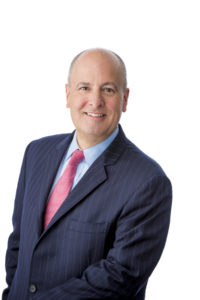 “Understanding balance sheet risk, claims and underwriting is so fundamental to what we do day in and day out that you have to have that in your DNA.”
Eventually, Andrade had an opportunity to apply for the Presidential Management Internship Program—a program run by the White House that allowed students to spend two years at the senior-most levels of government. Andrade worked at the Department of Defense, the Department of State and the Office of National Drug Control Policy at the White House, and after the two years, he was allowed to pick an area where he could continue to work. First choosing the Department of Defense, he later moved on to the Department of Justice at the Drug Enforcement Administration. “Part of that is the timing of what’s happening. This is the late ’80s, so you have the civil war in El Salvador, you have the Contras and the Sandinistas in Nicaragua. Then at the end of the ’80s, beginning of the ’90s, you now have the drug wars beginning. The U.S. government started to put a lot of money and effort into that, and because I’m Hispanic and I speak languages, I became a natural to be involved.”
Family responsibilities interrupted a longer career in government, Andrade reported, noting that it was time “to get a grown-up job” when his wife gave birth to their first child. He “would disappear literally for a few months at a time” without being able to say where he was going.
The prospect of working at a multinational company had the most appeal. Applying to Occidental Petroleum, AT&T and AIG, he got offers from all three but chose the global insurer, which offered exactly what he hoped for: a training program and a promise of an overseas position down the road.
Andrade learned to be an underwriter in AIG’s trainee program, and 18 months later, AIG sent him to a Caribbean division of American International Underwriters. He not only served as assistant to the division president but took on P&L responsibility in personal lines for the islands in the Caribbean. There he was mentored by Manalo Rodriguez, a Cuban who Maurice “Hank” Greenberg installed in San Juan to lead AIU’s Puerto Rico offices. (Editor’s Note: A 2016 Wall Street Journal article also described Rodriguez as AIG’s longest tenured employee, logging more years than Greenberg himself.)
“I attribute a lot of my success to him,” Andrade said, noting that Rodriguez taught him the ropes of general management.
Next Stops: Progressive, The Hartford and ACE/Chubb
When AIG made an acquisition in Mexico, Andrade hoped to make Mexico his home base for a while. But with a second child on the way and an offer from Progressive Insurance to work back in the U.S., Andrade headed back to Florida to join the entrepreneurial personal lines insurer.
“When I started, they were a $2 billion company, and when I left, they were roughly $15 billion over a 10-year period of time,” Andrade said, recalling how Lewis ran the company: “You put in very smart people, you give them a lot of autonomy and you let them run. That’s what we did.”
Andrade held positions as product (underwriting) manager in Florida; general manager in California, Wyoming and Colorado (responsible for pricing, claims, sales and distribution); head of claims from Florida and then all the Gulf states. In 2000, when Glenn Renwick became CEO, Progressive reorganized the general managers to oversee six regions rather than 50 individual states.
“It was a good change. The company had gotten so big that you couldn’t run it the same way that it was being run before,” Andrade recalled, noting that his stint leading claims in some of the most litigious places in the South—Alabama, Louisiana, Florida, Mississippi—coincided with Hurricane Katrina and other massive storms, serving as a learning experience for him. “That’s when you really realize the value of what insurance is about. There’s that intangible promise—that piece of paper actually becomes real when you’re facing people who have no home or no cars [and] their life’s been destroyed.”
The Hartford’s call for a chief claims officer, with a promise to put back into the sales and underwriting side of the business, drew Andrade north in 2006, and he later served there as head of sales and distribution and president of the P/C company. He joined ACE four years later as global head of personal lines and small commercial, domestically and internationally. Participating on a management team that led the growing company through 11 different acquisitions—culminating in the ACE-Chubb combination—Andrade was tasked with running the international operations. “We had 54 countries around the world and 14,000 people. We had over 600 branches, all lines of business basically,” he said.
Why take the call from Everest to be the next CEO?
“Everest has a great reputation, has a very strong balance sheet. It’s a very good platform—and they wanted to grow,” he said, noting that he also liked what he heard about the culture.
Comfortable With Complexity
Andrade describes the culture at Everest by saying that it’s a “collaborative but decisive place.”
“People work here; they work very hard. They’re very committed…That’s the sort of environment I like,” he said, noting that none of the companies he worked for were “hierarchical, patriarchal places. These are places where you roll up your sleeves and you work with people and you get things done.”
“At the end of the day, I’m a builder and these guys are builders here. That cultural fit matched.”
Looking beyond the “A+” rating, the low debt-to-equity and expense ratios—”all very good signs of a company that was well managed”—Andrade witnessed the growth of the insurance operations of Everest as a competitor and the roster of talented professionals flocking to that side of the business, which is headed by Jonathan Zaffino.
Zaffino, a 25-year veteran of the industry, joined Everest from Marsh in early 2015 and has been building the talent pool since. According to Andrade, Everest has hired over 1,000 people in the last five years, with close to 200 underwriters joining in the last year alone.
Why is Andrade the right person to lead the entire company forward?
“I’m used to dealing with complexity. When you’re dealing with over 50 countries around the world—different cultures, different operating systems, different regulatory environments—complexity is something I’m pretty comfortable with.” That’s needed for a company like Everest “because insurance and reinsurance are different animals. They’re different industries. They have different challenges.”
“The key is how do you make the whole work together at the same time.” he said.
“Having worked at some best-in-class carriers, there are things you can bring to the table,” he added. “Even though this is a great company, any company has room for improvement and room to sharpen strategies and execution,” he said, going on to note that he’s not out to change the strategy more than a few degrees at a time.
Asked about recent articles in reinsurance publications suggesting that his appointment signals a bigger push in the direction of insurance or international business, Andrade confirmed that he likes the current approach to the business. “When I talk about cultural fits, one of the things I liked about this company is that it’s also an underwriting company,” he said.
In 2019, Everest put $9.1 billion of premium on the books—a 7.8 percent increase over 2018—with insurance premiums soaring 23.4 percent, reinsurance premiums rising just 2.1 percent and both segments producing combined ratios around 95. Since 2014, the insurance business has more than doubled from $1.2 billion to almost $2.8 billion, an average jump of roughly 18 percent per year. With a few years of declining premiums on the reinsurance, premiums still rose more than 40 percent in the same time period, growing from $4.5 billion in 2014 to $6.4 billion in 2019.
Insurance premiums, which represented just over 20 percent of the overall premiums in 2014, were 30 percent of the pie last year. “It’s only been five years,” Andrade said, when asked if he thought the figure should be closer to 50 percent.
“To answer the question directly, I do foresee that the insurance side of the business could be as much as 50 percent of the company over time,” he said, stressing that while market firming that could continue for 18-24 months in his view is a factor in the equation, a condition for growth is that “we can do this in a sustainable way.”
Growth on the insurance side will also not be done at the expense of the reinsurance side, he stressed. “That market’s got its own dynamic. And we have some really creative people on that side,” he said, noting the disciplined actions that Everest has taken over the past year. While working to mitigate volatility in property catastrophe reinsurance—an area that Everest has been known for over the years, Everest has been growing in the mortgage and casualty reinsurance spaces, and writing more casualty on a proportional basis to take advantage of the improving rates and terms.
Right Time to Grow
Just over 60 days into his role as CEO, Andrade reflected on his three-month transition period as COO and what he learned during meetings with employees, brokers, key clients, investors and analysts. He said the most surprising misconceptions he heard were from analysts about how the insurance growth actually took place. “It’s not what people thought, which was [sell at] cheap prices and grow irresponsibly. Quite the opposite,” he said, emphasizing the contributions of talent acquisitions, a very focused distribution strategy and diverse products—40 percent of which are sold through a fast-firming wholesale distribution channel.
“Sometimes you’re lucky, sometimes you’re good, and I think these guys were both. The lucky part was just the market timing. When there was dislocation in the industry,…they were on the front foot with a value proposition that the brokers valued. And they were not bureaucratic. There are not a lot of layers of decision-making.” Brokers dealt with “experienced people that they knew. They were just now wearing a different jersey.”
“If you think about what was going on in 2015, 2016: AIG was going through its issues; ACE and Chubb were merging; Zurich was going through some reunderwriting; FM Global was doing certain things as well. There was a lot of talent available in the industry to be had,” Andrade said. “One of the things that we haven’t done, as opposed to some of our broker colleagues, is we have not been bringing huge teams of people. If you look at our staff, it’s not that we brought 20 from one organization. No, there’s two or three, maybe,” he added. “That’s been done on purpose because at the end of the day, you want to create your own culture. You don’t want to create a balkanized culture.”
Correcting a perception that the insurance book is largely casualty, Andrade said Everest sells roughly 150 insurance products; 43 percent of insurance premiums are in short-tail business and 20 percent are in a well-performing workers compensation book.
Giving a broad description of his go-forward strategy, Andrade said the central goal is growing book value per share for the company and its shareholders. That means disciplined underwriting for margin expansion in insurance and reinsurance. “We have a very disciplined organization to begin with, but there’s always an opportunity to get more granular into your portfolios into your classes of business, into your teams, into your geographies—to really know what’s driving things in a good way or in a bad way.”
As an example, Andrade noted that Everest is being cautious on workers compensation. “At some point, there’s going to be an inflection point,” he said, noting actions to reduce comp volume to 20 percent of the insurance book, down from 24 percent, while increasing participation in specialty areas like political risk, surety and reps and warranties.
“We’re a specialty niche company. So, we’re not in the market to go head-to-head with a Travelers or Hartford or a Chubb. We know what we like and we stick to it. That is something that we’re going to continue doing, but just getting more focused and sharper in identifying the opportunities to both be offensive and defensive,” he said.
As CEO, Andrade also looks to investment income as another lever to drive book value and a targeted double-digit ROE. With growth in insurance and reinsurance driving cash flows to record levels, he said that total return on the investment side is good, even in a declining yield environment right now.
Leadership Style
Asked to describe his leadership style and what it takes to lead a P/C organization, Andrade offered that he is “very hands on—involved, decisive, inclusive”—attributing his inclusiveness to his years at companies like Progressive and ACE. “You realize that you’re not a team of one and you can’t be.
“In our business, details matter and granularity matters. That’s why I’ve always been convinced that CEOs that come from banks and non-insurance financial services are seldom successful in our industry—because understanding balance sheet risk and understanding claims, understanding underwriting is so fundamental to what we do day in and day out that you have to have that in your DNA. You can learn it, but it takes a long time. We’re very experiential in insurance. You learn by making mistakes along the way,” he said. “You have to learn from issues in the past, and adapt and go forward.”
Andrade attributes his leadership style to both inborn traits and business experiences. “If you’re into the details with your sleeves rolled up, that’s something you’re born with. You either have that or you don’t. The other part of it is you either like people or you don’t,” he said, also pointing to CEOs like Greenberg, Ayer and Lewis, who he learned from.
Asked about career successes, Andrade said he is proud of the work leaders did to integrate the businesses—and the people—of Chubb and ACE. “There’s a lot of complexity because you were dealing at that point with probably over 30 countries where there was overlap in business. There are social issues anytime you bring all of that together, but we tried to make that as seamless as possible from the outside in. From the perspective of our customers and brokers, it appeared relatively seamless.”
Working at The Hartford during the financial crisis also stands out for Andrade. “I was there when the life company had their issues. I was on the P/C side, but obviously it affected us because of the ratings implications, the stock drop and all the turmoil…What I’m proud [of] there is that we were able to hold the business and the people together. It was probably one of the most difficult leadership challenges that I’ve ever faced. But we got through it. You get through it because your distribution supports you, your employees are loyal, and [because] you put in the time and effort.”
“Optimism, perseverance and absolutely communication” were the keys to weathering that storm, he said. “I can’t tell you how many town halls and individual interactions with external stakeholders, internal stakeholders we had to have during that period of time,” Andrade said, also offering what he learned from Ayer. “Ramani never gave up. He was always looking for a solution, a way out. And if that door got closed, then he’d looked for the next door. You admire that, and that’s something that sticks with me to this day. There’s always more than one way to get around an obstacle; you just have to find it.”
 Zurich US Names Wells as CEO
  Help Me Understand: How Insurers Build Trust
  Hurricane Lowell Estimated Damage to Hawaiian Islands Between $.5B and $1B: Cotality
  In Bots We Trust? For Insurance?