
















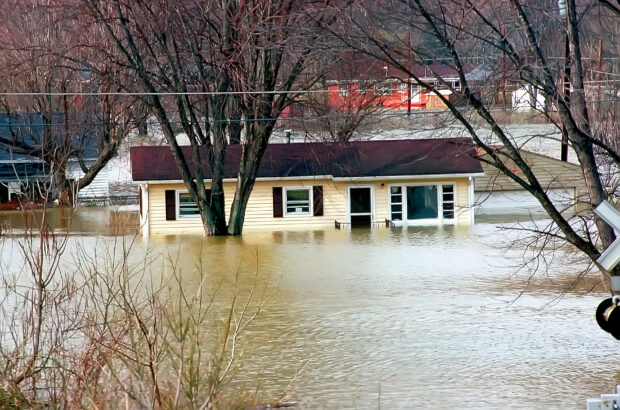
The U.S. faces a widening gap between growing flood risk and the take-up of flood insurance, potentially exposing the nation to more than $375 billion in aggregated uninsured flood losses from a 1-in-100-year event, according to a new whitepaper from Moody’s.
The growing insurance protection gap, now at 65%, poses a significant financial risk to households and local governments, which have long relied on FEMA Specific Flood Hazard Area (SFHA) maps primarily based on riverine flooding, and generally don’t account for flood risk from storm surge, sea level rise or extreme precipitation, the Moody’s report said. This exposes counties to losses that can occur outside of mapped FEMA flood zones, added Moody’s.
Mortgage underwriters use FEMA SFHA maps to determine if a property needs to carry flood insurance, which is primarily provided to U.S residences by the National Flood Insurance Program. According to Moody’s, private flood insurance represents about 10% of the market.
“Uninsured losses arise not from isolated outliers, but from persistent gaps between expanding flood hazards – particularly beyond regulatory flood maps that dictate mortgage requirements, as well as rarer, high-severity events – and insurance take-up,” Moody’s concluded.
The interactive whitepaper analyzed residential flood risk in the U.S. using the Moody’s RMS US Inland Flood HD model, including scenarios of a 1-in-100-year flood and a more extreme 1-in-500-year flood, which could result in uninsured loss exposure of more than $1 trillion with a 70% protection gap.
In a 1-in-100 year-flood scenario, most counties’ uninsured loss exposure is manageable as a share of property replacement cost, the whitepaper found. A 1‑in‑100‑year flood is a flood event that has a 1% chance of occurring in any given year.
In such a scenario, less than 2% of counties in 11 states carry 65% of the country’s uninsured loss exposure. Counties in Florida, Louisiana, South Carolina and Texas face more than $5 billion in potential uninsured losses in the event of a 1-in-100-year flood. Protection gaps range from 45%-75%, Moody’s found.
Flood events are not constrained to 1-in-100-year or even 1-in-500-year scenarios.
Asheville, N.C., experienced rainfall far above the expected rainfall from a 1-in-1,000-year event when Hurricane Helene hit in September 2024. Buncombe County, the home county of Asheville, had a flood insurance protection gap of 88%, Moody’s RMS model results indicate.
The divergence of potentially catastrophic flood events and low flood insurance take-up “highlights the risks and limitations of relying solely on backward-looking statistics to characterize flood risk in a changing hydroclimate, particularly for short‑duration, high‑intensity rainfall events,” the whitepaper states.
Moody’s found that uninsured loss exposure from a 1-in-100-year flood event could increase nationwide by about 25% on average by 2050, to around $472 billion.
 Delegation Without Abdication: A Division of Labor for Human-AI Decisions in Insurance
  The Latest Launches from Soteris, CLARA, Cozmo AI
  Building Trusted Insurance Brands: How Nationwide Delivers Tangible Value to Customers
  Majority of Online Scam Campaigns Target Common Infrastructure: Study