












During the recent Berkshire Hathaway annual meeting, Chief Executive Officer Greg Abel told shareholders that the conglomerate’s decisions on investments and acquisitions depend on several factors, highlighting price relative to risk as one of them.
See related article: Details TBD: Berkshire’s Jain, Abel Discuss Tokio Marine M&A Pact, Insurance Strategy
Ajit Jain, vice chair of the insurance operations of Berkshire, had a similar take when asked about underwriting a specific risk currently in search of capacity.
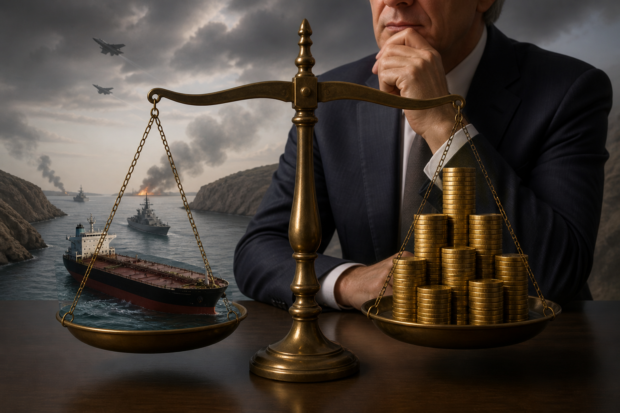
“When can you offer insurance to ships crossing the Strait of Hormuz?” CNBC’s Becky Quick asked Jain on behalf of a Berkshire shareholder during the Berkshire Hathaway annual meeting in Omaha on Saturday.
“The short answer is it depends on the price,” Jain said, offering a response on the marine risk question that was reminiscent of one offered by Warren Buffett, the former CEO of Berkshire Hathaway, during the 2020 annual meeting.
“We have no reluctance to quote on very unusual things and [with] very big limits,” said Buffett six years ago, when asked about Berkshire’s appetite for offering pandemic insurance coverage. If someone wants to “dream up the coverage and they can tell us the price they’ll pay, [then] we will consider writing it,” Chairman Buffett said back then, recalling that Berkshire and American International Group were among the few insurers that were willing to write a lot of terrorism risk insurance after the 9/11 terror attacks. (Related 2020 article: At The Right Price, Berkshire Will Write Pandemic Cover, Buffett Says)
As for the current situation, Jain said at Saturday’s 2026 annual meeting that while there’s a lot of need for coverage of for ships stalled by the war with Iran, “fortunately, there’s enough capacity in the insurance world today that would like to write that risk.” The capacity exists “for no other reason [than that] people are sitting on excess capital, and they’d like to find a way to deploy that excess capital,” Jain said, referring to large insurance competitors.
Related article: ‘The Arms Race Is On’: Chubb’s Greenberg on Mythos, Middle East
“We ourselves have taken a small participation in a program that’s been put in place…to write insurance for the ships in the Strait of Hormuz. We haven’t written any deals as yet,” he reported, referring to fine-tuning around the underwriting and the assurance that the U.S. Navy will escort the ships. “We have put a price [for] which we will be comfortable underwriting that risk, but nothing’s happened as yet.”
(Editor’s Note: Jain made his remarks before a U.S. effort to escort ships through the strait began on Tuesday, and then halted on Wednesday as an agreement with Iran reportedly progressed.)
The Berkshire annual meeting kicked off with a tribute to former Berkshire CEO Buffett, featuring a video displaying newspaper headlines about the investing legend’s activities over the course of his 60-year career as a recording of Huey Lewis singing “Back in Time” blared through the Omaha arena. Meeting highlights included a number of appearances from Buffett sitting in the front row of the audience before a “deep fake Buffett” emerged to interrupt the festivities at one point. The fake Buffett pretended to take a call from someone wanting to sell him “an elephant” (his term for a large acquisition).
Abel explained that the fake had been created with “zero input” from the real ex-CEO. “We were able to obtain that with information that’s out there and replicate those actions and that voice,” Abel said. “The reality is that’s what we’re dealing with when we think of Berkshire and how we have to protect it every day,” reported Abel, teeing up another question about insurability for Jain—this time about cyber risk being amplified through the use of AI by bad actors.
Jain, who said he was wary of insuring cyber risk during the 2024 meeting, hasn’t changed his view much but hinted that could change in the future.
“We have been slow in terms of entering that class of business as an underwriter,” he reported, adding, “I find it very difficult to have some meaningful method to assess and model the aggregation. People will tell you, ‘We’ve got it under control,’ and they will show you all kinds of models. But [there is] nothing that I can really hang my hat on in terms [having] a good feeling for what the aggregate exposure is.”
For any risk Berkshire takes on, the first question underwriters ask is how bad can bad be? “I’m not sure we can answer that question as well as we should,” Jain stated, going on to cite insurance market competition as another reason for caution, for now.
Related article: Berkshire Wary of “Fashionable’ Cyber Insurance, AI
“Cyber has been a very popular, fashionable product in these last several years. We have not played in it. Now, as it turns out, there haven’t been very many cyber losses. So, people who’ve taken on cyber risk have actually made profits. And as a result, the premiums that cyber insurance commands has been coming down over time.”
“We hate entering a line of business where prices are coming down. So, we are sort of sitting on the sidelines,” he said, going on to suggest that that could change when the price is commensurate with the risk. In his words, “I’m not sure when, but I’m pretty certain that the day will come when we will have a fairly significant role to play in cyber,” he said.
Later, following a discussion of the use of carbon resources by Berkshire’s energy company to support data-center demand in the AI era, Jain offered another version of his cyber risk analysis to voluntarily explain why Berkshire’s insurance operations have not been active in insuring data centers.
“Right now, in the insurance sphere, the supply is greater than the demand, and that makes it very difficult to be able to carve out a [data-center coverage] deal that rationally is good for the buyer and the seller. When supply is greater than demand, then it’s the seller that loses,” Jain said.
“But clearly there is a surge in demand, and as long as supply doesn’t go crazy, we will get a few days in the sun sometime in the next few years,” he suggested.
More specific to the role of AI in insurance, Quick read a question from a shareholder who wanted to know whether human judgment still gives Berkshire a competitive edge “in an era of increasingly complex risk models and AI tools.”
Noting that “AI also is very fashionable right now,” in and outside of the insurance space, Jain conceded that “it will be a huge game changer” when the reality matches what is being projected at some point in the future. “Right now, what we are seeing is AI being used as a productivity tool, as a mechanism for reducing labor costs and doing routine, repetitive things. I do not think AI will reach a point where you can make a tradeoff on things like pricing, settling a claim. That is still years away,” Jain said. “I tend to be skeptical. I’ll be surprised if I can solve that problem for you.”
“If you’re counting on AI telling you which stock to buy and which you want to sell, I don’t think that’s going to happen,” he added.
Abel seemed less skeptical about the near-term trajectory of AI applications in insurance, and at one point described how AI has figured in the technological transformation of Berkshire’s personal lines insurer, GEICO. (See related article, “Growth Going to be Hard: Abel Discusses GEICO and Berkshire Tech Transformation“)
Engaging with Jain after his response to the question about the advantages of human judgment in assessing complex risks, Abel gave an example of how AI is increasing underwriter productivity within Berkshire’s insurance operations, noting that the example had been shared with him during a recent meeting with Jain’s insurance team. “If we were looking at a risk, and we had our traditional underwriters doing it, we might have looked at the five largest risks….Now, we can pretty much in a fairly quick way, yes, focus on those, but [also] get a view on another using technology.”
“We’ll probably look at those other 15 risks and have a strong view on it. Is that fair?” he asked Jain, who confirmed that the description was a correct assessment of the evolving use of technology within the insurance businesses of Berkshire.
For more information, see related article on Berkshire’s first-quarter results, “Growth Going to be Hard: Abel Discusses GEICO and Berkshire Tech Transformation.“
Featured image: AI-generated (ChatGPT)
 Viewpoint: The One Thing Holding Back Insurers’ AI Efforts
  The Latest Launches from Vertafore, One Inc., Qumis
  Amazon Cargo Plane Pilots Weren’t Warned About Wind Before Miami Crash: NTSB
  US States Allege Corteva Spinoff a Bid to Evade PFAS Liabilities