




















A recent survey of more than 1,200 global businesses found that as AI adoption accelerates, 82% of respondents report positive impacts on their organizations.
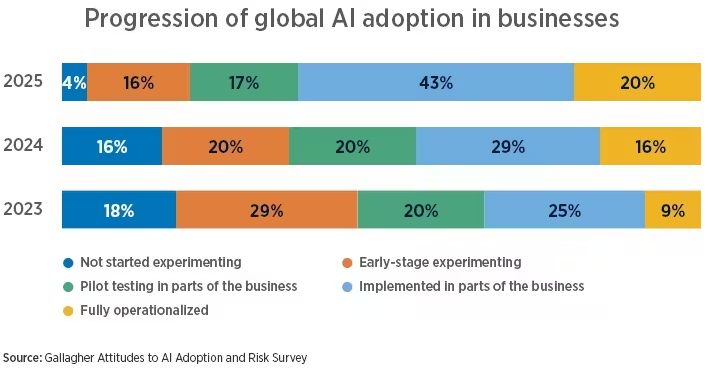
Global insurance brokerage Gallagher recently released its third annual AI Adoption and Risk Survey, which found that companies are increasingly integrating AI into their operations, focusing on IT operations, client-facing functions and analytics, with 63% of businesses having fully operationalized or implemented AI within parts of their business, up from 45% in 2024.
The majority of respondents (83%) believe that AI will drive revenue growth in the future, and 93% reported feeling confident in their understanding of AI risks, rating their knowledge as “quite well” or “very well.”
While the benefits of AI seem clear, the survey found that many challenges remain.
This year’s survey included insurance professionals. One in five indicated a client experienced a loss or claims due to AI-related risks in the past year, with just over half covered by insurance.
Over half of respondents report skills gaps and recruitment challenges, while 46% appointed an AI ethics officer to balance technology with ethical considerations.
Many companies have rolled out job protection strategies, citing a people-first approach; however, 59% of respondents reported reducing positions or planning to do so in the future.
Respondents from South Korea were more likely to say their company made headcount reductions through redundancies, followed by India. And in Australia, 53% of businesses reported reduced workforce numbers through redundancies/not rehiring.
The impact of AI adoption on headcount appears most significant in telecommunication, technology, energy, and financial services.
Reskilling and upskilling will help with the transition, Gallagher added, noting that this could help manage employees’ eroding trust.
Nearly two-thirds of organizations (63%) are actively measuring ROI, and though many are seeing productivity boosts, they estimate it will take an average of 28 months to realize a return on their AI investment.
AI errors, misinformation, and hallucinations remain a key concern, topping the list of perceived threats from AI adoption (57%), as do legal and reputational risks from AI misuse (56%) and data protection and privacy violations (55%).
Top perceived risks of using AI in business, according to the survey:
- AI errors, misinformation, and hallucinations
- Legal and reputational risks
- Privacy violations and data breaches
- Cyber‑attacks and fraud risk
- Over-reliance and reduced human judgment
- Job insecurity and industrial action
- Ethical risk and weak governance
- Declining employee engagement and change fatigue
- Algorithmic bias and discrimination
- Shareholder action over poor ROI
- Reduced trust in leadership
This year’s survey included insurance professionals. One in five indicated a client experienced a loss or claims due to AI-related risks in the past year, with just over half covered by insurance.
Classes of business most likely to be impacted by AI-related claims are cyber liability, product liability, and employers/employment practices liability.
Insurance professionals state that current coverage language is too vague for AI losses.
“Insurers are considering including clearer language around AI risks across a range of policies to be able to better understand the total cost of risk. However, the wording could prove challenging given that AI is constantly evolving,” said Paige Cheasley, Canada National Technology practice leader at Gallagher.
The risk related to AI use has prompted dedicated AI insurance solutions, endorsements, bespoke add‑ons, and, in some cases, exclusions, the report stated.
Related article: AI Needs Its Own Risk Class
It’s expected that the industry as a whole will adopt a wait-and-see approach, using an onslaught of claims to guide future policy language, similar to how cyber insurance evolved.
Ultimately, the onus is on the company to ensure a multi-department approach to monitoring AI use and governance, Gallagher’s experts said.
The survey also revealed the importance of maintaining a human element, including personal accountability, governance, and training, while involving HR early on to address employee concerns.
What should remain top of mind is customer experience, according to Steve Rhee, Gallagher’s global chief digital officer, who suggests mapping the entire customer journey.
“This survey complements what we’ve seen with our clients. At Gallagher, our AI adoption journey is about more than just implementing cutting-edge technology—it’s about empowering our people and centering on our customers’ needs,” said Rhee. “We have continued to invest over the last several years in data, analytics, and digital workforce skill development to ensure our teams are equipped to deliver the best outcomes and solutions for our clients in a rapidly evolving landscape.”
Featured image: AI-generated (ChatGPT)
 Federal Bill Seeks to Reduce Work Week to 32 Hours
  The Latest Launches From The Zebra, Sigo Seguros, Applied Systems
  Viewpoint: The One Thing Holding Back Insurers’ AI Efforts
  Sedgwick: Property Claims Face Delays, Are Growing More Complex