

















Global insured losses from natural catastrophes during the first nine months of 2025 are estimated to hit $105 billion, bringing the sixth consecutive calendar year with losses topping $100 billion and the eighth year since 2017, according to Gallagher Re.
Ironically, there was an uncharacteristic lack of major natural disasters between July and September, which led to one of the least expensive third quarters for insurers since 2000, said Gallagher Re in a report titled “Natural Catastrophe and Climate Report: Q3 2025.”
“The abnormally low frequency of high-cost events has, thus far, left the year well within annual catastrophe budgets for governments and the insurance industry,” the report said, explaining that the below-average claims are largely the result of quieter-than-expected tropical cyclone activity in the Atlantic and Pacific Oceans and generally manageable flood and storm events worldwide.
When looking at Q3 on its own, Gallagher Re said, it tentatively has produced less than $15 billion in insured claims – the lowest total since 2016 ($18 billion).
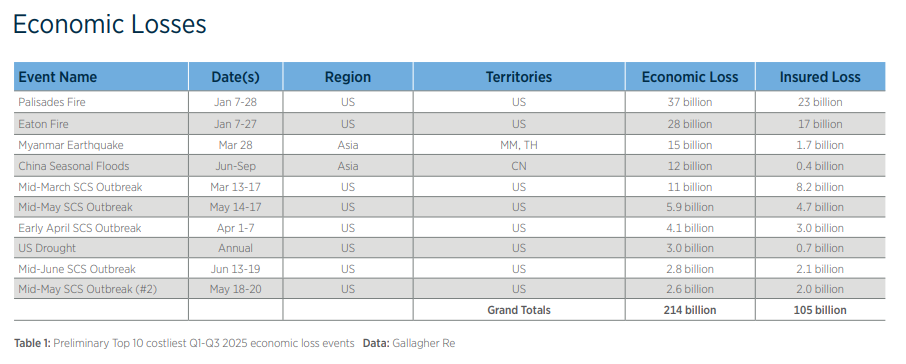
The estimated $214 billion in overall economic losses (which include insured losses) from all natural perils during Q1-Q3 was well below the 10-year Q1-Q3 average of $338 billion.
Gallagher Re described 2025 as “top-heavy,” with the top five costliest events in January accounting for 53% of all global insured losses. These events were the two major January wildfires in the Los Angeles area and three outbreaks of severe convective storms (SCS) in the U.S.
Q3 weather and climate-related economic and insured losses are on track to be among the lowest recorded this century, the broker said.
Entering the fourth quarter of 2025, preliminary data indicates this year’s natural cat losses will remain well below recent averages, said the report, explaining that Q4 is typically one of the least expensive on an economic and insured loss basis.
“Late-season tropical cyclone landfalls remain an ongoing risk, as is the constant possibility of a consequential earthquake,” the report said.
If the final quarter of 2025 produces manageable losses, “this will likely be a further boost to the re/insurance industry’s financial buffers,” the report added.
Gallagher Re estimates it would now take an event, or series of large events, resulting in an insured loss of at least $115 billion to meaningfully impact the re/insurance industry. “This suggests that even a singular $100 billion event may not strongly change the recent softening shift in property reinsurance renewal pricing.”
Despite the lower insured losses for the first three quarters, Gallagher Re emphasized that with the increasing influence of climate change, the trend of greater losses over time is likely to persist as extreme weather becomes more extreme “or shift their geographical occurrence patterns.”
“Building financial underwriting protections against loss volatility is critical in mitigating increased climate risk.”
Other findings from the report include:
- There have been 16 billion dollar insured loss events thus far this year with 15 of those events occurring in the U.S. and one in Asia Pacific, marking the lowest Q1-Q3 total since 2017 when 16 events occurred.
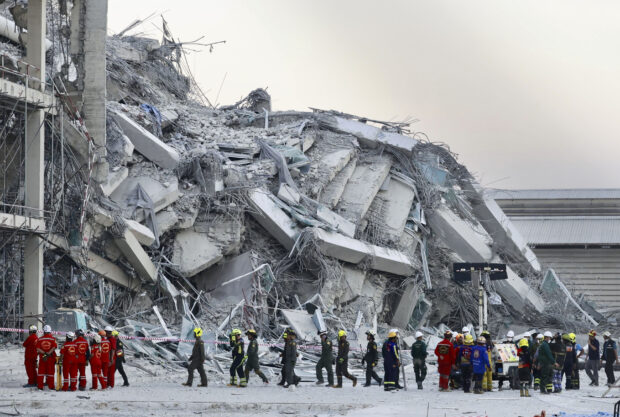
- The costliest individual non-U.S. event is the March 28 Myanmar earthquake, which also caused major damage in Thailand.
- Other notable events included Cyclone Alfred on March 8-10 in Australia; Windstorm Éowyn (which hit Ireland, the Isle of Man and the UK on January 24 and Norway on January 24-25); the Taiwan earthquake (on January 21), and a series of severe summer hailstorms and flooding in Europe.
- U.S. severe convective storms cost insurers an estimated $46 billion, the third consecutive year in which U.S. SCS claims through September exceeded $40 billion. Insured SCS losses in the U.S. this year already amount to the fourth-costliest year on record, behind 2023 ($62 billion), 2024 ($57 billion), and 2020 ($47 billion).
- Preliminary data indicate that 2025 will be Canada’s second worst season on record in terms of the extent of affected land: 8.8 million hectares (21.7 million acres).
- A July hailstorm in Calgary, Canada caused at least $110 million in industry losses.
Photograph: Rescuers work at the site a high-rise building under construction that collapsed after an earthquake, in Bangkok, Thailand, on March 28, 2025. (AP Photo/Wason Wanichakorn, File)
 Weather Damage Turning Into Long-term Debt for Homeowners: Report
  Levers and Guardrails: How Growth Is Being Built at Hippo
  Large Commercial Property Rates Drop 14.5% in Q2 to Highlight Latest Willis Report
  Viewpoint: Insurers Are Automating the Front Office While Ignoring the Function That Determines Trust