


















Economic losses from wildfires remain a concern for 2023, despite last year’s average season, according to a new report by Gallagher Re.
Climate change, shifting weather patterns and homes that continue to be built in areas of wildland urban interface (WUI) are contributing to an increase in wildfire frequency and severity.
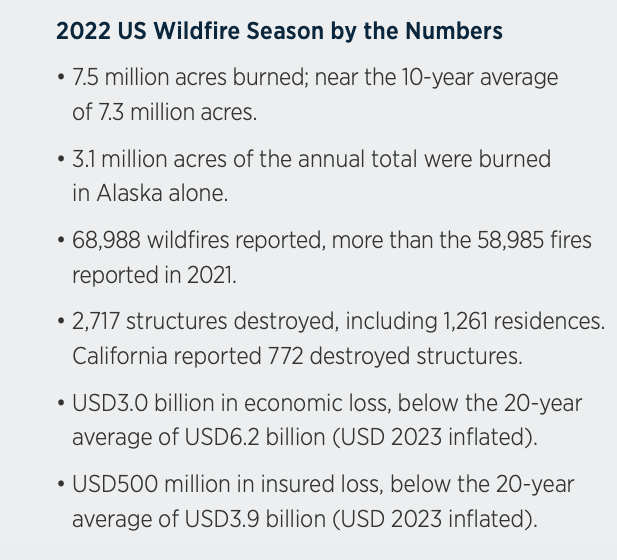
The 2022 U.S. wildfire season ended near the long-term average, according to the 2023 US Wildfire State of the Market report, in terms of acres burned and below average in terms of economic and insured loss. Below average activity was noted in most of the U.S. and California (the state saw 363,939 acres burn in 2022), with Alaska and parts of the Southwest seeing the most wildfire activity.
Previously in 2020 and 2021, considered record years, California reported 4.4 million acres and 2.6 million acres burned in wildfires.
“A myriad of factors led to below-average financial loss from wildfire in 2022, including weather patterns, geography, exposure and availability of ignition sources,” the report stated.
Because of limited precipitation in prior years followed by decent rain and snowfall in the latter part of the year, 2022 didn’t have the typical fuel sources and drought to contribute to a higher number of wildfires.
Fires across the southern U.S. in 2022 highlight wildfire risk as a national concern, not just limited to certain regions of the U.S. as previously modeled. As a result, the report indicates “patterns of historical wildfire frequency and severity may no longer sufficiently predict today’s risk.”
As homes continue to be built near and in wildfire prone vegetation, determining the geographical boundary of the WUI is critical to evaluating wildfire risk, particularly when considering risk selection and pricing, the report stated.
Risk declines significantly the further away a dwelling or building is from the WUI.
According to the report, the peak wildfire season in the West, particularly in California, will be influenced by an abundance of new vegetation due to heavy rainfall and near-record snowpack experienced during the first quarter of 2023.
The El Niño pattern predicted for this year will likely bring “increased rainfall in the West, most notably during the cold season,” which may assist in reducing the potential for wildfires.
Since the devastating wildfires in 2017 and 2018, Gallagher Re noted a considerable change in how insurers and reinsurers view wildfire-prone areas of the country. For example, in California, many property insurers and reinsurers have limited their exposure due to the catastrophic losses experienced in the market in recent years.
Catastrophe losses nationwide have led reinsurers to significantly increase rates and retention as companies continue to restrict capacity.
The report found that “after the January 1, 2023 renewals, property reinsurance rates had increased by more than 60 percent since 2017, which has had an immediate impact on insurers’ overall profitability and may translate to higher rates for policyholders.”
A strong wildfire pricing program, along with underwriting and portfolio management strategies will enable insurers and reinsurers the ability to add capacity while maintaining lower prices, the report stated.
 Teen’s Death Prompts Plan to Ban New York Central Park’s Horse-drawn Carriages
  Delegation Without Abdication: A Division of Labor for Human-AI Decisions in Insurance
  Edison Utility Shares Drop Due to Willful Misconduct Allegations in Eaton Fire Case
  Insurers Say French Supermarkets’ Cyber Insurance Unlikely to Cover Food Losses