

















Having steered clear of Altadena since late March 2025, shortly after the Eaton fire tore through the community, I decided to return this past weekend. My hopes were high for a sustained recovery. The town is just three miles east of our home in La Cañada Flintridge. Both communities are nestled in the foothills of the San Gabriel Mountains, their peaks often described as the crown framing the Los Angeles basin and valleys below.
Executive Summary
More than a year and a half after the devastating wildfires in Altadena and Pacific Palisades and four years mired in the state’s insurer of last resort, our reporter’s systematic fire-hardening measures have finally provided an escape hatch.
In earlier articles, “An Insurance Journalist’s Perspective on Southern California’s Wildfires” and “Revisiting California’s Wildfires: A Personal Journey,” Insurance Journalist Russ Banham describes his family’s evacuation from the 2025 California wildfires, and the family’s decision to prepare the home they love for future events.
I had been assigned to cover the wildfire’s impact and previously wrote two articles for Carrier Management on the disaster that consumed Altadena. The first described the terror of the four-day mandatory evacuation my wife, Jenny, and I experienced, alongside our intrepid plans to fire-harden our house, an expensive but vital investment, we concluded. The follow-up article detailed a trip to see the devastation firsthand. As Jenny drove slowly through the charred remains of the formerly bustling, beautiful neighborhood, I took notes. Where craftsman homes and grand mansions had stood for more than a century, nothing remained but a graveyard of chimneys, rising like tombstones from the bare earth.
Our own nightmare began on the evening of January 7, 2025, when the Watch Duty app buzzed to warn us to gather our important documents, medications, pet food, cash, and clothes. Hurricane-force Santa Ana winds kept us awake all night. At 4:58 a.m. the next morning, the app issued a definitive command: Evacuate. Our city’s air-raid siren blared as we loaded our possessions, two dogs, and cat into our cars under an ominous orange sky.
Fires raged to the west, east, and north. We drove south to find a pet-friendly hotel, joining more than 150,000 neighbors in Los Angeles County also forced by mandatory orders to flee. Twenty-four days elapsed before the Eaton and Pacific Palisades fires were fully contained.
In Altadena alone, the Eaton fire destroyed roughly 9,400 structures, including more than 6,000 residential homes, wiping out massive swaths of the historic community’s housing and its main commercial district. My recent return trip showed only modest progress. Driving through the scarred streets for an hour, I tallied about three dozen new homes under construction or newly completed.
When I returned home to my computer, reports indicated that fewer than one hundred houses in all had been completely rebuilt from scratch. Out of more than 1,300 submitted applications for building permits, only 140 or so have been approved. Residents struggled to navigate new stringent building codes, lead-contaminated soil, and immense insurance gaps. According to an analysis by the United Policyholders consumer advocacy group, homeowners with legacy insurance policies on average were $375,000 short of modern rebuilding costs due to the escalating price of labor and building materials.
Even if Altadena residents surmount these obstacles, their chances of securing standard private insurance remain low. Admitted carriers generally refuse to write new policies inside an active wildfire scar for several years following a disaster. Moreover, the January 2026 expiration of the state’s temporary moratorium, which had forbidden insurers from dropping existing policyholders, prompted many major carriers to halt new coverage and pull back entirely from the San Gabriel foothills. The sudden contraction has forced hundreds of thousands of high-wildfire-risk residents into the California FAIR Plan, the state-mandated property insurance of last resort.
The FAIR Plan presently holds 696,562 active residential policies, compared to around 200,000 policies in 2020. The cost of this fire insurance comes with a painful price tag. For context, the owner of a typical 1,500-square-foot home who previously paid a premium of $1,500 a year for a private insurance policy is likely to pay between $5,000 and $8,000 annually for a baseline FAIR Plan policy.
That cost will climb even higher. An impending 29.1% average statewide rate hike is set to hit new and renewing FAIR Plan policies on October 15. Layering that rate hike onto the baseline fire policy and adding a separate private Difference in Conditions (DIC) policy to cover theft, water damage, and liability multiplies the financial strain. According to independent broker data, the total combined annual cost for the highest-risk homes could climb to five to eight times the original private rate.
For four years after moving to La Cañada Flintridge, the FAIR Plan was our only option. No longer is this the case: Jenny and I are free from such worries thanks to the expensive renovation of our house and gardens to mitigate wildfire damage, paired with the tireless efforts of our independent insurance agent to secure private insurance. We are incredibly fortunate in that regard; many other homeowners lack the funds to undertake the fire-hardening measures we felt were necessary.
To finance the renovations, we took out a $135,000 home equity loan on a house that had been completely mortgage-free. The investment was never predicated on reducing insurance costs. Rather, it was driven entirely by our intent to protect what will likely be our last abode: a 76-year-old small house shaded by giant cedars, located just minutes from Los Angeles. Leaving our beloved home was out of the question.
Pinpointing the Vulnerabilities
Exiting the FAIR Plan required fortifying our home against a fast-moving wildfire. For guidance, I had interviewed Dr. Ian Giammanco, managing director of atmospheric science and lead research meteorologist at the Insurance Institute for Business & Home Safety (IBHS). He noted the property was fortunate to already feature a Class A fire-rated roof. The highest risks stemmed from the legacy single-paned windows, fences, gates, and siding, all constructed from highly combustible wood.
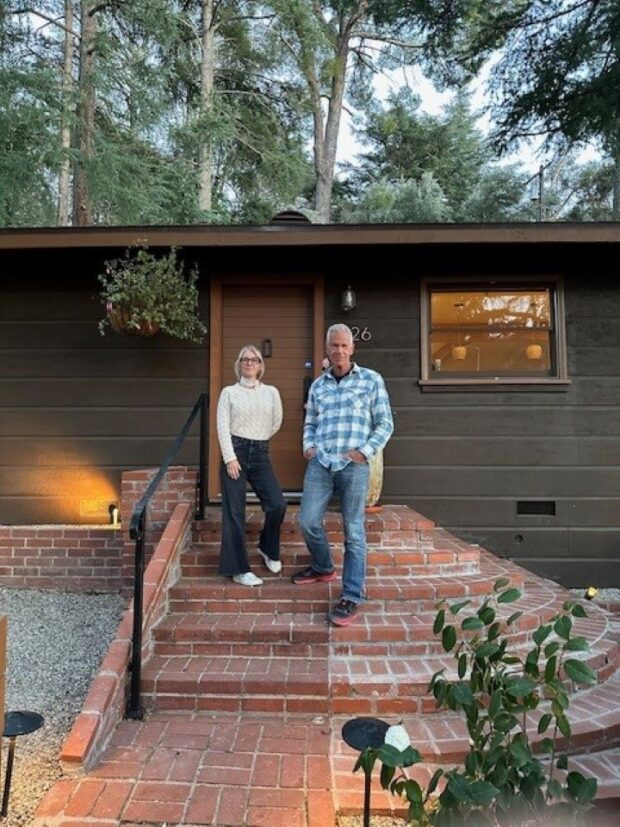
The exterior of the house consists of historical, harvested cedar planks milled from old-growth timber. At two and one-half inches thick and 14 inches wide, this dense wood naturally resists deep fire penetration far better than thin, modern dimensional lumber. However, to meet strict Wildland-Urban Interface (WUI) standards and further reduce flammability, the wood, along with a pool deck and a small fence, was treated with a Class A-rated exterior intumescent coating that delays ignition by creating a heat-shielding barrier. Eight-inch-high galvanized steel flashing was affixed across the lowest portions of the house where embers frequently accumulate, and two wooden side gates were replaced with aluminum alternatives.
The bulk of the borrowed capital, approximately $90,000, went toward replacing 19 single-pane wood windows and doors with dual-paned tempered glass framed in fire-resistant composites. Although the small house is roughly 1,300 square feet, the layout features an abundance of windows. Choosing premium, high-durability materials, we selected Andersen Windows to design and execute the installation, which required a full week of labor. Next, the open vents in the foundation, soffit, attic, and roof were replaced with 18 ember-blocking Vulcan Vents.
Dr. Giammanco emphasized that vent replacement is one of the most critical modifications a homeowner can undertake. Up to 90 percent of home ignitions during a wildfire are caused by windblown embers rather than direct contact with a wall of flame. Standard vents are designed to circulate air freely, but during a firestorm, they act like vacuums, pulling thousands of microscopic embers directly into a home and destroying the structure from the inside out. Vulcan Vents feature an interior intumescent material that chemically expands and seals shut when exposed to extreme heat, blocking both embers and radiant heat.
Another primary vulnerability stemmed from the close proximity of the house to next-door structures. The neighboring garages are just a few feet from the property line, nearly encroaching upon the critical five-foot noncombustible zone required to meet the rigorous IBHS’s Wildfire Prepared Home standards. To mitigate this exposure, a contractor installed a eight-foot-tall, noncombustible corrugated steel panel on top of a three-foot-high cinder block wall along one side of the property line. On the opposite side, the house was sheathed with Class A fire-rated James Hardie fiber-cement siding.
Flammable vegetation was a separate, yet equally severe vulnerability. Mature rosemary bushes planted by previous owners for their drought tolerance grew in abundance across the property. However, rosemary contains highly volatile oils and resins that make it exceptionally combustible. Using the plant identification app PlantNet, every plant on the premises was photographed to evaluate its specific fire resistance. The results were alarming, prompting the removal of several small trees alongside a couple dozen bushes and shrubs. Within a critical 10-foot perimeter of the front of the house, the former vegetation was replaced with pea gravel, which visually complements the timber siding. While no plant is entirely fireproof, highly fire-resistant shrubs, including lilac, salvia, roses, and especially succulents, were selected for the backyard, spaced widely apart to prevent a single ignition from spreading across the yard.
The one vulnerability that could not be eliminated was a 135-year-old deodar cedar tree shading the front of the house. As one of 50 designated Tree City USA communities in California, La Cañada Flintridge prohibits the removal of these historic trees, which line both sides of nearly every street. Instead, the limbs were thinned out to reduce the total fuel load, a maintenance step the city performs regularly on public property anyway.
While these comprehensive changes entirely depleted the $135,000 home equity loan, they provided peace of mind. Neighbors took notice and asked for advice. Most were retired and living on fixed incomes, so I passed along Ian’s most cost-effective recommendation—to replace their legacy vents with ember-resistant alternatives. Many did just that.
The Tipping Point
The Eaton and Pacific Palisades wildfires did not ignite the state’s property insurance crisis. In 2022, carriers had already begun to incrementally scale back or cease writing new homeowners insurance policies. However, State Farm, the carrier holding the largest property insurance market share in California, initially continued to write the line of business, even within high-risk wildland-urban interface areas. When the insurer decided in May 2023 to halt new applications for homeowners insurance statewide, the private market stalled.
Shortly thereafter, in September 2023, California laid the regulatory groundwork for carriers to eventually return to the admitted market. Under the state’s Sustainable Insurance Strategy, which took full effect on January 1, 2025, just six days before the Eaton and Pacific Palisades wildfires erupted, standard insurance companies were permitted to utilize forward-looking catastrophe modeling and incorporate reinsurance costs into their rate filings to set more actuarially accurate premiums. However, the regulatory modernization came with a strict mandate: participating carriers must commit to writing a minimum of 85 percent of their statewide market share within distressed, wildfire-prone ZIP codes—a designation that includes La Cañada Flintridge.
“While these comprehensive changes entirely depleted the $135,000 home equity loan, they provided peace of mind. Neighbors took notice and asked for advice. Most were retired and living on fixed incomes, so I passed along Ian’s most cost-effective recommendation—to replace their legacy vents with ember-resistant alternatives.”
Among the insurers utilizing the new guidelines to expand homeowners coverage was Mercury Insurance. “They were actively looking at existing DIC policies and helping identify locations where a client could potentially qualify for a full homeowners policy using the new guidelines,” said Azy Susman, independent agent and co-owner of the Susman Insurance Agency, and our trusted agent.
Many of Azy’s clients lost their homes in the Eaton and Pacific Palisades fires. With her own office forced into the mandatory evacuation zone, her staff of 17 worked remotely from 6 a.m. to 10 p.m. to guide traumatized policyholders through the darkest days of the crisis. Throughout it all, Azy knew that Jenny and I were doing everything within our power to protect our home, and she remained a constant source of hope that our structural modifications would eventually satisfy a private underwriter.
In early May 2026, Azy’s office contacted me with uplifting news: “We may now have some options available through other insurance companies that could be an alternative to your current FAIR Plan policy.” After her team shopped the market thoroughly on our behalf, Mercury Insurance expressed a willingness to consider our home specifically because of the fire-hardening investments. “You were rare in having the distinct advantage of having already pursued and completed your fire-mitigation plans,” Azy explained.
Still, we had to jump through a few final hoops. Mercury required extensive video and photographic evidence verifying every single upgrade. We also had to hire a general contractor to certify the baseline condition of our electrical, plumbing, HVAC, roofing, and insulation systems. Fortunately, our house had been completely gutted and modernized in 2019 by the previous owners, leaving the core systems in pristine condition. On July 29, 2026, the months of rigorous risk mitigation and administrative hurdles culminated in a triumphant email from Azy: “April and I received the approval with Mercury this morning for the home!!!!!! Yay!”

“I would love nothing more than to not deal with the FAIR Plan.”
Azy Susman, Susman Insurance Agency
Our new, comprehensive homeowner policy with Mercury costs $3,701. By comparison, we had been paying a combined total of $6,931, consisting of $5,605 for the FAIR Plan dwelling fire policy and $1,326 for the separate private DIC policy. And that’s before the additional 29.1 percent premium hikes kick in this October. Not only did the admitted policy slash our annual premium by nearly half, it also delivered comparable line-item limits along with superior replacement cost and ordinance or law coverages.
But more than structural fire-hardening measures played a role in Mercury’s decision. As Azy observed, Mercury’s corporate strategy closely mirrored our own proactive approach to risk. Just as our household stepped back after the fires to focus entirely on structural mitigation, Mercury was among the first admitted carriers to restrict new risk exposure during the height of the market chaos to adapt its underwriting models. Armed with updated data and the state’s new regulatory framework, they are now leading the charge back into the foothills and other high-risk areas ahead of their competitors.
Winds of Change
The timing of our transition back to private insurance could not have been better, as a major disruption is poised to hit the homeowners still left behind in the state’s residual market. On October 15, 2026—the same date the steep rate hikes take effect—the FAIR Plan will also slash independent broker renewal commissions from 8 percent to 3 percent, when the industry average is 10 percent to 12 percent. Because state regulations prohibit brokers from charging supplementary administrative fees to offset the decrease, a growing number of independent agencies are questioning the value of still writing and managing new FAIR Plan placements. “It puts a real squeeze on us and other brokers to afford writing the policies,” Azy said, adding that “the more it reduces consumer choice, fewer and fewer agents are motivated to pursue it.

The system has become an operational bottleneck for many independent agents and brokers. The FAIR Plan relies on slow, labor-intensive manual entry systems that are notoriously difficult to navigate compared to streamlined private carrier platforms. Worse, its bare-bones fire coverage forces brokers to double their administrative workload by managing separate private DIC policies just to provide baseline theft, water damage, and liability protections. “I would love nothing more than to not deal with the FAIR Plan,” Azy said.
The good news is that the plan’s operational strains are coinciding with an anticipated migration of admitted carriers back to California. Like Mercury, other insurers see a renewed opportunity to achieve profitability by utilizing forward-looking catastrophe models to charge higher, more actuarially accurate rates. This newfound flexibility will eventually assist independent agents to transition more clients back into the standard market, provided that homeowners invest in fire-hardening their properties.
While other insurers adjust their underwriting guidelines more slowly, Mercury Insurance has established a strong footing and the traction to seize market share. “They were committed to being here and figuring out a way to make it work,” Azy said. “Are they going to be able to write a policy for everything? No. But given that this is the first round with the new regulations for them and for us, it’s a very positive change that will get better and better.”
As the recent wildfires devastating Spokane and Reno attest, failing to mitigate the threat of property loss in the wildland-urban interface is a gamble. Maybe—without spending a single penny—we could have lived in our house forever. Then again, maybe not.
Featured image: AI-generated (ChatGPT)
 Broad AI Exclusions in Insurance Policies Could Create Uncertainty, Marsh CEO Says
  Majority of Online Scam Campaigns Target Common Infrastructure: Study
  Most Americans Think AI Is Developing Too Fast: Poll
  More Roller Coasters Shut Down as Authorities Probe Fatal Fall Off Georgia Ride