

















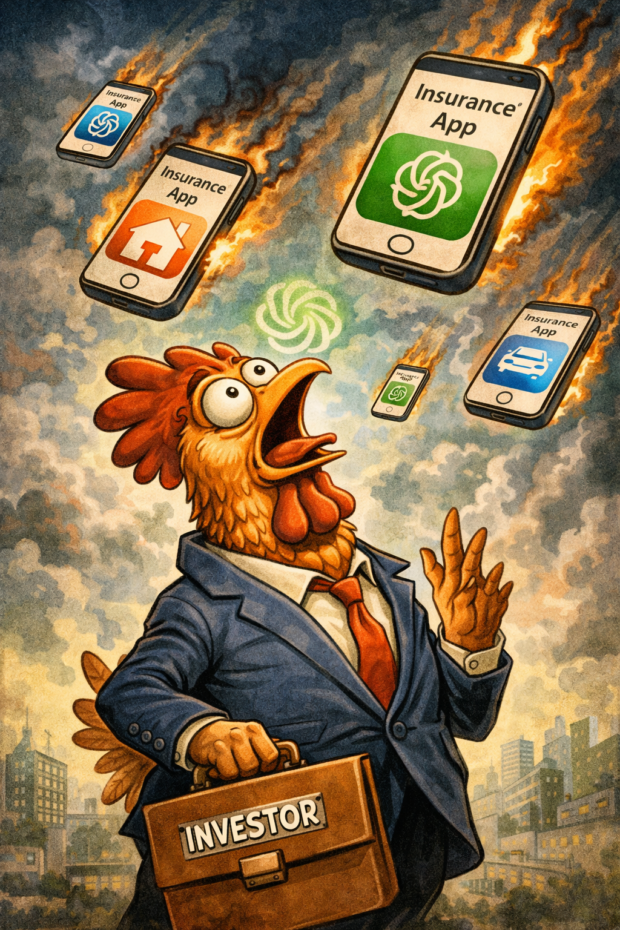
“Overdone,” Goldman Sachs calls the average 9% drop of insurance brokers’ stock last month. The selloff was attributed to news that technology firms Tuio and Insurify will offer a GenAI-powered insurance app on OpenAI for consumers to receive customized insurance quotes via natural language.
Game-changing? Revolutionary?
Executive Summary
SAS’s Franklin Manchester offers a viewpoint on the impact of AI-powered insurance apps on platforms, opining that they are unlikely to displace carriers’ existing digital channels, because they still rely on carrier APIs, websites and underwriting infrastructure, often sending consumers back to carriers to complete quotes and bind coverage.For insurers, the real impact is intensified competition and higher quote volume—not structural efficiency gains—reinforcing the need to continue investing in core digital capabilities, data quality and human expertise rather than divesting from them, he reports.
Hardly.
While some analysts and industry experts have likened this announcement to “day zero” for an industry notorious for antiquated processes and stodgy distribution, calmer minds call for caution.
When insurance quoting came online nearly 30 years ago, carriers and storefronts did not go away. In fact, online quoting often served as a referral source when customers wanted someone to handle their business locally.
Certainly, it’s hard to argue with the success of Progressive and GEICO here in the U.S. But Progressive is also sold through independent agents, not just direct to consumer. Ironically, GEICO lost its pole position to the former and staffs local offices.
Some have predicted that a decrease in acquisition costs in the “AI channel” (you heard it coined here first) will lead to decreased investments in other digital channels, like an insurer’s website or app.
I say: Wrong!
Here are three reasons why insurers will not divest heavily in existing digital capabilities.
First: Yes, expect acquisition costs to decrease. But that will be canceled out by an increase in competition. Bind rates will drop, so carriers will need to quote more. Achieving the same $10 million in new business growth will require significantly more quoting activity. Thus, no efficiency is gained in the process.
Next, we know large language models learn from internet content, including website information. This reality partially drives the zero-click search phenomenon we have seen for all industries globally, fueled by the popularity of generative AI capabilities. Content and information will still need to live on websites to be discovered by LLMs.
Finally, we risk making a flawed assumption about the quoting capabilities of Tuio, Insurify or other apps that will undoubtedly make their way to ChatGPT.
You see, it’s a data problem.
Insurify connects directly to insurance carriers via APIs, passing along quoting information through the application. Tuio directly interfaces as well. Put simply: The apps source their information from the carriers. They provide a shortcut—nothing more.
Insurify, in some instances, still sends you directly to the carrier’s website to finish the quote. Tuio’s engagement feels very similar. In its coverage of this news, Carrier Management reported that, “For an official quote or policy issuance, users are directed to Tuio’s official buying channels.” While consumers will save time completing a form or checking a price, they cannot always (or maybe even the majority of the time) complete the journey. Ultimately, the same plumbing for today’s buyer journey still exists and likely will never go away.
So, in reality, another step has potentially been created—leaving consumers with an even longer path to securing coverage.
Brokers seem potentially hardest hit by this change. Brokers represent multiple—sometimes double-digit—insurance carriers; it seems logical to conclude that their services as intermediaries may not be as important going forward.
However, it’s worth remembering the timeless wisdom of The Office‘s Michael Scott: “People will never go out of business.” And the insurance business has just as antiquated a reputation as Scott’s paper industry.
Many consumers or insurance laypersons do not even know the questions to ask in a buying journey. The same review referenced earlier delves into a question regarding an SR-22—a very specific topic. Those sorts of issues—involving very specific domain expertise—do come up, especially with commercial insurance and life or health insurance.
It’s a safe assumption that the insurance expert will not go the way of the dodo.
 Fundamentally, this means LLMs are being fed their own dog food. This is not expertise; it’s regurgitation.
Does this mean LLM/quoting integration isn’t useful? Of course not. Discerning buyers can and should use these tools to start the journey. However, proceed with caution. Over-trusting these tools can lead to folly.
J.D. Power reports that in Q3 2025, 40% of insurance consumers used AI tools to shop for insurance, and 80% trusted the results. SAS’s own research confirms respondents trust generative AI 200% more than machine learning. Individuals and business may not be aware of a troubling dynamic with the interplay between the buying journey and large language models.
LLMs such as OpenAI are sycophantic. They return answers people want (or supposedly want) because their creators want you to keep using the model. Additionally, there is an increasing amount of data on the web that is not human-generated. This is the Dead Internet theory.
Reddit co-founder Alexis Ohanian said he has “long subscribed to the dead internet theory,” acknowledging it was regarded as a conspiracy theory a decade ago but is now “a very real thing” because of the proliferation of bots on social media, as well as humans using AI to create and amplify content.
Fundamentally, this means LLMs are being fed their own dog food. This is not expertise; it’s regurgitation.
Any critical business transaction, including quoting/binding insurance coverage, should not rest solely upon this AI slop reality.
So, think twice before you click and bind. And insurance CMOs, sleep easy knowing traditional digital is not going away.
 At-Bay to Be Acquired by Munich Re for $575 Million
  Tornado Alley’s on the Move and Creating New Risk Concerns, Modeler Says
  Despite Risk, Speeding Becoming Normalized AAA Study Finds
  Florida AG Charges 7 in $100M Workers Compensation Fraud Scheme