
















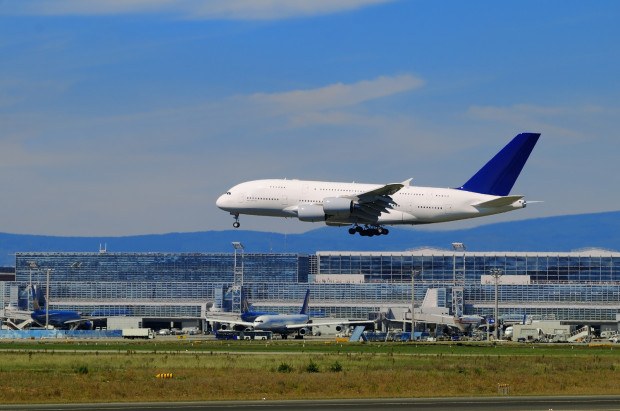
The Federal Aviation Administration (FAA) announced a new measure to enhance safety in areas where helicopters often cross both arrival and departure paths near busy airports.
Following the Washington D.C. deadly midair collision between a Blackhawk helicopter and a passenger jet last year, the FAA began using innovative AI tools to evaluate airports nationwide with high volumes of mixed helicopter and airplane traffic to implement appropriate safety changes.
The general notice (GENOT) suspends the use of visual separation between airplanes and helicopters, mandating that air traffic controllers use radar to manage aircraft to keep them separated at specific lateral or vertical distances in Class B (up to 18,ooo feet) and Class C (around busy airports) airspace.
Visual separation occurs when air traffic controllers advise pilots on nearby aircraft and allow them to remain visually clear of the other aircraft. The FAA’s data analysis revealed that for high-traffic areas, visual separation was not an adequate safety mitigation tool.
The change was based on a year-long review by the FAA’s safety team of cross-traffic data and incident reports.
One incident occurred on Feb. 27, when an American Airlines Flight 1657 was cleared to land at San Antonio International Airport in Texas, as a police helicopter was flying through the airport’s final approach path. The helicopter and aircraft were on converging courses when the helicopter made a left-hand turn to avoid the American Airlines flight.
Another incident occurred on March 2, when a Beechcraft 99 was cleared to land at Hollywood Burbank Airport in Southern California and conflicted with a helicopter flying through the final approach path. The aircraft were on converging courses when the helicopter made a right-hand turn to avoid the Beechcraft.
“The tragedy over the Potomac one year ago revealed a startling truth: years of warning signs were missed, and the FAA needed dire reform. Since then, we’ve implemented numerous changes to protect the skies over our capital and keep the traveling public safe,” said U.S. Transportation Secretary Sean P. Duffy. “But the job isn’t done. Using innovative data analysis, the safety team at the FAA has identified the need for enhanced protocols at all airports across the National Airspace System.”
Helicopter operators who received immediate approval to transit through certain areas in the past may need to adjust their flight routes or be delayed while controllers ensure they maintain a safe distance from other aircraft.
Priority clearance may be given to medical helicopter missions.
 Push to End U.S. Changing Clocks Hits Dead End
  Majority of Online Scam Campaigns Target Common Infrastructure: Study
  Most Americans Think AI Is Developing Too Fast: Poll
  Nearly 50,000 Cars Damaged by Floods This Year: CARFAX