

















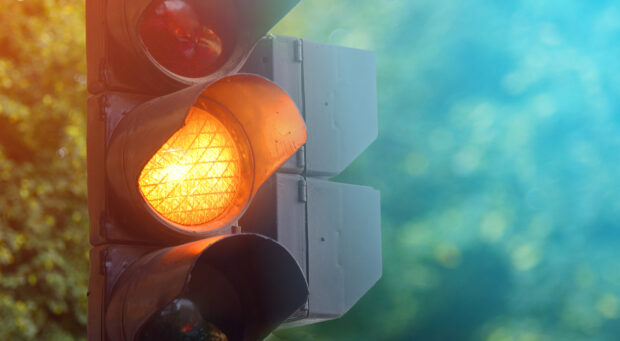
A new study highlights how automatic emergency braking systems lead to a reduction in rear-end crashes, especially when linked to drivers stopping short due to red light safety-camera equipped intersections, according to the Insurance Institute for Highway Safety.
Red light safety cameras reduce dangerous right-angle crashes that can cause injuries or fatalities when drivers run red lights, but the increase in rear-end collisions from drivers stopping short can be reduced as more auto manufacturers offer the automatic emergency braking (AEB) feature.
“Red light running causes extremely dangerous, high-speed side crashes, so red light safety cameras are an essential intervention,” IIHS President David Harkey said. “This study illustrates that AEB helps address one of their few downsides, which hopefully can help accelerate their deployment in intersections across the country.”
In 2023, more than a thousand people were killed and more than 136,000 were injured in crashes that involved a driver running a red light, IIHA said.
While ensuring the duration of the yellow signal remains sufficient can reduce red light running, the addition of red light safety cameras has a more dramatic effect.
An IIHS study conducted in Philadelphia showed that a longer yellow reduced red light violations by 36 percent, while adding a camera boosted the effect by another 96 percent.
Despite the benefits, only 343 communities across the United States were operating red light safety cameras as of this month, and the number of places using them has declined by more than a third since 2012, the IIHS study showed.
Community opposition is often cited as a reason for turning cameras off, and opponents highlight studies showing that cameras are associated with an increase in rear-end crashes to argue against deploying them.
Rear-end crashes are costly and can sometimes cause serious or debilitating injuries, but the severity of rear impacts is rare enough that the benefits of red light safety cameras outweigh that downside.
AEB boosts camera benefits
The new study shows that red light safety cameras would slash injury crashes by as much as a fifth and result in a net reduction in crashes of all types, even if no vehicles were equipped with AEB,
To determine the effects of red light safety cameras on crashes without AEB, IIHS researchers performed a meta-analysis of 35 studies of red light safety camera interventions, focusing on their influence on rear-end crash rates.
To estimate the mitigating effects of AEB, they analyzed police-reported crashes from 19 states over several years, comparing the rates of rear-end crashes at signalized intersections where the striking vehicle had AEB with those in which the striking vehicle was not equipped with the crash avoidance feature.
They combined those findings and used statistical analysis to extrapolate the overall effects of AEB systems on crash rates at intersections with red light safety cameras, assuming different percentages of the fleet were equipped with the technology.
If no vehicles on the road had AEB, the researchers found, red light safety cameras would be associated with a 7 percent decrease in all crashes at the intersections where they are used.
Since 2023, more than 28 percent of the U.S. fleet has been equipped with AEB, according to analyses conducted by the Highway Loss Data Institute. With that many AEB-equipped vehicles on the road, the reduction in crashes ticks up to 8 percent, the IIHS found.
In 2045, when virtually all vehicles in the fleet will have AEB, red light safety cameras will reduce all crashes by nearly 10 percent, assuming no other advancements will make them more effective.
Not all crashes are equal
Importantly, though, those numbers fail to capture the full benefits of red light safety cameras, the IIHS said.
The small net reductions reflect much larger decreases in the more dangerous right-angle crashes that tend to occur when drivers run red lights. In the net numbers, those reductions are offset by increases in comparatively minor rear-end crashes that happen when drivers stop suddenly to avoid getting fined.
The net 7 percent reduction that would occur if no vehicles had AEB includes a 21 percent increase in rear-end crashes. At the current AEB-installation rate, that increase in rear-end crashes narrows to 19 percent. If every vehicle had AEB, it would drop further to 14 percent.
As the increases in those less-dangerous crashes reduce and the reductions in overall crashes get larger, the reductions in crashes that cause injuries — the obvious safety benefit of red light safety cameras — remain comparatively constant at 19-20 percent, the IIHS said.
“This is a great example of a vehicle technology and an infrastructure solution working in tandem to produce better results,” said IIHS Senior Transportation Research Engineer Wen Hu, the lead author of the study. “As advanced driver assistance features become more common, researchers will need to revisit other tried and true safety measures to see how their effectiveness has changed.”
 Federal Bill Seeks to Reduce Work Week to 32 Hours
  Why Your Boss Matters More Than Remote or Hybrid Work When It Comes to Burnout and Job Satisfaction
  Amazon Cargo Plane Pilots Weren’t Warned About Wind Before Miami Crash: NTSB
  Levers and Guardrails: How Growth Is Being Built at Hippo