














The data is clear: Overall customer satisfaction—and customer trust levels—rise when U.S. auto and home insurance customers have confidence that they understand their policies.
Executive Summary
Customers who understand what their insurance policies cover have more trust in their carriers, according to Stephen Crewdson and Craig Martin of JD Power. But surprisingly, while both say that ensuring that customers completely trust their agents is a best practice for building trust, they’ve also found that customers who buy through agents are less likely to understand their policies. Here, the two analysts provide their thoughts on what’s going on and offer other recommendations to help carriers elevate trust scores.But more than 40% of them don’t. And more than half of insurance customers surveyed by JD Power over the course of the last three years have low levels of trust in their insurers.
“That key performance indicator of what the overall satisfaction score will be—the KPI that they understand their policy and what it covers—has been in our auto study all the way back to 2000. And insurers haven’t moved the needle that much,” said Stephen Crewdson, managing director of insurance business intelligence at JD Power.
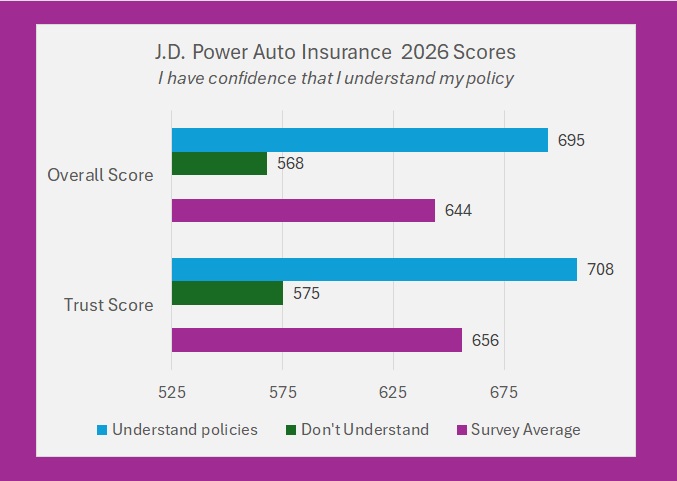
Digging into some of the information sitting behind results of the 2026 U.S. Auto Insurance Study published in early June, Crewdson revealed that the average satisfaction score of 644 across more than 52,000 respondents (measured on a 1,000-point scale) plummeted to 568 for those survey takers who didn’t feel they understood their policies. For those reporting confidence in their understanding of what their policies would cover, the score rose to 695—127 points higher than the uninformed group.
Craig Martin, executive director, global insurance intelligence at JD Power, offered a similar comparison for respondents included in the soon-to-be published 2026 U.S. Home Insurance Study, showing a gap of nearly 150 points in the overall satisfaction scores for respondents who do vs. those that do not understand their home insurance policies.
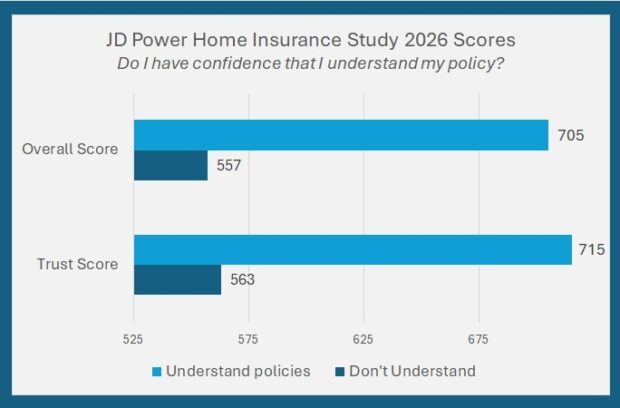
The two researchers noted similar gaps in the trust dimension of overall satisfaction scores based on customer-reported levels of understanding.
According to Crewdson, JD Power spends a lot of time with insurers discussing the finding. For some carriers, “it might be intentional. You don’t want to invest a lot of effort in explaining a difficult-to-understand product because you might have found that the juice isn’t worth the squeeze,” he said, suggesting that these carriers believe people still won’t understand even after the carriers spend money and time to educate them.
“That might be the case. Or it might be the case, for some insurers, that they don’t want customers to better understand what their coverage isn’t,” he said.
Martin said there’s also much internal debate within the walls of homeowners insurance companies—specifically about helping customers understand premium changes. “How deep do I want to go? How much do I want to explain? What do I gain for that? And, if the customer doesn’t leave—if they don’t quite understand their policy but they’re still staying with me—do I want to open up and share more details?”
Do the facts and details about how a carrier prices a policy, in fact, arm customers with information they can use on their shopping journeys?
Martin doesn’t think it’s an insurance-specific question but one that’s broadly repeated within the financial services umbrella.
Said Crewdson, “The fact of the matter is consumers haven’t been getting better explanations, by and large, for a quarter century now. We’ve been collecting data on this for 25 years in auto. And the number hasn’t moved that much.” The percentage of customers who say they understand has been in the mid-50%-to-low-60% range over the time span. “It hasn’t gone from maybe 40% to 80%. The industry hasn’t put in that kind of effort to improving it,” he said.
Martin noted that customers now have the potential to beef up their knowledge about how their insurance works with the help of AI. “There’s an inherent fear with consumers, people in general of looking dumb. They don’t want to admit they don’t understand. They’ll say, “‘I’m all good. I don’t need anything else. When inherently they do have questions,” as the survey responses show.
“They can go to AI, which in many ways is a non-judgmental source… I’m not going to look dumb to Chat,” he said.
The Trust Dimension
Crewdson and Martin shared those views during a recent interview about trust in the property/casualty insurance industry. Trust has been a specific dimension of overall satisfaction score calculations for both auto and home insurance since 2024.
Asked why JD Power decided it was important to start measuring trust three years ago, Crewdson explained that it was part of an effort to zero in on a small set of key questions to ask customers, who no longer fill out answers to paper surveys over the course of days, or even spend 30 minutes online.
“Our data scientists spent years figuring out what key questions to ask that help us best understand how a customer thinks of their auto or home insurer. And trust made the list.” It was one of the seven questions identified by the data scientists, “and it ends up being the most influential question we ask in how they evaluate their auto insurer.” Martin confirmed it’s the same for home insurance.
The redesigned approach for insurance was officially announced in the JD Power 2024 U.S. Auto Insurance Study. The study “measures customer satisfaction with auto insurers based on performance in seven core dimensions on a poor-to-perfect rating scale. Individual dimensions measured are (in order of importance): level of trust; price for coverage; people; ease of doing business; product/coverage offerings; problem resolution; and digital channels,” a statement about the study said at the time.
Two insights highlighted in that 2024 media statement still garner attention from researchers to this day. These takeaways have been repeatedly cited by authors contributing articles to Carrier Management about customer retention over the last two years:
- The average overall satisfaction score among auto insurance customers with the highest level of trust in their insurer is 917 (on a 1,000-point scale)—426 points higher than those having the lowest level of trust in their insurer.
- Slightly more than half—51% of customers—fall into the low-trust category, while 15% have high levels of trust and 34% have mid-levels of trust.
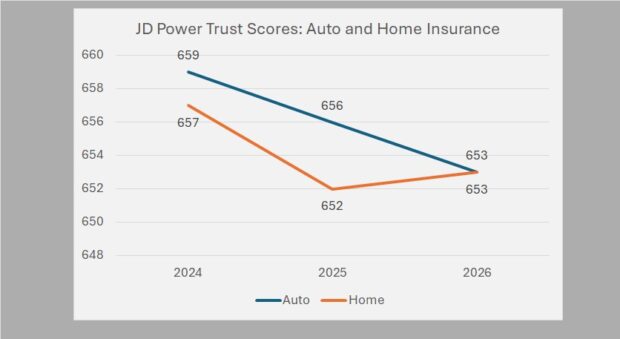
The measurements didn’t look much different in 2025 and 2026, according to Crewdson, who reported the updated figures set forth in the graph below based on a special pull from the survey data requested by Carrier Management. Asked to rate their experiences by completing the sentence, “My level of trust with [insurer name],” 52% of 2026 survey takers said it was low (below the “excellent” level on JD Power’s poor-to-perfect scale), while just 14% said it was perfect.
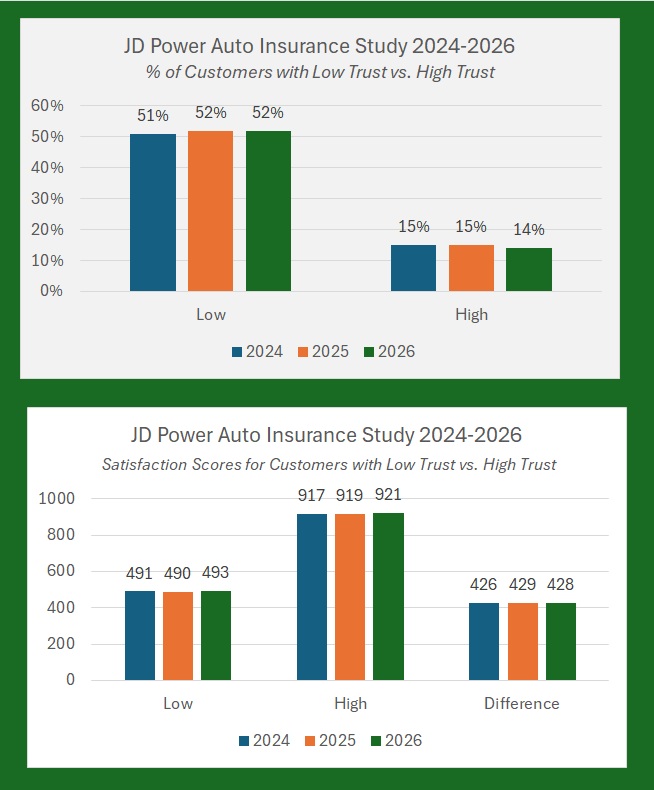
And the difference in overall satisfaction scores at the two extremes is still more than 400 points—with scores for high-trust customers coming in almost double those of low-trust customers.
Across all survey takers, average trust dimension scores reported in both the auto and home insurance surveys fell to 653 in 2026. For auto, that’s a 6-point drop vs. 2024. For home it’s a 4-point drop.
Are those declines material?
Crewdson said there are two ways to view the numbers. “Most people in the business world will ask, ‘Is it statistically significantly different?’ The significance test says people are less trusting now than they were in 2024,” he said, offering a “business significance test” as an alternative. “I say a 653 out of 1,000 versus two years ago, a 659 out of 1,000, is not a house that’s on fire. Maybe I want to repaint the walls in the house, but I’m not running out” to escape a blaze, he said, downplaying any real evidence of a worsening trend.
Over the 2024-2026 period, while the trust dimension scores declined a few points, they remained higher than the overall satisfaction scores. According to Crewdson, price of coverage and digital channels have been pulling down the overall satisfaction score for auto insurance, which held steady at 644. (The JD Power Home Insurance Study is set to be published in early September.)
When comparing trust scores with other financial services a few years back, Martin found that trust levels were fairly close to the insurers. Investment advisors were the exception, he said, calling the result unsurprising. For people who pay for a financial advisor, “it’s a much more high-touch, high-engagement relationship. So, they tend to have higher trust. If they don’t trust you to manage their money, it’s probably not a very good relationship.”
Across a broader range of 22 industries, trust levels for the insurance industry fall in the middle of the pack, Crewdson said, referring to a 2024 report from an outside source—Quatrics XM Institute (“Examining 12 Years of Consumer Trust Ratings“). Insurance ranked 12th with 49% trust rating based on the Qualtrics 2023 study documented in that report, while the grocery industry topped the list with a 59% rating and TV/Internet Service ranked last with a 38% rating.
Trusted Insurers’ Best Practices
While Crewdson and Martin were not comfortable sharing information on how individual auto and home insurers rank in terms of just their trust scores—or how individual carrier trust scores have changed over time—they confirmed that given the importance of the trust dimension in the determination of overall satisfaction scores, a high satisfaction score is a good indication that a carrier garners a high level of trust from customers.
Without commenting specifically on whether the Amicas, Eries and USAAs of the industry—perennially capturing the highest satisfaction scores—were also at the top of the heap for trust scores, they said there were no notable exceptions. In fact, responding to a CM speculation about one possible type of exception—an insurer known for selling coverage at low prices, who might see a better overall satisfaction score because of that non-trust factor, Crewdson said the opposite is true.
Selling cheap means “you’ll probably end up with a book of customers that’s harder to satisfy,” he said, explaining that customers that get bargain prices are likely less trusting about the value exchange. They’re thinking, “What’s the catch?” and “What happens when I go to make a claim?” he said.
More broadly, are mutual insurers more trusted than stock insurers? Do single-state insurers and regionals get higher trust scores than national writers?
While Crewdson doesn’t believe ownership structure is predictive of trust level, scanning the list of trust scores for auto insurers confirmed the second hypothesis. He reported that the top scorer for trust was a national company but that it sells a lot more in certain geographic regions. “Then you go down to second and it’s a regional, third is a regional, fourth is regional, fifth is a single state insurer, … I have to go down to the 20th highest trust score to see a national that is truly a national writing a lot of policies everywhere.”
“There’s an inherent trust [level] when you’re in my marketplace,” said Martin, confirming that regional home insurers also earn high trust scores. Nationals, he suggested, can also build trust through local recognition. “A lot of big carriers are using agents locally. So, the agent has a local presence and is a local face. Even if the brand itself is not ‘trusted’ locally because it’s not as big in the media, they’ve got a local representative who has established relationships.”
“They build trust. They’ve lived there. They’ve been a neighbor,” he said, articulating how local trust-building happens.
Still, Crewdson noted that during harder markets, trust scores for local insurers can take a big beating. “You’re right around the corner. I expect the national big conglomerate to do this to me, but I don’t expect you to do it, he said, imagining the thoughts of customers of the handful of insurers whose high trust scores suffered when auto insurers hiked premiums a few years back.” Local insurers that were historically award winners in their regions in the auto study “fell dramatically from the top of the perch when they took rate,” he said.
“In a normal market, it benefits you to be the local or regional.”
Whether they’re local or national, Crewdson and Martin identified some key performance indicators linked to higher insurer trust scores, such as providing seamless experiences across channels, thanking customers for their business when they contact the call center, and ensuring that “customers completely trust their agents.”
“Ensure customers completely understand their policy and what it covers,” the analysts also said, referencing the link between trust and policyholder confidence about knowing what they bought.
How are the most trusted insurers doing this? Are they dumbing down the policies? Or having agents explain what they mean?
“On the auto side, we find that people who bought their policy through an agent, compared to people who bought on a website or at a call center, are less likely to say they understand their policy and what it covers,” Crewdson said, reporting a surprising discovery unearthed from survey data.
One insurer offered an explanation that seemed reasonable to Crewdson. “I have a professional taking care of that for me” might be the unspoken thought process of the customer, he said, drawing an analogy to Martin’s earlier reference to investors who trust financial advisors to take care of their retirement funds.
Martin offered his take on the best ways for agents to educate customers. “What I’ve seen in the past is when people try to get technical, that’s usually the failure,” he said, partly drawing his insights from prior experience working in the wealth management area. When an agent tells the customer “all the technical details and spends 30 minutes explaining all the nuances of policy differences, I glaze over as a customer. I don’t pay attention and you lost me.”
The better approach is the agent who says, “I understand you. I know you’ve got a couple of young kids. This is what’s really on your mind. This is what you’re trying to do. And I want to help make sure this is comfortable for you, and at the same time, make sure it’s the right fit. Here are the options.”
“I’ve heard you. Let’s work toward what’s the right solution for you.”
The right dynamic involves helping people to get comfortable rather than making them insurance experts, Martin said, noting that the approach to winning trust isn’t easy to do. “You recognize that person, what they want to know and how they want to know it” rather than simplifying to the point where they get insulted.
“There’s not a one-size-fits-all in many ways,” he said, stressing the need to provide a high level of confidence without too many technical details.
 Viewpoint: What U.S. Insurers Should Learn From the EU AI Act
  Viewpoint: Global Reinsurance Pricing to Remain Under Pressure Through 2027
  Examining Trust: It’s Not All About the Lawyers
  Anthropic Researchers’ Dire Safety Warnings Prompt Call for New AI Rules