













Severe weather volatility and rising loss severity are placing sustained pressure on the small commercial property insurance landscape.
Executive Summary
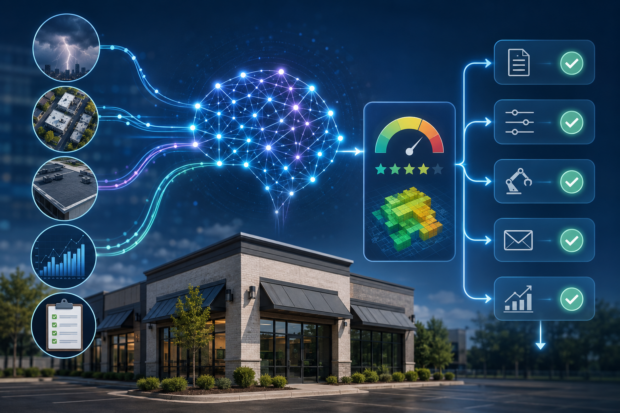
Small commercial property underwriting is being tested by a mix of pressures: higher weather-related losses, persistent underinsurance, and a risk environment that is becoming more localized and less predictable. Yet many underwriting decisions still lean on signals that can be too narrow on their own, such as basic weather data, roof condition or aerial imagery that may not be current, according to David Hemry of LexisNexis Risk Solutions.Here, he advocates holistic, predictive approaches that integrate loss data, weather insights and granular property characteristics using advanced analytics and neural network-based models to improve risk selection and pricing and to support workflow automation that can be consistently applied at scale.
Weather-related events now account for more than 65% of U.S. property losses (LexisNexis Risk Solutions internal study, 2025). Earlier research found that 68% of commercial properties are underinsured by at least 25% (based on 2020-2021 commercial property appraisal findings). Together, these forces are challenging underwriting and pricing adequacy, as well as portfolio resilience.
Many of these challenges stem from how commercial property risks are evaluated today. Underwriting automation remains limited, while assessments often rely on static or incomplete inputs. Basic weather data can often provide context but little predictive insight; roof age or condition may offer only a narrow view of vulnerability; and while aerial imagery can add visual detail, it is not universally available and needs consideration in terms of recency.