















The global economy is built on the backs of hardworking “industrial athletes,” and providing those athletes with the equipment to keep them safe is the mission of one New York-based technology firm with ties to insurance.
Executive Summary
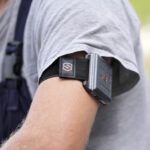
Technology-enabled dynamic policies that reward positive behavior and disincentivize at-risk behavior are the future of the workers compensation insurance market. Here, Matt Norcia, COO of StrongArm Technologies, and CM Guest Editor Matteo Carbone discuss the path to that future and the current benefits of StrongArm wearables in detecting individual risk situations, inspiring behavioral changes across worksites and entire facilities, as well as workers comp insurance implications that include lower claim costs and access to digital data for continuous underwriting and risk benchmarking.Photo Credits: StrongArm Technologies
The technology firm is StrongArm Technologies, the employer of one of the co-authors of this article (Matt), which has trademarked the term “industrial athletes” to describe those workers who lift and sort countless boxes, deliver mail in any weather, stock grocery store shelves in the middle of the night, and risk physical injury in multiple ways in warehouses and industrial settings to build and maintain the world’s critical infrastructure.
Through IoT wearables, StrongArm Tech has collected millions of hours of safety data, across thousands of industrial workers worldwide, generating a 45 percent reduction in injuries, on average. Workers compensation carrier partners are using the technology to differentiate risk, reduce injuries and empower loss prevention services.
Micro-Level Solutions, Macro-Level Results
A defining characteristic of the Internet of Things is the physical and digital embodiment of the world’s objects—the enhancement of “things” capabilities through the intelligent use of transferred information. IoT solutions have a pervasive presence in the life of any person and any organization, and can be observed at different levels:
- At a micro level, single solutions are connected, generate data and enable smart actions. Examples include your smartphone, your smartwatch, the smart thermostat in your house, your connected car, the continuous glucose monitoring connected with the mobile phone, the QR code on the escalator for tracking the maintenance or the connected tractor at a farm.
- At a system level, a group of single solutions are interconnected and combined, such as the Apple HealthKit in your phone, the domotics hub in your house (home automation), farm management systems allowing precision agriculture techniques or the facility management system currently managing the HVAC in your office.
- At a macro level, where different systems are integrated and orchestrated, as with smart cities, air traffic control or the food supply chain, to name only a few.
IoT data enables a broad spectrum of use cases for the enterprise clients; however, cost savings, compliance, security and safety have been the main drivers of the current adoption in many sectors. StrongArm Tech has deployed a proprietary IoT safety technology that works at the micro level. Through a device worn by a front-line worker, high-risk movements such as an improper bend or a deep and repetitive twist are detected and data-driven insights are then used to further reduce risk.
The company has deployed sensors to over 25,000 “industrial athletes” and collected over 25 million hours of safety data to date. The company’s solution is particularly valuable for enterprises with high ergonomic injury risk, such as global warehousing, retail trade, distribution, logistics, 3PL (third-party logistics) and repetitive manufacturing. The StrongArm IoT-enabled platform provides these customers with a single solution to improve their safety data analytics and reduce injury risk.
Risk reduction can be achieved in two ways:
- Directly, through a real-time risk mitigation solution if IoT data indicates that a client is getting into a risky situation.
- Indirectly, by promoting safer behaviors over the long term.
(Insurance Nexus & IoT Insurance Observatory, Connected Insurance Report. FC Business Intelligence, 2018)
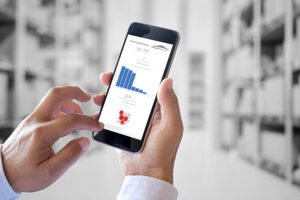
StrongArm Tech’s solution, the FUSE Risk Management Platform, incorporates both. Real-time and direct risk mitigation comes in the form of alerts to front-line workers when high-risk movement is detected and encouraging them to correct the behavior to reduce or eliminate the risk of injury. The indirect behavioral modification component is accomplished by providing custom safety reports to the client’s safety leadership. StrongArm Technologies’ cloud platform receives data from workers’ wearables and produces a critical benchmark of safety data on an individual, team or facility-wide level. A data interface accessed by safety teams empowers a two-way dialogue that engages those most at risk and champions those already working in a safe manner.
As highlighted by the research “From Risk Transfer to Risk Prevention: How the Internet of Things is reshaping business models in insurance,” done by The Geneva Association and the IoT Insurance Observatory, this approach represents a concrete opportunity for the workers compensation insurance line of business.
“Loss prevention and minimization activities are part and parcel of what insurers do” even if it is more visible on large commercial insurance (Insurance Regulatory and Development Authority of India, 2020, Report on loss prevention and minimization in the general insurance industry). IoT basically allows us to do it better and to apply the approach more broadly in the insurance business. These use cases are the essence of the evolution from a pure risk transfer to a “prescribe and prevent” scenario (McKinsey, The future of life insurance: Reimagining the industry for the decade ahead, 2020).
The IoT Paradigm
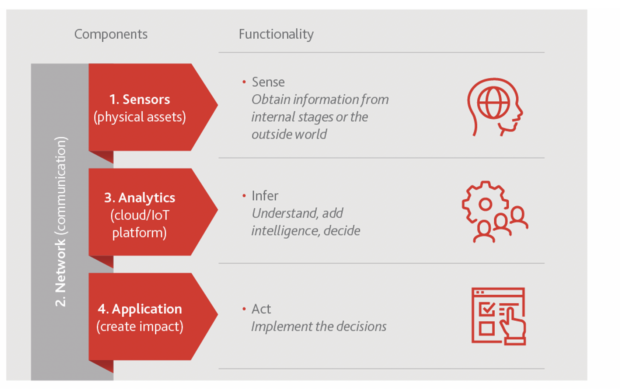
Source: The Geneva Association (Adapted from the IoT Insurance Observatory based on the interview with Prof. Ahmed Banafa)
Real-Time Risk Mitigation
The direct utilization of the IoT paradigm—through the IoT capabilities of sense, infer and act—aims to minimize client losses and claims to be paid by the insurer. This can involve automated actions by IoT actuators that impact on the risky situation without any human intervention, like autonomous driving systems (ADAS) in cars, or can happen as the result of a warning dispatched to humans in order to trigger some kind of human participation in the intervention, e.g., when a water leakage alert is triggered and repair service is needed.
These risk mitigation actions can be triggered by the detection of three different situations:
- Missed safety tasks, such as scheduled equipment maintenance or inspection, equipment that shows need for preventative maintenance, a diabetic’s missed blood sugar levels check, an out of order or absent risk mitigation system, e.g., as low pressure in the sprinkler system, or a smoke alarm out of battery power.
- A risky situation, such as a frozen pipe, a fridge room’s door left open, the presence of liquids on the supermarket floor, presence of workers without the adequate equipment in the workplace, an employee lifting unsafely, a distracted driver, a forklift operator speeding in a warehouse, high temperature or anomalies in an electrical control panel, early detection of abnormal conditions or complications in a person or animal.
- Mitigation of the consequences of an event already happened, such as detection of a water leakage, the quick evacuation of a worksite deemed unsafe, the life-saving proactive assistance of an injured person or monitoring of treatment adherence of a patient.
StrongArm Tech’s approach is focused on the second kind of situation. Its device provides auditory (beeps), visual (lights) and haptic (vibrational) feedback to the worker in order to indicate the detection of a high-risk movement and encourage the subsequent protective behavior change. Understanding that operational environments are often loud and hectic, haptic alerts are commonly reported by workers and management as being the most effective. With the sensor worn on-body, typically the torso or the hip, vibrational alerts are non-invasive but effective in earning the wearer’s brief attention.
Behavioral Change
The second prevention option is to promote safer habits. The intention is to guide toward a long-term and lasting change in behavior that will reduce the expected deaths, injuries, property damages and other insured events.
Approaches can target two different levels: the enterprise and its employees in the field that are responsible for behaviors.
IoT insights give loss control teams objective and detailed information on their current activities and also provide digital tools that allow corporate clients to have a better awareness of the causes of losses and to implement adequate managerial actions.
StrongArm Tech’s approach provides a deep look into the worker behavior at the time of an incident and any subsequent environmental conditions that might have caused or factored into it. Not only can that exact type of incident be avoided in the future, but larger operational changes can be made to improve the overall safety of a facility based on these insights. Site-safety leaders must use the granular data to target employees for coaching, and senior-level managers must analyze the trends when implementing new programs that require capital expenditure.
In addition, employee reward programs, similar to the rewards used in personal lines, are emerging in commercial lines. Safer worker behaviors are rewarded in order to incentivize changes in behavior. For example, a cold storage distributor embedded StrongArm’s FUSE Sensor into its safety incentive program to drive participation and safe behavior. Site leaders are awarded more points for high program participation and more points for demonstrating safe behavior—identified through StrongArm’s proprietary Safety Score.
The combination of real-time risk mitigation and behavioral change programs allows the company to maximize the return on the prevention investment. Moreover, successfully deploying wearable technology, such as FUSE Platform, requires commitment from the end users, site leaders and senior-level managers to drive meaningful change. The data collected must be used to inform decision-making by all stakeholders. The result: an enduring safety culture based on actual data that scales in size and complexity in lockstep with the demands on any workforce. When all three levels are engaged in the data and the feedback, StrongArm can have a significant impact on improving behavior. This is no more apparent than in a successful deployment at Walmart that drove a reduction of targeted injuries by 64 percent across 6,000 associates and three years.
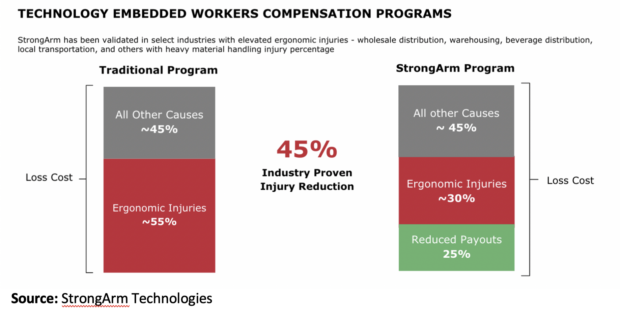
StrongArm Tech KPIs are calculated using its next-gen, leading indicator Safety Score, which aggregates key motion factors including bending, twisting and tilting. A single point change in Safety Score equates to a 7.5 percent change in risk. The most successful programs result in a six-point increase in Safety Score and subsequent 45 percent decrease in targeted injuries, which results in a 25 percent decrease in total cost of risk or claims payouts.
Sustainable Business Cases
Casualty insurers are using IoT technology to build competitive technology-based workers compensation programs. Carriers are learning how to structure and finance technology-embedded programs to incentive participation and create better outcomes for both carrier and enterprise clients. To generate a sustainable business case, the cost of the risk prevention services must not exceed the cost reduction they drive.
StrongArm has partnered with carriers to deliver wearable injury reduction technology at a cost well below the $1,100 average cost of injury per each existing employee (Work Injury Costs 2019, National Safety Council). Programs fully funded by carriers have produced a 300 percent ROI by reducing ergonomic injuries by 35 percent for leading merchant wholesalers and manufacturing policyholders.
A shared risk concept, in which both insurer and insured share the cost and the benefit of the outcome, has proven to incentivize the proper behavior. The workers compensation market has various levers it can use to transfer risk. A properly funded technology policy aligns technology cost equitably with insurance program structure. In a guaranteed cost policy, the insurer bears the majority of the injury risk, whereas in a loss sensitive policy, the insured is responsible for the majority of the first layer of medical and indemnity cost through a high deductible. Understanding these different policy dynamics changes the funding available for risk prevention technology.
Carriers are building sustainable, IoT-enabled policies that drive bottom-line results to both the enterprise client and the insurer. For example, a leading global carrier partnered with StrongArm to offer its loss sensitive client two different renewal options: a discounted tech-protected policy or a traditional policy with no risk prevention technology attached. The client chose the discounted policy option with a commitment to deploy the wearables across its 3,000-user workforce. This partnership resulted in a reduced premium, better-performing policy and safer “industrial athletes.”
By leveraging insurance policy components like deductibles, dividends and renewal rate changes, insurers can build a variety of tech-enabled workers comp products that share both the cost of the technology and the benefit of the outcome between insurers and insureds. In addition, insurers also have the opportunity to use the same data for another use case: risk selection. Underwriting is a key business function that can be transformed by the availability of this digital data.
Risks are dynamic, and a constant flow of digital data allows underwriting to be continuous or dynamic as well. A continuous underwriting approach can improve risk selection and pricing.
Casualty insurers who have worked with StrongArm Tech have access to data such as Safety Score, number of lifts and other risk metrics, down to the individual for risk benchmarking. For example, comparing lift rate (number of lifts) across a portfolio of warehousing risks enables continuous and accurate benchmarking and risk selection. IoT-enabled data sources, such as lift rate, are an enhanced data source within the underwriting process that can be used at the policy level and the portfolio level. Today, carriers are using this data to compare two businesses with similar operations. Uncovering varying degrees of lift rates and Safety Score differences provides these insurers with competitive insight.
Future of Workers Compensation
The essence of the insurance sector, since its origin in 1347, has been assessing, managing and transferring risks, but the direct results of the technology adoption are “superpowers” to do the same things much better (Carbone, “Insurers Will Be Even More Relevant, November 2017, InsuranceThoughtLeadership.com). The evolution of IoT data sources in the workers compensation market has arrived. Not only are captives and insurers enhancing the way they approach risks, but even brokers have the opportunity to build and propose their own approaches to clients. They can select technology to recommend and obtain programs with favorable conditions from insurance carriers, as is starting to happen in commercial property (Carbone, IoT Success Stories Are Emerging in Commercial Lines, June 2021, Leaders Edge).
Carriers and brokers are assembling their analytics team to better understand which data sources can be used to build dynamic insurance policies that bridge the gap between risk prevention and risk financing. IoT-enabled platforms, like StrongArm Tech, are on the front end of that data supply chain. In the years to come technology will be the key ingredient in building real-time commercial insurance policies. Technology-enabled dynamic policies will reward positive behavior and disincentivize at-risk behavior, which will create a better outcome for carrier, enterprise and “industrial athlete.” This incident reduction will also generate clear positive externalities to the entire society, increasing the contribution of the insurance sector to advance sustainable development goals.
 Policy Disconnects, Deferred Mitigation Escalate Weather-Related Claims
 Oversight, Safety Questions Raised in Deadly Brooklyn Building Collapse
 Email Cyber Attacks Becoming More Precise and Evasive: Report
 The New Corporate Status Symbol Is How Much AI Access You Have