

















To know where you stand in your company’s hierarchy, check your AI budget. Companies are quietly sorting workers into different tiers of access as they determine which roles deserve more spend.
Bosses are grappling with how to allocate limited budgets as AI costs rise. At some firms, managers are capping use across the board. Other companies are being more selective, giving some teams, such as engineering, unfettered access to the best models and letting other workers get by with more basic options.
Recent cuts at Apple Inc. show how those tiers are beginning to take shape, even for companies that are rapidly embracing AI as part of their broader business. The iPhone maker has reduced the daily spending cap for some engineers to $200 from $300 and is planning further reductions for some teams as part of a cost-cutting effort, Bloomberg News reported last week. Staff outside of engineering already have a $100 daily cap, though the company has considered paring it back to as little as $25.
As employers make those calculations, the differences in access are contributing to a new kind of workplace hierarchy, according to executives and consultants.
“Effectively now we’re creating what I call the haves and have-nots,” said Lydia Wu, a senior director analyst at consulting firm Gartner who advises executives on AI.
Teams considered revenue-generators, like research and development, are starting to get more allocation, whereas the ones traditionally considered cost centers, like finance, are getting less, she said. In this way, AI access can serve as a clear signal of a department’s perceived value.
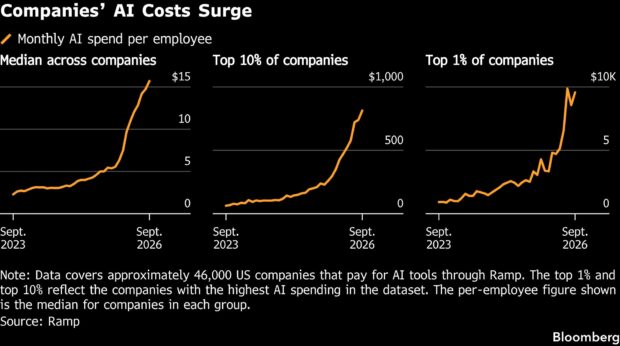
The median amount companies spent on AI per employee tripled from September 2025 to September 2026, up from $5 to $15, according to data from expense-management platform Ramp. That figure ballooned to more than $9,500 from around $2,500 for the top 1% biggest AI spenders in the dataset.
Accenture Plc removed access to the more specialized Claude enterprise license from a subset of employees last month, though the company noted those workers still have access to Claude models through Microsoft Copilot and other AI tools. “Licenses for specialized AI tools, like Claude Enterprise, are granted for those with a specific role-based need,” a spokesperson said. Goldman Sachs Group Inc. frustrated traders after it said last month it would revoke their access to AI coding tools, restricting their access to engineers only.
It makes sense to give the highest revenue-generating roles more access, some managers said. “We are a capitalist enterprise, we allocate resources where there’s the most ROI [return on investment], it’s what our shareholders expect of us,” said Amit Koren, who leads AI product strategy at global commercial real estate and investment management firm JLL. “That’s pretty typical. I don’t think anybody in the company will look at that and say, ‘Oh, that’s unfair.'”
At Match Group Inc., the company behind dating apps such as Tinder and Hinge, engineers get four times the AI budget of non-technical employees, according to Steven Bailey, the company’s chief financial officer. The average engineer spends about $600 a month, according to the company. Match started the year with an AI budget of $5 million, mostly for engineers. In May, it raised the budget to $10 million after expanding access to all 2,300 employees.
At some organizations, employees are given monthly AI spending limits and are alerted when they approach them. AI usage is metered in “tokens,” the units of data processed by AI models. Those caps, which often vary by an employee’s department, job type and seniority, can range anywhere from $20 to $2,000 a month, according to interviews with executives across industries. Often these caps are more of a soft limit than a hard cutoff, executives said; workers can usually get more by making a compelling case.
At other firms, Wu said, executives put restrictions in place behind the scenes: Employees in one department may not be aware that they’ve been given access to more basic versions of AI tools, while employees in other departments have access to much more sophisticated versions. “When we tell our employees that we have Copilot or we have Claude, there are 10 layers of Copilot license add-ons,” she said. “As an everyday employee, you’re not necessarily going to dig into what level of Copilot access you have.” Anthropic, on its website, suggests companies sort employees into “light,” “standard” and “power” tiers for access to its Claude models. An employee sorted into the “light” tier, as defined by their company, may not be able to access the most powerful models.
At AI company Sonar, which builds tools to help automate code review, AI use among employees ranges widely, said Tariq Shaukat, the chief executive officer.
“I’ve got one guy who, if I let him — and I think we’re going to let him — will spend a million dollars or so on tokens in 2027,” he said.
That engineer has written 5 million lines of code in the last six months by himself, whereas a typical engineer will write several thousand in a year, Shaukat said. That’s saved the company from having to hire two or three additional full-time employees. All engineers started the year with the same relatively small budgets — thousands of dollars per person, per year — with additional leeway granted as employees prove they can use the technology well. The company has internal dashboards that track the volume, quality and speed of code that its engineers churn out, which Shaukat uses to help assess who merits additional AI access.
“Step one for us is just who is using the tokens productively versus who is not,” Shaukat said. “And you have a whole bunch of people burning tokens and you really can’t see that their underlying shipping rates or quality or whatever is getting better.” About 5% of Sonar’s employees fall in the super-user category, while about 5% haven’t figured out how to leverage the technology effectively, he said. The rest fall along a bell curve.
At some companies, an unlimited token budget is like an American Express Black card handed out only to those who have earned the implicit trust of top leaders for work on the most important projects.
At Cisco Systems Inc., that includes a 27-year-old engineer who wants to rewrite most of the company’s code and who had been “buried way down in the org somewhere,” according to Jeetu Patel, Cisco’s president and chief product officer. After a chance conversation at the company’s San Francisco office, Patel was impressed enough to bring the engineer onto his team.
“I’ve given him unlimited tokens,” Patel said. “If you’ve done something extraordinary and created a lot of value, then we’ll be far more liberal with your tokens.”
Having better AI can mean better work — and bigger rewards. “It’s altering the playing field going forward because if I have more AI budget, other things equal, I will find some use for it,” said Peter Cappelli, a management professor and director of the center for human resources at the Wharton School of the University of Pennsylvania. “You’re starving the resources from people who haven’t made the big moves yet, and they’re not going to get an opportunity to try because the money’s going someplace else.” That can breed discontent if employees don’t believe those decisions were made fairly, Cappelli said.
Koren, at JLL, has considered the equity question. “How do we ensure we’re not creating a situation where we have the haves and the have-nots, and different people in the same job profile have different levels of access and therefore different performance?” Koren said. “It gets complicated.”
JLL plans to take differences in access into account come performance review season, especially as it’s limiting access to the most expensive AI tools to a subset of employees until the cost-to-value ratio is better understood. “We’re going to give managers very explicit guidance that says, ‘Hey listen, this is a consideration in your evaluation, don’t penalize people because they didn’t have access to this tool,'” he said.
At software maker Asana Inc., each employee is given a budget based on their role and past performance, including how well they’ve leveraged AI so far, according to Chief Financial Officer Aziz Megji. The trickier questions come after the initial allotment, he said.
“It’s easy to go into a budgeting cycle and say, ‘Hey, we’ve got X amount for tokens and this is how we’re going to allocate it.’ The question comes when people blow through that, how are you going to underwrite additional spend?” Megji said. “What are the tools and the insights that are going to allow you to make effective decisions so that you’re not saying, ‘Oh, you blew through $20,000 worth of tokens, I’m gonna give you another $20,000 just because I’m a nice person’?”
These kinds of decisions are “still a learning game,” and the verdicts sometimes lead to conflicts with employees, Megji said. But they also foster “healthy competition” as employees are pushed to make a compelling business case for their work.
Some engineers are negotiating larger budgets upfront when they join a company. “It’s becoming a hard requirement for top-class engineers to confirm that they can work with the tools of choice and not be limited by constrained token budgets or access to non-state-of-the-art models,” said Marcus Bergstrom, head of the AI services and software division at staffing firm Insight Global.
And some executives are lobbying for bigger AI budgets for their teams behind the scenes.
In executive job interviews, “you used to have questions about scope of responsibility and how many direct reports and what’s my budget overall,” said Bryan Ackermann, the head of AI strategy for the executive search and consulting firm Korn Ferry. AI budgets are now on that list, he said.
It’s a potentially expensive new line item for companies to consider. Microsoft Corp. executive vice president Charles Lamanna said at a conference in March that a job candidate he’d interviewed recently wanted a certain AI budget. “He said, ‘I’ll come as long as in my team they’re given at least X dollars’ — I won’t say the X number. It’s pretty big,” Lamanna said, when concerns about AI costs were coming to the fore. “You think, oh you know, what is it, like $50? You should think $100 to hundreds of dollars” per day. Those numbers are not representative of Microsoft’s current token budgets, according to a spokesperson.
These negotiations are influenced by the fact that not everyone has the most sophisticated understanding of “tokenomics,” or the study of how the economics of AI usage work, Ackermann said. The cost of running AI systems will also continue to change, he noted, further complicating these conversations. “These folks don’t always know what a token is when they’re going in and negotiating for it,” he said.
Though most employees may not realize how their AI budget compares to their coworkers’, “they’re going to find out,” said Cappelli, of Wharton. “They know who’s got the money. Across departments, they’re watching what’s going on.”
 The Latest Launches from Insurify, Insurity
 Adaptive Insurance CTO Sees a Future for Parametric in Homeowners
 U.S. Southwest Flood Risk Remains High After Destructive Storms
 Clocks Set to Permanent Daylight Savings Time Could Raise Danger to Kids: Study